

Paper
Christopher S. Chivvis, Rohan Mukherjee, Milan Vaishnav
{
  "authors": [
    "Milan Vaishnav"
  ],
  "type": "other",
  "centerAffiliationAll": "dc",
  "centers": [
    "Carnegie Endowment for International Peace"
  ],
  "collections": [],
  "englishNewsletterAll": "ctw",
  "nonEnglishNewsletterAll": "",
  "primaryCenter": "Carnegie Endowment for International Peace",
  "programAffiliation": "SAP",
  "programs": [
    "South Asia"
  ],
  "projects": [],
  "regions": [
    "North America",
    "United States",
    "South Asia",
    "India"
  ],
  "topics": [
    "Political Reform",
    "Democracy",
    "Economy"
  ]
}
Source: Getty
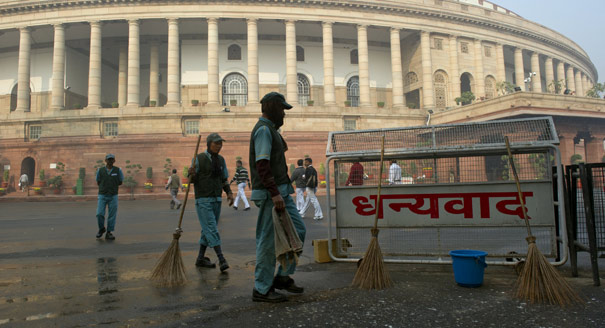
Voters in India select candidates with criminal records to fill a gap left by weak institutions. Criminal politicians promise to provide services to their caste or social group, no matter the cost.
Source: The Wharton School
Speaking at the Wharton School at the University of Pennsylvania, Milan Vaishnav discussed his new book, When Crime Pays: Money and Muscle in Indian Politics, with Devesh Kapur and Mukul Pandya.
He noted that 34 percent of members of Parliament in India face ongoing criminal cases, and 21 percent face serious cases. These numbers have been increasing, both at the national and state level, over the past few election cycles. According to Vaishnav, criminals seek a political career both to avoid being brought to justice, and to pull strings and gain financial benefits once in office. Unfortunately, Vaishnav argued, criminal politicians have no incentive to fix what ails the system, and instead rely on bandaid solutions to appease voters.
He further argued that the nexus between crime and politics is not a result of ignorant voters. As transparency has improved, the number of elected criminals has actually increased. This is because candidates use crime to signal a willingness to get things done for their specific caste or social group, no matter the cost. By promising to fill the gap in services left by weak institutions, criminals work within the democratic system.
Vaishnav went on to explain that this problem exists around the world, including in the United States. Decaying institutions in the United States have led to widespread distrust in the government. In the recent election, many voters put their faith in Donald Trump, an outsider who promised to fight for them, even if he had to bend the rules.
Vaishnav concluded with the observation that, unfortunately, many other countries have only reformed and removed criminals from power after a crisis. With criminal politicians distributed equally between parties and across India, at some point Vaishnav fears India may face such a crisis.

Director and Senior Fellow, South Asia Program
Milan Vaishnav is a senior fellow and director of the South Asia Program and the host of the Grand Tamasha podcast at the Carnegie Endowment for International Peace. His primary research focus is the political economy of India, and he examines issues such as corruption and governance, state capacity, federalism, and electoral behavior. He also conducts research on the Indian diaspora.
Recent Work
Christopher S. Chivvis, Rohan Mukherjee, Milan Vaishnav



Sophia Besch, Eric Ciaramella, Steve Feldstein, …
Carnegie does not take institutional positions on public policy issues; the views represented herein are those of the author(s) and do not necessarily reflect the views of Carnegie, its staff, or its trustees.

As the U.S. stumbles in its war with Iran, we are likely to see an acceleration of its disengagement from the region.

Michael Young

Huawei pushed hard to enter the Egyptian data centers market, until the Americans made a better offer.

Angie Omar

Middle Eastern states should welcome an accelerated U.S. disengagement from their region.
Michael Young

In an interview, former ambassador Charles Freeman assesses the Trump administration’s war against Iran.
Michael Young

By failing to address Palestinian representation, the current process is bound to lead to just another temporary arrangement.

Nathan J. Brown