

Commentary
Huawei pushed hard to enter the Egyptian data centers market, until the Americans made a better offer.
Angie Omar
{
  "authors": [
    "Richard Sokolsky",
    "Aaron David Miller"
  ],
  "type": "legacyinthemedia",
  "centerAffiliationAll": "",
  "centers": [
    "Carnegie Endowment for International Peace"
  ],
  "collections": [],
  "englishNewsletterAll": "",
  "nonEnglishNewsletterAll": "",
  "primaryCenter": "Carnegie Endowment for International Peace",
  "programAffiliation": "",
  "programs": [],
  "projects": [],
  "regions": [
    "North America",
    "United States"
  ],
  "topics": [
    "Political Reform",
    "Foreign Policy"
  ]
}
Source: Getty
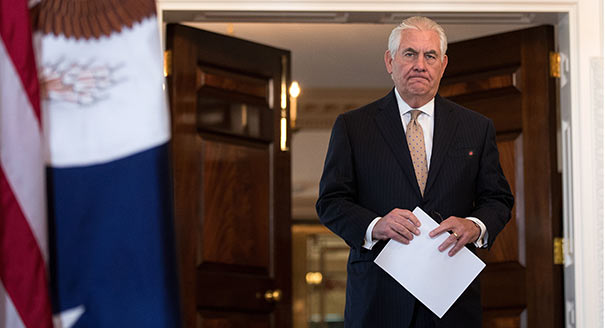
Without a reasonably close relationship with the president and authority conferred by the White House, it matters little or not at all how talented the nation’s chief diplomat may be. He or she cannot succeed.
Source: USA Today
Defending his boss recently against charges that he’s heading up an incredible shrinking State Department, strategic adviser R.C. Hammond opined that the Secretary Rex Tillerson is thinking like a cowboy. Comparing words to bullets, he said “You carry a revolver with only six shots, and you don’t waste your bullets.”
Fair enough. Successful secretaries of State husband their resources and invest in issues that are strategic and strike at the right time. But five months in, and based on our long tenures at the State Department under both Republican and Democratic administrations, it seems pretty clear that at least in five cases, Tillerson’s gun jammed or the rounds he fired went wide of their mark. Presumably he has yet to use the sixth bullet — a frank conversation with the president about his presumed aspirations to be a consequential secretary of State. Will he?
Tillerson reportedly is at the boiling point over everything from leaks to personnel. When it comes to his core diplomatic mission, he is struggling for leverage or even a role on several key foreign policy issues confronting the nation....
Nonresident Senior Fellow, Russia and Eurasia Program
Richard Sokolsky is a nonresident senior fellow in Carnegie’s Russia and Eurasia Program. His work focuses on U.S. policy toward Russia in the wake of the Ukraine crisis.

Senior Fellow, American Statecraft Program
Aaron David Miller is a senior fellow at the Carnegie Endowment for International Peace, focusing on U.S. foreign policy.
Carnegie does not take institutional positions on public policy issues; the views represented herein are those of the author(s) and do not necessarily reflect the views of Carnegie, its staff, or its trustees.

Huawei pushed hard to enter the Egyptian data centers market, until the Americans made a better offer.

Angie Omar

Middle Eastern states should welcome an accelerated U.S. disengagement from their region.

Michael Young

In an interview, former ambassador Charles Freeman assesses the Trump administration’s war against Iran.
Michael Young

By failing to address Palestinian representation, the current process is bound to lead to just another temporary arrangement.

Nathan J. Brown

Morocco and Algeria, each in its own way, are having to navigate the global economic fallout of the U.S.-Israeli military campaign against Iran.

Yasmine Zarhloule