

Commentary
Michael Pettis
{
  "authors": [
    "Michael Pettis"
  ],
  "type": "legacyinthemedia",
  "centerAffiliationAll": "dc",
  "centers": [
    "Carnegie Endowment for International Peace",
    "Carnegie China"
  ],
  "collections": [],
  "englishNewsletterAll": "asia",
  "nonEnglishNewsletterAll": "",
  "primaryCenter": "Carnegie China",
  "programAffiliation": "AP",
  "programs": [
    "Asia"
  ],
  "projects": [],
  "regions": [
    "East Asia",
    "China"
  ],
  "topics": [
    "Economy"
  ]
}
Source: Getty
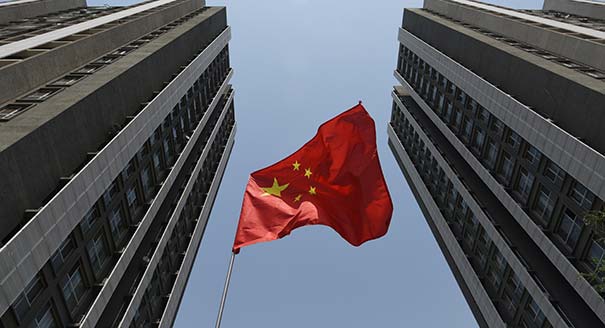
China must force through a deleveraging process to overcome local barriers and restrain its crushing debt.
Source: Foreign Policy
China’s economy is in deep trouble. A decadelong overreliance on overinvestment in manufacturing capacity and infrastructure has generated crushing debt. Tremendously powerful vested interests in control of state-owned enterprises and provincial and municipal governments, meanwhile, are blocking Beijing’s efforts to break up existing monopolies and stimulate growth.
Because it creates uncertainty about allocating future debt servicing costs, the debt will force down growth. While this can result in a debt crisis, in China it is more likely to lead to several lost decades of very low growth, as occurred most famously in the Soviet Union after the early 1960s and in Japan in the two decades after the early 1990s. In both countries, the share of global GDP dropped precipitously.
Mainstream economists from China and abroad, along with institutions such as the World Bank, have a standard solution. They want China to strengthen the role of markets in the decision-making process, including liberalizing legal, financial, and other institutions governing the economy; freeing up trade and investment flows; unshackling the exchange rate; and easing capital controls. These reforms, they claim, are not only useful for increasing overall growth prospects but will boost productivity enough to allow China to outgrow its debt before the financial crisis that they see as the main threat hits.
But this is the wrong answer. The liberalizing reforms that attempt to channel resources into higher-productivity investments implicitly assume that businesses and investors are constrained mainly by low savings and institutional distortions. But this is not the case in China, where the constraints arise out of a deeply unbalanced economy. The financial sector is dominated by corruption, speculative investment, and capital flight while heavy state influence distorts corporate governance and protects insolvent companies.
Under such conditions, liberalizing reforms could further accommodate distorted behaviors and would most likely worsen investment misallocation. The infamous malpractices of U.S. savings and loans institutions in the 1980s show how liberalizing a highly constrained, insolvent banking system increases abuses and multiplies the eventual cost of solving the issue. This is a dangerous risk for Beijing to assume. China has previously been able to avoid financial crisis precisely because its banking system is closed and regulators can restructure liabilities at will. The proposed reforms would weaken the government’s defenses against disaster.
The real solution is deleveraging. In recent history, dozens of countries weighed down by debt attempted similar policies, but none of the plans succeeded — no matter how forcefully the reforms were implemented — until they also substantially reduced debt by forcing the cost onto one sector of the economy or another.
Mexico restructured at a discount in 1990, for example, thereby pushing the cost onto creditors, while Germany inflated its debt away after the end of World War I, forcing the cost onto pensioners and others with fixed incomes. If it is to grow sustainably, China, too, must force through a deleveraging process in which local governments are forced to absorb a share of debt servicing costs, whether they like it or not.
Only forceful action from the top, as when China itself pushed through reforms in the 1980s while moving away from the planned economy, can overcome local barriers and restrain the country’s debt. A more liberal China may be desirable in the abstract, but not before a more centralized and more controlled China gets debt under control.

Nonresident Senior Fellow, Carnegie China
Michael Pettis is a nonresident senior fellow at the Carnegie Endowment for International Peace. An expert on China’s economy, Pettis is professor of finance at Peking University’s Guanghua School of Management, where he specializes in Chinese financial markets.
Recent Work
Michael Pettis
Michael Pettis

The armed forces champion a form of capitalism that is generating revenue, but its reliance on rent faces diminishing returns, leaving the country with massive sunk costs and deferred returns, deepening dependency on external borrowing.

Yezid Sayigh

In an interview, Ishac Diwan looks at the merits and flaws in the draft legislation distributing losses from the financial collapse.

Michael Young
Mustaqbal Misr has expanded its portfolio with remarkable speed, but a lack of transparency remains.
Yezid Sayigh

Arab diaspora business communities in Egypt often mirror the same systemic challenges facing Egyptian businesses.

Nur Arafeh, Yezid Sayigh, Qaboul al-Absi, …

Largely characterized thus far by a single-minded focus on extractivism, Riyadh must commit to greater equitability in its approach to investment and development deals with Sudan, Ethiopia, and Eritrea.

Hesham Alghannam