

Commentary
Andrew Miller
{
  "authors": [
    "Andrew Miller"
  ],
  "type": "legacyinthemedia",
  "centerAffiliationAll": "dc",
  "centers": [
    "Carnegie Endowment for International Peace"
  ],
  "collections": [],
  "englishNewsletterAll": "menaTransitions",
  "nonEnglishNewsletterAll": "",
  "primaryCenter": "Carnegie Endowment for International Peace",
  "programAffiliation": "MEP",
  "programs": [
    "Middle East"
  ],
  "projects": [],
  "regions": [
    "Middle East",
    "North Africa",
    "Tunisia"
  ],
  "topics": [
    "Political Reform",
    "Democracy",
    "Civil Society"
  ]
}
Source: Getty
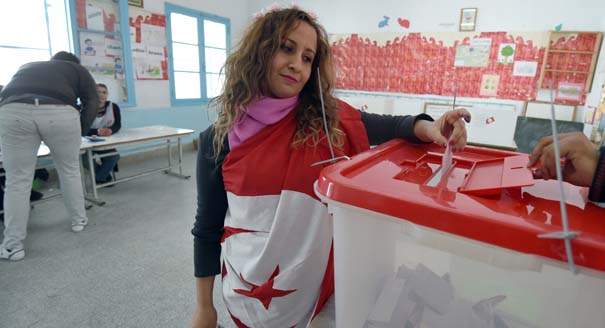
Given Tunisia’s smaller size and its receptivity to U.S. assistance, an American investment in Tunisia can pay real dividends. But President Trump’s proposed aid reduction shows he sees little importance in the nascent democracy.
Source: Washington Post
For the second consecutive year, President Trump has proposed a substantial cut in U.S. assistance to Tunisia, the sole democratizing country in the Middle East and North Africa. Slashing aid by more than half, from $185.4 million to about $80 million, would send a clear message: Trump could care less about Tunisia. To be fair, in the past year Secretary of State Rex Tillerson called Tunisia “an important partner” and Deputy Secretary of State John Sullivan said the United States is “proud to support [Tunisia’s] efforts to improve security, develop democratic institutions and practices and foster economic growth.” But, rhetorical flourishes aside, money talks in Washington, even more so since Trump became president.
It’s not entirely a surprise that Trump dismisses Tunisia’s importance. Tunisia lacks many of the qualities that tend to appeal to Trump: domestic political salience (Israel), vast wealth (Saudi Arabia) and alleged counterterrorism cooperation (Egypt). The Obama administration’s hailing of Tunisia as the only Arab Spring success story may be a detriment in the eyes of Trump, who has openly declared his affinity for dictators.
But you don’t have to be a starry-eyed idealist to understand why a democratic Tunisia is hugely important for U.S. interests. The Middle East and North Africa are in the throes of what is likely a generation-long period of political upheaval and change: The old bargain in which repressive Arab governments provided a modicum of economic and physical security in exchange for popular acquiescence to authoritarian rule is breaking down. Even governments that tried to evade the Arab uprisings by doubling down on repression will be affected by citizen demands for more just and effective governance.
As it stands, authoritarian leaders present two choices to their publics: the chaos of a Syria or a Libya, or the strongman rule of an Egypt. And they exploit this false dichotomy to justify increasingly repressive practices that almost certainly increase the long-term risks of instability. The implications for U.S. interests are not encouraging, even in the case of the ostensibly pro-American Egyptian government.
The democratic transition in Tunisia represents a third path, one that demonstrates how people and their governments can re-negotiate the social contract between them without repression or chaos. There’s nothing theoretical about the example: Every day others throughout the region see how the Tunisians are tackling the challenges of transition. Last month, civil society activists in Morocco told me that Tunisia gives them “hope” that peaceful, democratic change is possible in their own country.
To be clear, Tunisia’s transition remains incomplete. There are signs of democratic backsliding, including passage of a controversial law granting immunity to figures from the era of former president Zine el-Abidine Ben Ali and discussion of a new anti-democratic nongovernmental organizations law. The political elite has failed to boost the economy, and gaping regional economic disparities and widespread joblessness (especially among the young) threaten to erode the credibility of democratic governance. Municipal elections, a crucial stage in the decentralization of authority, have finally been scheduled for May 6, but a law giving local governments meaningful power and autonomy has yet to be passed. Appointments to oversight bodies mandated by the new constitution, such as a Constitutional court, are long overdue.
It is this mixture of hope and risk that makes U.S. assistance to Tunisia so critical. Security aid to the Tunisian military and security services has already delivered results, dramatically improving the country’s counterterrorism capabilities. Continued U.S. support for Tunisia at prior levels could enable Washington to help on a variety of fronts, including programs designed to address rampant corruption. If assistance is slashed, the State Department would have to make hard trade-offs among necessary programs, giving Tunisians the impression that the United States is disengaging just as the going gets tough.
Given Tunisia’s smaller size and its receptivity to U.S. assistance, an American investment in Tunisia can pay real dividends. If Trump does not appreciate this, Congress can reject Trump’s proposed cuts, just as it did last year. But strong congressional support for Tunisia is not a complete substitute for White House attention. U.S. funding to Tunisia will only fulfill its potential for supporting democracy if it enjoys the imprimatur of the president and is backed by high-level U.S. engagement. Let’s hope that Trump soon comes to his senses and commits to re-energizing Tunisia’s transition before it’s too late.
This article was originally published in the Washington Post.
Former Nonresident Scholar, Middle East Program
Andrew Miller was a nonresident scholar in Carnegie’s Middle East Program.
Recent Work
Andrew Miller
Andrew Miller
Carnegie does not take institutional positions on public policy issues; the views represented herein are those of the author(s) and do not necessarily reflect the views of Carnegie, its staff, or its trustees.

As the U.S. stumbles in its war with Iran, we are likely to see an acceleration of its disengagement from the region.

Michael Young

The accord represents a pivotal moment in the region to avert a security vacuum in the Gulf.


Azeema Cheema, Mohanad Hage Ali

In an interview, Jason Burke discusses his sweeping account of the “revolutionists” who so shaped the 1970s and early 1980s.
Michael Young

The armed forces champion a form of capitalism that is generating revenue, but its reliance on rent faces diminishing returns, leaving the country with massive sunk costs and deferred returns, deepening dependency on external borrowing.

Yezid Sayigh
This will be the region’s most representative tournament, amid broad changes in its footballing landscape.

Issam Kayssi