

Article
Yasmine Zarhloule
{
  "authors": [
    "Yasmine Zarhloule"
  ],
  "type": "commentary",
  "blog": "Diwan",
  "centerAffiliationAll": "",
  "centers": [
    "Carnegie Endowment for International Peace",
    "Malcolm H. Kerr Carnegie Middle East Center"
  ],
  "englishNewsletterAll": "",
  "nonEnglishNewsletterAll": "",
  "primaryCenter": "Malcolm H. Kerr Carnegie Middle East Center",
  "programAffiliation": "",
  "regions": [
    "Middle East",
    "North Africa"
  ]
}
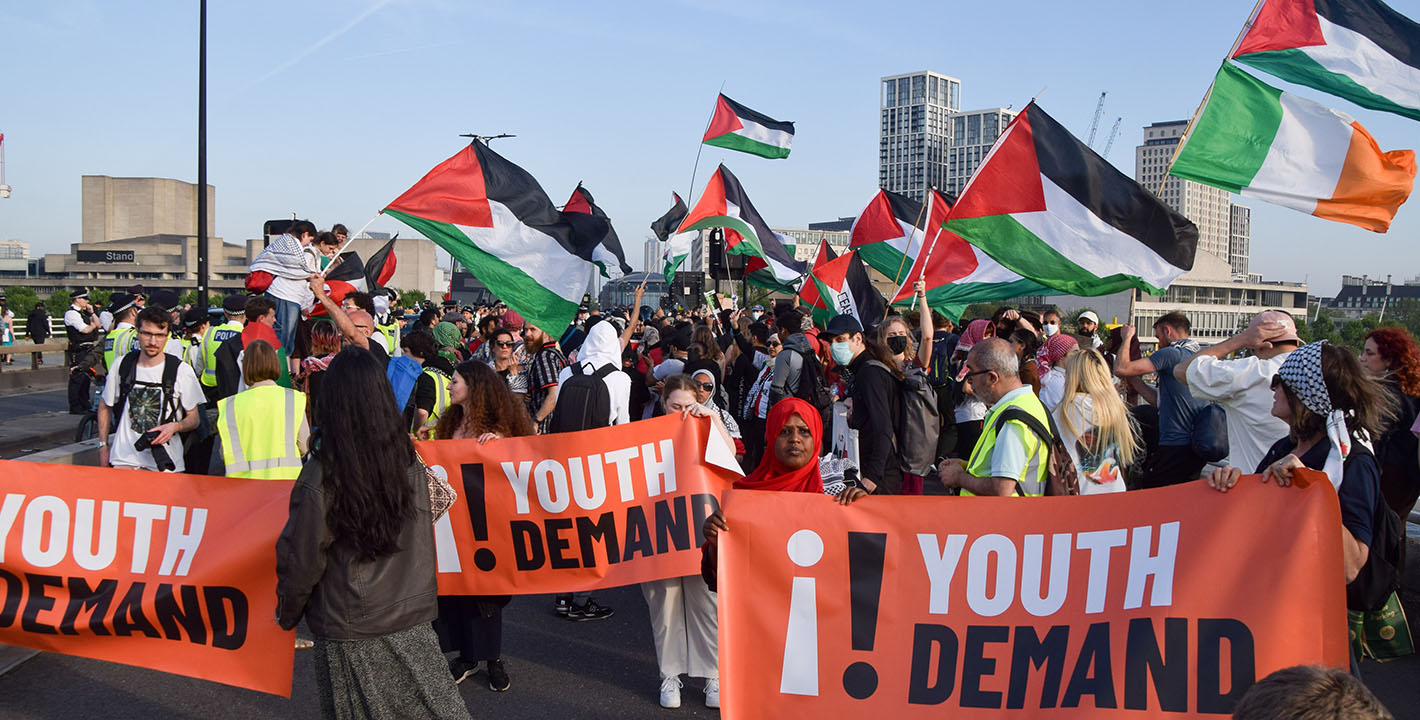
Source: Getty
In an interview, Mayssoun Sukarieh discusses youths in the region, and how they are being defined and reshaped.
Against the backdrop of renewed youth-led protests in France and across the Global South, questions about the role of young people in politics and their relationship with the state have once again come to the fore. Diwan speaks with Mayssoun Sukarieh, senior lecturer in Middle Eastern Studies at King’s College London and author of A Global Idea: Youth, City Networks, and the Struggle for the Arab World (Cornell University Press, 2023). Drawing on her research of the “youth development complex,” Sukarieh discusses the changing place of youths in politics, the contradictions of institutional approaches to youth empowerment, and emerging forms of political mobilization.
Yasmine Zarhloule: Much of your work has examined what you call the “youth development complex.” Could you explain how this complex emerged and what kinds of ideas about young people and their place in society it has helped to produce?
Mayssoun Sukarieh: I have been following the rise of youth as a category in the last three decades in the Middle East and North Africa. This culminated in the creation of the concept of the youth development complex (YDC). The concept can be defined as the operations of a diverse transnational network of state, private sector, civil society, and international development and aid organizations working in both the West and the Middle East to create, incubate, and disseminate a hegemonic set of ideas, discourses, policies, programs, and practices around youth and youth development. The youth development complex involves setting up youth programs, youth organizations, and youth-oriented activities locally, nationally, and regionally; introducing and fostering ideas of youth voices, youth empowerment, youth leadership, youth entrepreneurship, and youth activism; and insisting that these are central to larger projects of national social, political, and economic development.
Ostensibly, the youth development complex has emerged in the name of empowering, liberating, celebrating, and listening to the voices of young people throughout the region. But, as I and others have argued, the youth development complex has actually been created to serve an elite agenda in support of a neoliberal project of reform in the Arab region. The correct pathways of youth development, for example, are readily identified as those that lead to the construction of productive and cooperative citizen subjects, eager to join and support prevailing political and economic models as these have been developed by elites, not refuse or contest them.
Part of what I am trying to get at is that, as an identity and social category, youth was not always so prominent and so talked about in the Arab world in the way it has been in the past few decades. When we talk about young people, there is often a binary. On the one hand, either the young are seen as problems, as violent, threatening, and delinquent, with the fear of youth unrest creating a feeling that youths need to be controlled. On the other hand, positive talk about youth oftentimes highlights its changes over the years, as well as youth development, leadership, voice, activism, and empowerment. And part of what I am trying to do with YDC is to take apart both sides of this binary and ask how, why, and who labels the young people as bad, threatening, and harmful; and conversely how some of the positive aspects of youth empowerment, voice, and leadership can be harmful to young people. The YDC concept therefore helps us to think through what the idea of youth as a social category does to society—how it is deployed for specific policies and agendas and to spread certain ideas about the economy, society, and so on.
YZ: In your recent work on Gaza, you point to a striking gap between the language of youth empowerment promoted by YDC and the forms of political agency that young people have exercised, whether in Gaza or through Palestine solidarity movements globally. What has Gaza revealed about the limits and contradictions of the dominant ways in which institutions have understood and sought to “empower” youth?
MS: The YDC that has been built up in the last couple of decades in the Arab world and in Palestine has a very particular social and political history and agenda. It emerges out of the neoliberal transformation in the Arab world, the “war on terror” of the United States, and U.S. policies in the region. It then gets picked up by elite groups in the region as well. In this, different programs for youth empowerment and leadership are all about developing young people within specified political and ideological social spheres. There can be variations on this—some programs can be progressive and liberal, some more neoliberal and conservative.
So then what we have with Gaza are two things: First, as soon as you begin to see young people trying to overthrow Israeli apartheid and occupation, whether they do this by taking up arms or through other forms of social organization, intellectual production, or everyday acts of resistance in their local communities, they are ignored or labeled as bad, harmful, problematic, and therefore need to be suppressed and controlled.
Conversely, as the direct conflict surfaces and youths are subjected to Israeli military assault and genocide, you see not only the complete withdrawal of YDC actors, such as Injaz and the Education for Employment Foundations, the largest youth nongovernmental organizations in the Middle East and North Africa, both of which operated in Gaza previously, but also a resounding silence from these youth-promoting actors regarding the onging genocide there, even if it involves the very same young people with whom they have been working and who are being massacred by Israel.
Globally, one of the things we have seen with the genocide in Gaza is the extraordinary resistance movement within Gaza and solidarity movement across the world. This is not just about young people, it is multigenerational. However, lots of young people of all ages have not only participated in solidarity movements, they have been leading them. For the most part, these are young people participating outside the institutions and programs of the YDC. They are participating through memberships in political parties, social movements, and solidarity groups, and creating new social formations.
There have been times when young people have played a leading role in mobilization, through encampments and putting pressure on universities, for example. But this does not just encompass young people. For example, in the United Kingdom, with the draconian suppression of encampments and movements of solidarity with Palestine on campus, one of the main sites of Palestine solidarity action in the country has been led by retirees who have been arrested for supporting Palestine Action and opposing the proscription of the group as a terrorist organization.
This mass mobilization and solidarity movement really shows the nature and limits of YDC. Even though young people have been participating in political processes, showing leadership and displaying all the values YDC claims to foster, their actions have not been supported but have instead been suppressed.
YZ: Some of these mobilizations have created spaces in which young people learn politically outside established institutions. Since the start of the genocide in Gaza, we have seen Palestine solidarity encampments become sites of collective reading and political education, while these and other student and youth movements have used digital platforms to organize, debate, and take collective decisions. How should we think about these spaces in shaping youth political consciousness and collective action?
MS: Yes, of course, the global solidarity movement with Palestine and the ensuing global encampments created spaces for young people to exchange ideas, learn about Palestine, about organizing, about the political economy of higher education—notably the connections of universities to militarization and to charities led by big corporations—alongside artificial intelligence companies’ involvement in their universities, among other things. Encampments hosted lectures and roundtables, invited speakers from within universities and outside, screened films, and taught students to cook Palestinian dishes and dance the dabkeh. Libraries were set up in which students read and discussed books, and agreed on how to run temporary communities that had been set up in the encampments.
However, the Palestine solidarity encampments on campus were brief, before being suppressed and cleared. This does not mean that these places of student organization have disappeared. Rather, they are continuing in different forms. The students who were active in the encampments are still active on Palestine issues, still organizing protests, still participating in community solidarity actions for Palestine. Right now, we have an outbreak of mass student demonstrations in France and across Europe, and even though these protests are about deteriorating educational conditions and broader social grievances, solidarity with Palestine has retained a constant presence in them. You will see Palestinian flags in the demonstrations, you will see placards talking about Palestine, and students wearing kufiyyehs. And that is because there has been this continuity about organizing places that directly connect the encampments of two years ago with the education and cost-of-living protests of today.
YZ: Contemporary youth mobilization is repeatedly interpreted through earlier moments of student revolt. In France today, for example, the student movement has already prompted comparisons with May 1968. In the United States, Palestine solidarity encampments have similarly been discussed through memories of earlier periods of student activism and state repression. How useful are these historical analogies? And more broadly, how do these inherited ideas continue to shape how youth mobilization is understood today?
MS: First, the collective actions of students and young people never occur in a vacuum. Youths learn from and draw on other examples elsewhere. They might be learning from parents, grandparents, or elders. They might be learning from deliberate studies and awareness of what other young peoples’ movements have done in the past, and adapt this in their own tactics. The encampment and solidarity movements were not a first. Youths led movements in the anti-apartheid struggle during the 1980s and in protests against racism or involving housing issues, as well as in the Occupy movement. In France you see deliberate echoes of the student uprising of 1968. One of the famous slogans of 1968 was “Sous les pavés, la plage!” [Under the cobblestones, the beach!]. Now, this same slogan has been taken up by protesters, which shows that historical reappropriation is taking place.
But of course, cycles of student movements take place in totally different historical contexts. The 1968 student movement occurred during the early stages of the mass expansion of higher education around the world, with new students entering universities. The protests today are taking place after dramatic increases in higher education and the failures of promised access to good jobs and social mobility. Students are wrestling with the breakdown of the promises of higher education nowadays, not with a university that marginalized them as in the 1960s.
YZ: The institutional landscape that helped produce the youth development complex is itself changing. The contraction of U.S. foreign assistance, including the dismantling of large parts of USAID, has disrupted organizations and programs that depended on international development funding, while war and destruction have transformed civil-society infrastructures in places such as Gaza. Do you see this as a moment in which the youth development complex itself may be weakening or changing form? If so, what kinds of institutions, networks, or political practices might emerge?
MS: There is not one form of YDC in the world. It is more a methodology that helps us look at the infrastructure and networks that are promoting the idea of youth, and this construction’s implications for society, the economy, and politics. When we talk about YDC we are trying to argue that social categories and identities are produced and the aim is to uncover who is constructing and what is being constructed.
There are constant shifts and the construction of youth has been changing from the early “war on terror” to managing the Arab uprisings and the economic crisis. Even though this particular version of YDC was strongly pushed by U.S. policies and ideas, they have been picked up by state actors, elites, and civil society in the Arab world. As the United States may play lesser roles in this complex, we can keep asking these analytical questions—of who constructs youth in this way or another way, why, and for whom?
Nonresident Scholar, Malcolm H. Kerr Carnegie Middle East Center
Yasmine Zarhloule is a nonresident scholar at the Malcolm H. Kerr Carnegie Middle East Center.
Recent Work
Yasmine Zarhloule
Yasmine Zarhloule
Carnegie does not take institutional positions on public policy issues; the views represented herein are those of the author(s) and do not necessarily reflect the views of Carnegie, its staff, or its trustees.
As the U.S. stumbles in its war with Iran, we are likely to see an acceleration of its disengagement from the region.
Michael Young
The accord represents a pivotal moment in the region to avert a security vacuum in the Gulf.

Azeema Cheema, Mohanad Hage Ali
In an interview, Jason Burke discusses his sweeping account of the “revolutionists” who so shaped the 1970s and early 1980s.
Michael Young
As Iran defends its interests in the region and its regime’s survival, it may push Hezbollah into the abyss.
Michael Young

The recent African Cup of Nations tournament in Morocco touched on issues that largely transcended the sport.
Issam Kayssi, Yasmine Zarhloule