

Commentary
- +5
Zaha Hassan, Sarah Yerkes, Yasmine Farouk, …
{
  "authors": [
    "Federiga Bindi"
  ],
  "type": "legacyinthemedia",
  "centerAffiliationAll": "dc",
  "centers": [
    "Carnegie Endowment for International Peace"
  ],
  "collections": [],
  "englishNewsletterAll": "ctw",
  "nonEnglishNewsletterAll": "",
  "primaryCenter": "Carnegie Endowment for International Peace",
  "programAffiliation": "EP",
  "programs": [
    "Europe"
  ],
  "projects": [],
  "regions": [
    "North America",
    "United States",
    "Iran"
  ],
  "topics": [
    "Political Reform",
    "Democracy",
    "Civil Society"
  ]
}
Source: Getty
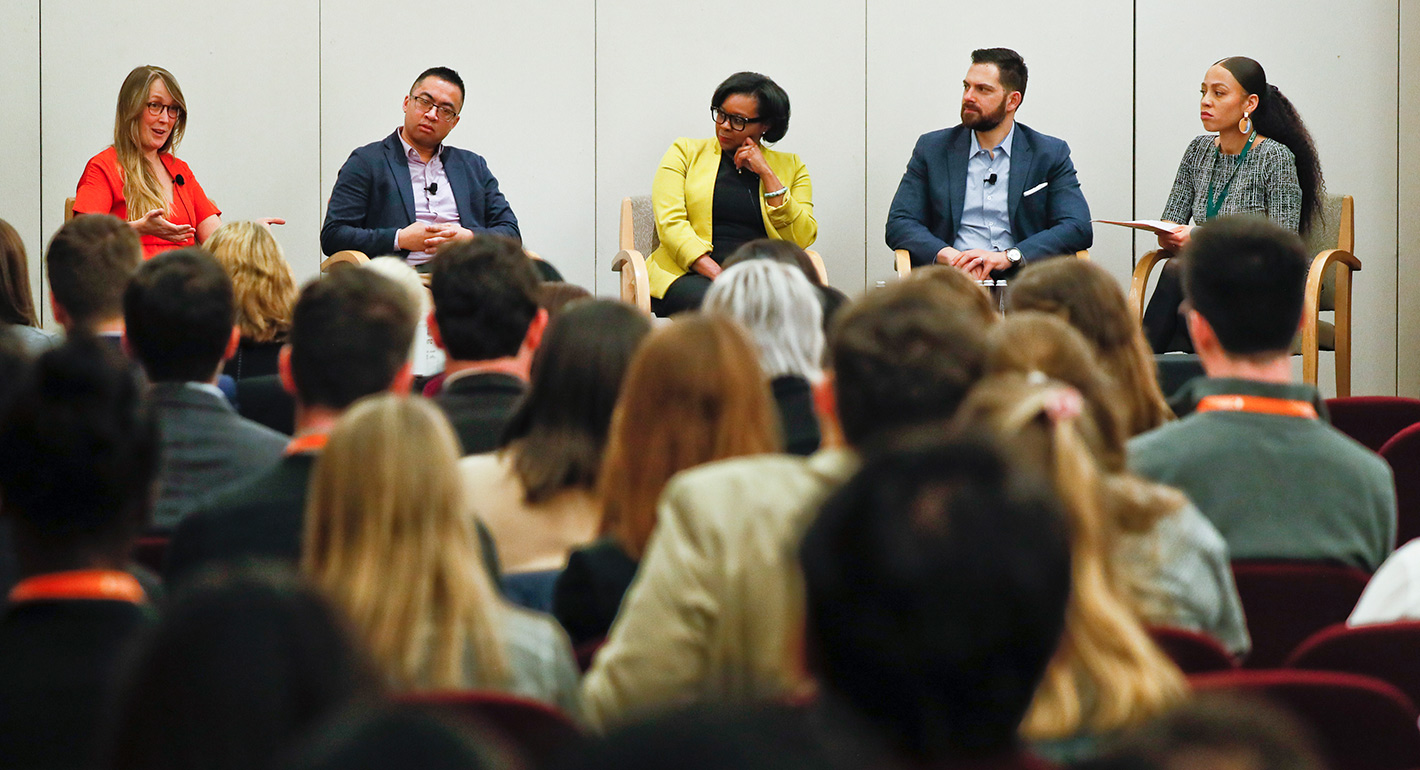
There are a few think tanks in DC that seem to have made conscious efforts to avoid manels. Visibility is a major component for success on the job, and the first step toward that success is speaking on panels.
Source: GenderAvenger
The WIIS [Women in International Security] Gender Scorecard: Washington, D.C. Think Tanks 2018 highlighted how men are still running the show in foreign and security policy establishments. Only five think tanks have at least 40 percent women scholars: the Stimson Center (52%), the Nuclear Threat Initiative (50%), the United States Institute for Peace (49%), the Institute for Policy Studies (44%), and the RAND Corporation (40%). The vast majority of the think tanks actually have less than 30% female scholars.

In the peculiar D.C. think-tank environment, visibility is a major component for success on the job, and the first step toward that success is speaking on panels. In 2014, Tamara Wittes and Mak Lynch described on Monkey Cage how only 25 percent of D.C. speakers were women. In the framework of an EU-funded research project on women leaders at the Institute for Women’s Policy Research (IWPR), we analyzed the presence of women in every 2018 public foreign policy-related event listed on the websites of think-tanks ranked by the WIIS report.
The results are not encouraging: in 2018, there was one woman for every three men (34 percent) on D.C. foreign policy panels, and 27 percent of the panels were manels — that is, all-male panels. To make things worse, in most cases, the woman on the panel was the moderator, not actually a speaker. This perpetuates the idea that women can be gracious hosts, but not real experts.
There are a few think tanks that seem to have made conscious efforts to avoid manels. RAND exceeded gender parity on panels, closely followed by the Council on Foreign Relations, the Center for American Progress, the U.S. Institute for Peace (USIP), the Center for a New American Security (CNAS), and the Stimson Center, all whose panels consisted of 40 percent or more women.

Only the Center for American Progress completely avoided organizing single-gender panels. For the rest, out of 967 foreign policy panels, 217 were manels. In other words, in 27 percent of the cases, the organizers were apparently unable — or unwilling — to put at least one woman on stage. At CATO, the Institute for Policy Studies, and the American Enterprise Institute, half or more of the panels were all-male. At the Heritage Foundation, Aspen Institute, the Carnegie Endowment for International Peace, and the Bipartisan Policy Center, one third or more of the events were all-male.
It should be noted that several think tanks organized women-only panels that were either held on International Women’s Day or focused on topics like sexual violence. Finally, only a few think tanks did an event around a single woman or a single woman scholar (for example, a global leader or a book launch), while there was an abundance of events revolving around a single male leader or scholar.

The correlation between the presence of women experts and the percentage of women speakers is weaker than we expected: the think tanks with the most women scholars are not always the ones featuring the most women speakers.

With 40 percent of female scholars, RAND exceeded gender parity in panels (52 percent). The Center for Foreign Relations, with 29 percent female scholars, almost reached gender parity on panels (44 percent). Ditto for the Center for American Progress where, with just 16 percent of female scholars, panels averaged 44 percent of women. The United States Institute for Peace, with 49 percent of female scholars, had 43 percent women speakers, which is similar to the Stimson Center (51 percent female scholars, 40 percent on panels). Among think tanks with 30 percent or less female scholars, the correlation is somewhat stronger: the Carnegie Endowment for International Peace scored 29 percent in both categories, with the German Marshall Fund closely behind with 27 percent in both categories. Heritage featured 22 and 24 percent respectively, and American Enterprise 21 and 20 percent. The Aspen Institute featured more female speakers than scholars (28 percent vs. 20 percent), while CATO did the opposite with 27 female experts comprising only 20 percent of its speakers overall.
The correlation between female leadership and gender parity is promising. Seven out of the twenty-one think tanks had a woman at the helm — Neera Tandem (CAP), Nancy Lindborg (USIP), Victoria Nuland (CNAS), Anne Marie Slaughter (New America Foundation), Jane Harman (Wilson Center), Karen Donfried (GMF) and Joan Rohlfing (NYI) — and five think tanks made the top 10 in terms of women speakers.

Finally, there appears to be a progressive-conservative divide, with openly-progressive think tanks clearly surpassing openly-conservative ones when it comes to gender parity of speakers: among conservative think tanks, just 18 percent of panel participants are women, as compared to 59 percent among progressive ones. Independent think tanks score in the middle.
Former Nonresident Scholar, Europe Program
Federiga Bindi was a nonresident scholar in the Europe Program at the Carnegie Endowment for International Peace working on European politics, EU foreign policy, and transatlantic relations.
Recent Work


Zaha Hassan, Sarah Yerkes, Yasmine Farouk, …
Federiga Bindi
Carnegie does not take institutional positions on public policy issues; the views represented herein are those of the author(s) and do not necessarily reflect the views of Carnegie, its staff, or its trustees.

In an interview, Ian Lustick and Eli Clifton discuss their new book on why a prominent ally has so much influence in America.

Michael Young

As the U.S. stumbles in its war with Iran, we are likely to see an acceleration of its disengagement from the region.
Michael Young

Huawei pushed hard to enter the Egyptian data centers market, until the Americans made a better offer.

Angie Omar

Middle Eastern states should welcome an accelerated U.S. disengagement from their region.
Michael Young

In an interview, former ambassador Charles Freeman assesses the Trump administration’s war against Iran.
Michael Young