

Article
- +1
Li Mingjiang, Le Hong Hiep, Ngeow Chow Bing, …
{
  "authors": [
    "Ngeow Chow Bing"
  ],
  "type": "commentary",
  "centerAffiliationAll": "",
  "centers": [
    "Carnegie Endowment for International Peace",
    "Carnegie China"
  ],
  "collections": [
    "Carnegie China Commentaries"
  ],
  "englishNewsletterAll": "",
  "nonEnglishNewsletterAll": "",
  "primaryCenter": "Carnegie China",
  "programAffiliation": "",
  "programs": [],
  "projects": [],
  "regions": [
    "China",
    "Southeast Asia"
  ],
  "topics": [
    "Trade"
  ]
}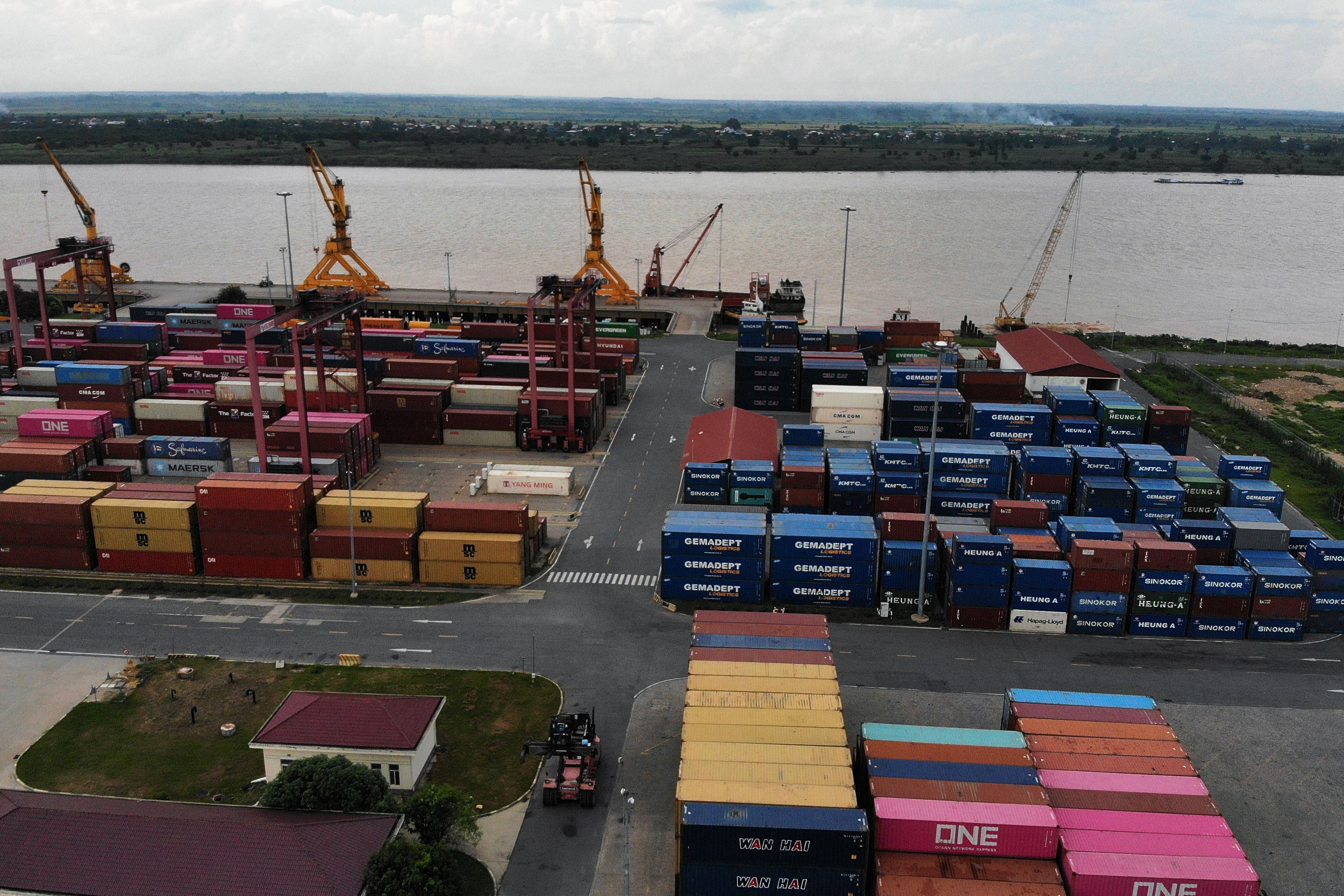
Source: Getty
The Pinglu Canal promises to unlock economic benefits not just for Guangxi but also for China-ASEAN relations.
This publication is a product of Carnegie China. For more work by Carnegie China, click here.
In August 2022, China began the construction of the Pinglu Canal, located within the Guangxi Zhuang Autonomous Region. As a new trade outlet, the canal promises to deepen the economic connections between China and Southeast Asia.
Starting from the Xijin Reservoir Area, the canal, when complete, will run approximately 84 miles, eventually flowing into the Beibu Gulf (Gulf of Tonkin). The canal is being built to accommodate 5,000-ton vessels—and once completed by the end of 2026—the canal is expected to have an annual capacity of 89 million tons of trade cargo. The total investment of the project is about $10 billion. The investment is substantial, although when being compared to other Chinese infrastructure projects, it’s roughly half of the cost of the world’s biggest sea-crossing bridge, Zhuhai-Hong Kong-Macau Bridge.
The Pinglu Canal project is a crucial component of the New Western International Land-Sea Corridor, a trade and logistics passage connecting inland China’s production center in Chongqing and Chengdu with international markets via outlets in southern and southwestern provinces instead of the traditional eastern coastal provinces. The canal itself is only one leg of a broader and ambitious project that promises to ease the transportation of goods from other southwestern provinces, such as Yunnan and Guizhou. Government estimates show the new canal will reduce shipping distance and save on transportation costs. Compared to the traditional shipping routes, the new route will reduce the overall shipping distance down to 347 miles, which will accelerate the shipment time from roughly a month to between seven and ten days. Accordingly, the canal will save up to $725 million in annual transport costs.
Guangxi is an unusual case where having a coastal border has not endowed the region with economic dividends. Normally, Chinese coastal provinces have thriving coastal cities that serve as their economic engines. Paradoxically, Guangxi’s coastal cities (Qinzhou, Fangchenggang, and Beihai) are economically much weaker when compared to the region’s inland cities such as Nanning and Liuzhou.
Guangxi believes the canal will be a game changer for the region. Guangxi’s economic performance has been subpar for decades, especially considering the advances made by its poorer provincial neighbors Yunnan and Guizhou. In 2020, the size of Yunnan’s economy surpassed Guangxi’s for the first time, despite the fact that Yunnan is a landlocked province and Guangxi has enjoyed several supportive policy measures from the central government.
For example, in the early 2000s, Beijing gave Guangxi the role to spearhead the China-ASEAN Expo (CAEXPO) and the China-ASEAN Business Investment Summit (CABIS), with Guangxi’s capital city Nanning selected as the permanent site for these two events.1 In 2006, with Beijing’s support, Guangxi proposed the Beibu Gulf Economic Rim initiative, which aimed to enhance sub-regional economic integration around the gulf and turn it into the fourth economic dynamo region of China, after the Bohai, Yangtze Delta, and Pearl Delta regions.2
These initiatives and policy measures have only brought modest results. Guangxi’s leaders have often looked to their more economically successful neighbor in the east, Guangdong, instead of looking south to the coast for economic opportunities. The 2019 Guangxi Plan to Integrate with the Greater Bay Area, for example, prioritized economic and infrastructure connection to Guangdong. Before the Pinglu Canal, the central, northern, and eastern interior regions of Guangxi received more investments in capital projects when compared to the coastal areas. Guangxi’s fragmented economic strategies over the past three decades have led to a failure in sufficiently investing in the Beibu Gulf area.
The reliance on Guangdong ultimately proved to be insufficient for Guangxi. Guangxi’s interests, after all, are subordinate in the considerations of Guangdong. In a sense, what the Pinglu Canal does for Guangxi is similar to what the Funan Techo Canal does for Cambodia, making the country and province less reliant on their respective neighbors (Guangdong for Guangxi and Vietnam for Cambodia) as trade outlets. The Pinglu Canal will further bolster the Port of Beibu Gulf (consisting of three smaller ports of Qinzhou, Fangchenggang, and Beihai). The Port of Beibu Gulf is designated as one of China’s international seaport hubs in the 2021 National Transport Network Plan, and is now one of the ten largest ports in China. In his inspection tour of Guangxi in December 2023, Chinese President Xi Jinping emphasized that the future development of Guangxi hinges upon its river-sea intermodal connectivity, namely the Pinglu Canal.
The Pinglu Canal will also have important impacts on the relations between China and Southeast Asia. It comes at a critical juncture of economic tensions between China and the United States, rising trade between China and ASEAN, and with the Regional Comprehensive Economic Partnership (RCEP) further enhancing ASEAN’s economic integration.
Economically, the role of the canal in connecting China’s inland region to the Beibu Gulf could finally vitalize the Beibu Gulf Economic Rim and serve to further consolidate China-ASEAN trade.
Southeast Asian countries will also be watching the Pinglu Canal and its future carefully, some with optimism and others less so. Singapore is a partner with the city of Chongqing through the Singapore-Chongqing Connectivity Project and views the canal as a potential boon for Singaporean business interests.
Malaysia has a foothold in the municipality of Qinzhou via the China-Malaysia Qinzhou Industrial Park (CMQIP), which is located adjacent to the Port of Qinzhou. Established in 2012, CMQIP is meant to be an investment hub for Malaysian investors, but most investors find the location of Qinzhou too remote and unattractive for business expansion. Pinglu could, however, change the fortunes of Qinzhou and CMQIP. Businesses preparing to take advantage of the Chinese mainland via the canal could find Qinzhou and CMQIP convenient locations to set up their operations.
The Muara Port of Brunei, the country’s only deep-water port, is a joint venture between Brunei Darussalam Asset Management and the Port of Beibu Gulf Group. This direct shipping connection between the two ports along with the opening of the Pinglu Canal will open up more opportunities for Chinese businesses in Brunei.
In contrast, Vietnam will be vigilant in evaluating the opportunities and risks of the Pinglu Canal. Vietnam is already unnerved by the potential adverse economic, ecological, and strategic effects of the China-backed Funan Techo Canal in Cambodia. However, the impact of Pinglu on Vietnam is not clear.
China-Vietnam interactions in the Beibu Gulf (Gulf of Tonkin) are mostly cordial, as both countries settled their territorial and maritime boundary disputes in the early 2000s. Despite having contentious maritime relations in the South China Sea, both countries’ respective maritime forces conduct regular joint patrols in the Beibu Gulf. Nonetheless, China’s new drawing of a baseline in the Beibu Gulf in March 2024 was not well received by Vietnam, although the Vietnamese government’s response was relatively muted.
Despite the fact that there is a People’s Liberation Army Navy base located at the mouth of the canal near Qinzhou, it remains uncertain if there are any military implications for the canal that could be of concern for Vietnam. Although, in general, any improved transportation infrastructure implies improved logistical capabilities for the Chinese military.
Vietnam will also scrutinize the economic aspects of the canal carefully. So far, Vietnam has sounded cautiously optimistic, as its state media reported on how Vietnam could benefit from the potential economic output promised by the canal. Since 2004, both Vietnam and China have agreed upon the concept of “two corridors and one belt” as a conceptual framework of cooperation. (The “two corridors” refer to two land-based economic corridors connecting Yunnan and Guangxi, with Vietnam’s northern region. The “one belt” is identical to the Beibu Gulf Economic Rim.) However, actual progress on the ground has been sporadic, as Vietnam has always been careful in aligning with China’s Belt and Road Initiative. Nonetheless, the completion of the canal, together with the recent decision by Vietnam to adopt China’s standard gauge for railway connection, will likely see Vietnam becoming more integrated with China’s economic orbit.
Overall, the Pinglu Canal promises to unlock economic benefits not just for Guangxi but also for China-ASEAN relations. Southeast Asian economies will likely realize the benefit of the canal, thus allowing for greater inroads to China’s inland market and vice versa. Beyond Southeast Asia, it could also become a viable route for trade coming from Europe, Africa, and the Indian Ocean.
The Pinglu Canal is not the only project China is working on to further integrate economic relations with Southeast Asia. Nearby the Pinglu Canal is the Hainan Free-Trade Port, another grandiose project by China, which plans to be the largest free-trade port by 2025. Given the location of the Hainan port, it is being positioned to advance China’s economic goals of expanding exports to Southeast Asia. Not all of these projects are guaranteed for success; wasteful redundancies are almost inevitable. Nonetheless, these projects are also examples of China’s ability to leverage its geoeconomic advantages to secure its position in the region through deepening its economic connections and dominating supply chains with Southeast Asia.

Nonresident Scholar, Carnegie China
Ngeow Chow Bing focuses on China’s relations with Southeast Asian countries.
Recent Work


Li Mingjiang, Le Hong Hiep, Ngeow Chow Bing, …



Selina Ho, Khin Khin Kyaw Kyee, Joseph Ching Velasco, …
Carnegie does not take institutional positions on public policy issues; the views represented herein are those of the author(s) and do not necessarily reflect the views of Carnegie, its staff, or its trustees.

Morocco and Algeria, each in its own way, are having to navigate the global economic fallout of the U.S.-Israeli military campaign against Iran.

Yasmine Zarhloule

China has aligned its cooperation model with Saudi Arabia’s own priorities, most notably since the kingdom unveiled its Vision 2030. Although China announced the Belt and Road Initiative in 2013, the big push in relations happened only after the ascendance of King Salman to the throne in 2015 and Riyadh’s push for Beijing to meet Saudi needs.

Hesham Alghannam

The interaction of national armed forces and private business sectors offers a useful lens for viewing the politics of numerous countries of the so-called Global South. A rising trend of military political activism—often accompanied by military commercial activity—underlines the importance of drivers and outcomes in these relationships.


Yezid Sayigh, Hamza Meddeb

The Gulf Cooperation Council has shifted its energy export focus to Asia, particularly India and China. This is part of a broader shift as GCC members look to expand their geopolitical alliances away from the West.

Alexandre Kateb
The advantage that China has over other global powers, especially America, is that its foreign policy is closely aligned with those of many of the Middle Eastern countries.

Jin Liangxiang, Maha Yahya, Hesham Alghannam