

In The Media
Minxin Pei
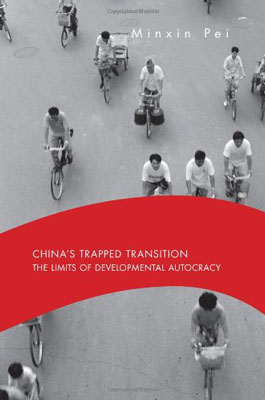
Minxin Pei examines the sustainability of the Chinese Communist Party's strategy of pro-market economic policies under one-party rule. China is trapped in partial economic and political reforms, and because the Communist Party must retain significant economic control to ensure its political survival, gradualism will ultimately fail.
Source: Harvard University Press

Pei casts doubt on three central explanations for why China's strategy works: sustained economic development will lead to political liberalization and democratization; gradualist economic transition is a strategy superior to the "shock therapy" prescribed for the former Soviet Union; and a neo-authoritarian developmental state is essential to economic take-off. Pei argues that because the Communist Party must retain significant economic control to ensure its political survival, gradualism will ultimately fail.
The lack of democratic reforms in China has led to pervasive corruption and a breakdown in political accountability. What has emerged is a decentralized predatory state in which local party bosses have effectively privatized the state's authority. Collusive corruption is widespread and governance is deteriorating. Instead of evolving toward a full market economy, China is trapped in partial economic and political reforms.
Combining powerful insights with empirical research, China's Trapped Transition offers a provocative assessment of China's future as a great power.
This book is available from Harvard University Press.
To order the book from HUP, please click here.
Minxin Pei is Senior Associate and Director of the China Program at the Carnegie Endowment for International Peace.

Former Adjunct Senior Associate, Asia Program
Pei is Tom and Margot Pritzker ‘72 Professor of Government and the director of the Keck Center for International and Strategic Studies at Claremont McKenna College.
Recent Work
Minxin Pei
Minxin Pei
Carnegie does not take institutional positions on public policy issues; the views represented herein are those of the author(s) and do not necessarily reflect the views of Carnegie, its staff, or its trustees.

Huawei pushed hard to enter the Egyptian data centers market, until the Americans made a better offer.

Angie Omar

The armed forces champion a form of capitalism that is generating revenue, but its reliance on rent faces diminishing returns, leaving the country with massive sunk costs and deferred returns, deepening dependency on external borrowing.

Yezid Sayigh

In an interview, Ishac Diwan looks at the merits and flaws in the draft legislation distributing losses from the financial collapse.

Michael Young

Mustaqbal Misr has expanded its portfolio with remarkable speed, but a lack of transparency remains.
Yezid Sayigh

Arab diaspora business communities in Egypt often mirror the same systemic challenges facing Egyptian businesses.

Nur Arafeh, Yezid Sayigh, Qaboul al-Absi, …