

Commentary
Huawei pushed hard to enter the Egyptian data centers market, until the Americans made a better offer.
Angie Omar
Source: Getty
The February IAEA safeguards report on Iran indicates that the answers provided by Iran on all but two issues are "consistent" or "not inconsistent" with its information and on schedule with the agreed-upon work plan. However, the final outstanding issues are those most closely associated with weaponization.

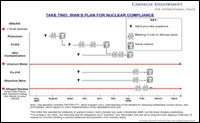
The February IAEA safeguards report on Iran (GOV/2008/4) indicates that the answers provided by Iran on all but two issues are "consistent" or "not inconsistent" with its information and on schedule (if not earlier) with the agreed-upon work plan. However, the final outstanding issues are those most closely associated with weaponization. An illustration of Iran’s progress shows that questions regarding its alleged weaponization studies and uranium metal will likely remain contested issues into April 2008 and beyond. (See below for a side-by-side comparison of INFCIRC/711 and GOV/2008/4.)
Comparing Iran’s Nuclear Compliance: INFCIRC/711 and GOV/2008/4
How close is Iran in complying with the Iran-IAEA work plan?
|
|
IAEA PROVIDES QUESTIONS |
MEETING IN IRAN TO DISCUSS |
CLOSURE | |||
|
INFCIRC/711//GOV/2008/4 |
INFCIRC/711 |
GOV/2008/4 |
INFCIRC/711 |
GOV/2008/4 | ||
|
Plutonium |
July 23 |
July |
July |
August 20 |
August 20 | |
|
P1/P2 |
August 31 |
September |
September 24 |
November |
November | |
|
HEU Contamination |
September 15 |
2 weeks after P1/P2 closure (mid-November) |
December 10-12 |
January |
January 8 | |
|
Uranium Metal |
INFCIRC/711: Iran agrees to facilitate comparison of sections of uranium metal document after which IAEA will close issue. | |||||
|
Po-210 |
September 15 after all other questions closed. |
2 weeks after HEU Contamination/ |
January |
March* |
February 22 | |
|
Ghachine Mine |
September 15 |
2 weeks after Po-210 closure (February 22) |
January |
April* |
February 22 | |
|
Alleged Studies |
INFCIRC/711: Iran finds allegations as “baseless” and “political motivated” but will review IAEA-provided documents. | |||||
*These dates were Carnegie estimates for possible issue closure, based on the text of INFCIRC/711. The IAEA indicated in GOV/2008/4 that it no longer considered the Po-210 and Ghachine mine issues to be outstanding.
Click here to download the PDF version of the above table.

Former Senior Associate, Nuclear Policy Program
Squassoni came to Carnegie from the Congressional Research Service. She also served for nine years in the executive branch. Her last position at the State Department was director of Policy Coordination in the Nonproliferation Bureau.
Nima Gerami
Former Research Assistant, Nuclear Policy Program
Carnegie does not take institutional positions on public policy issues; the views represented herein are those of the author(s) and do not necessarily reflect the views of Carnegie, its staff, or its trustees.

Huawei pushed hard to enter the Egyptian data centers market, until the Americans made a better offer.

Angie Omar

Middle Eastern states should welcome an accelerated U.S. disengagement from their region.

Michael Young

In an interview, former ambassador Charles Freeman assesses the Trump administration’s war against Iran.
Michael Young

The accord represents a pivotal moment in the region to avert a security vacuum in the Gulf.


Azeema Cheema, Mohanad Hage Ali

In an interview, Jason Burke discusses his sweeping account of the “revolutionists” who so shaped the 1970s and early 1980s.
Michael Young