• Research
  • Diwan
  • About
  • Experts
Carnegie Middle East logoCarnegie lettermark logo
LebanonIran
War in Saada: From Local Insurrection to National Challenge

Source: Getty

Paper

War in Saada: From Local Insurrection to National Challenge

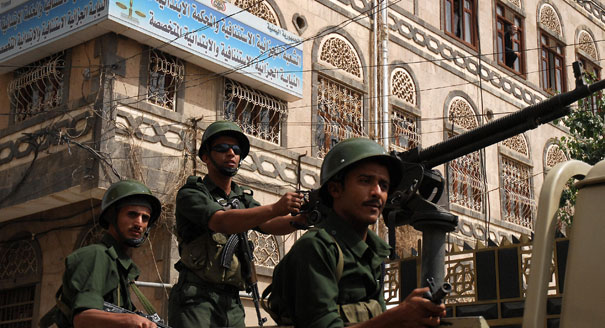
The Yemeni government is mired in an unwinnable and sporadic civil conflict in the northern governorate of Saada that has weakened the central government, accelerated the economic crisis, and threatens global stability by emboldening al-Qaeda.

Link Copied
By Christopher Boucek
Published on May 5, 2010

Additional Links

Full Text

The Yemeni government has been mired in an unwinnable and sporadic civil conflict in the northern governorate of Saada since 2004. This war has weakened the central government, accelerated the economic crisis, and threatened global stability by emboldening al-Qaeda, concludes a paper by Christopher Boucek.

Key conclusions about the conflict in Saada:

  • Fighting likely to continue. The current cease-fire agreed to in February 2010 is likely to fail as the central government shows little interest in addressing the core grievances of the rebelling Houthis.
     
  • Priorities are misguided. The Southern secessionist movement is Yemen’s more serious security threat, but the regime is more involved in Saada for two key reasons: the government believes the war is winnable, and uses the military operations in the North to send a message to agitators in the South.
     
  • Costs are escalating. In the six years the war evolved from a local insurrection into a national challenge, devastating the economy and consuming crucial resources.
     
  • Burdens disproportionately felt by noncombatants. The six rounds of fighting came with high humanitarian costs. Hostilities displaced over 250,000 people, killed hundreds or thousands (the exact number of casualties is unknown), and destroyed significant civilian infrastructure.
     
  • Conflict expands beyond borders. When Saudi Arabia’s military entered the conflict in November 2009 following Houthi incursions, conditions went from bad to worse. But there is no evidence that the conflict in Saada is a proxy war between Saudi Arabia and Iran as commonly asserted.

“The government’s uncompromising position in Saada has exacerbated local grievances and rapidly accelerated Yemen’s economic crisis,” writes Boucek. “Without a serious international effort at mediation, further fighting is inevitable—and poses a serious threat to Yemeni stability.”

 

About the Author

Christopher Boucek

Former Associate, Middle East Program

Boucek was an associate in the Carnegie Middle East Program where his research focused on security challenges in the Arabian Peninsula and Northern Africa.

    Recent Work

  • Q&A
    Yemen After Saleh’s Return and Awlaki’s Exit

      Christopher Boucek

  • Q&A
    Rivals—Iran vs. Saudi Arabia

      Christopher Boucek, Karim Sadjadpour

Christopher Boucek
Former Associate, Middle East Program
Christopher Boucek
Middle EastYemenGulfPolitical ReformSecurityForeign Policy

Carnegie does not take institutional positions on public policy issues; the views represented herein are those of the author(s) and do not necessarily reflect the views of Carnegie, its staff, or its trustees.

More Work from Malcolm H. Kerr Carnegie Middle East Center

  • people watching smoke rising at sunrise from rooftops
    Commentary
    Emissary
    Bombing Campaigns Do Not Bring About Democracy. Nor Does Regime Change Without a Plan.

    Just look at Iraq in 1991.

      Marwan Muasher

  • Commentary
    Diwan
    Axis of Resistance or Suicide?

    As Iran defends its interests in the region and its regime’s survival, it may push Hezbollah into the abyss.

      Michael Young

  • GCC foreign minister meeting in Kuwait City on June 2, 2025
    Article
    Can the Gulf Cooperation Council Transcend Its Divisions?

    Without structural reform, the organization, which is racked by internal rivalries, risks sliding into irrelevance.

      Hesham Alghannam

  • Commentary
    Diwan
    Iran and the New Geopolitical Moment

    A coalition of states is seeking to avert a U.S. attack, and Israel is in the forefront of their mind.

      Michael Young

  • Commentary
    The Middle East’s Promising Gen Z

    Fifteen years after the Arab uprisings, a new generation is mobilizing behind an inclusive growth model, and has the technical savvy to lead an economic transformation that works for all.

      Jihad Azour

Get more news and analysis from
Malcolm H. Kerr Carnegie Middle East Center
Carnegie Middle East logo, white
  • Research
  • Diwan
  • About
  • Experts
  • Projects
  • Events
  • Contact
  • Careers
  • Privacy
  • For Media
Get more news and analysis from
Malcolm H. Kerr Carnegie Middle East Center
© 2026 Carnegie Endowment for International Peace. All rights reserved.