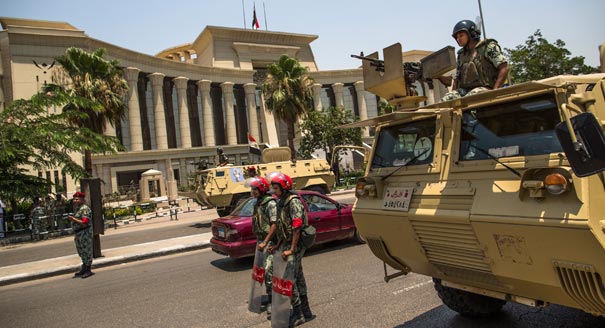
Egypt’s transitional leaders announced yesterday the most important step they have taken yet to sever ties with the Mubarak regime since the former president’s forced resignation: dismantling the hated State Security Investigations Sector (SSIS). Recently-appointed Interior Minister Mansour Eissawi said that a new “National Security Sector” would be created within the ministry to combat terrorism and protect domestic security in accordance with the constitution and human rights principles. He specified that the new service would not interfere in the political activities or personal lives of Egypt’s citizens.
Developments over the coming days and weeks will show how serious and thorough this change in internal security will be and whether it will be implemented effectively. What is clear already is that the change was badly needed. While Egypt’s diverse opposition and protest groups differ on many subjects, they are united in their determination that internal security forces must get out of the business of harassing, manipulating, and torturing peaceful political and civil society activists.
The initial steps taken by Mubarak and later on by the Supreme Council of the Armed Forces—dismissing former Interior Minister Habib al-Adly, referring him for prosecution, and appointing a less-known officer from the security apparatus in his place—did not send a clear enough message of change. The March 5
appointment of Eissawi—a retired police commissioner and former governor who enjoys credibility with opposition and protest groups—as part of a new cabinet constituted a further step. But when Prime Minister Essaf Sharaf delivered his first public speech in Tahrir Square on March 4, several audience members loudly i
nterrupted him to demand that SSIS be radically restructured immediately. Twenty-four hours after Sharaf’s inaugural address, hundreds of protesters
stormed SSIS offices in Cairo, Alexandria, and other cities to prevent personnel from destroying
documents that might have implicated them in corruption and human rights violations.
Rumors began to circulate in early March that the SSIS was beginning to reemerge after going underground for several weeks, and specifically that SSIS officers were fanning the flames of sectarian discord in order to prove the need for their services. Thirteen people were killed in sectarian clashes on March 8 and there were violent clashes between protestors and security-employed thugs once again in Tahrir Square.
Minister Eissawi said on March 15 that officers for the new security service would be selected in the coming days, leaving it unclear whether all SSIS officers will be dismissed (and perhaps have the ability to reapply for their jobs) or whether just the top leadership will be changed. Demobilizing a security force as massive as Egypt’s is no small feat. Over the course of his thirty-year rule, Mubarak steadily increased the size of the SSIS as well as the scope of its powers. In 1974, police personnel numbered only 150,000, but by 2009, analysts
estimated that the Egyptian Interior Ministry commanded a total of 1.7 million employees, including some 400,000 SSIS officers as well as 850,000 regular policemen and interior ministry staff and 450,000 Central Security Force troops. To put these figures in perspective, Egypt’s internal security personnel outnumber its active-duty military troops by a ratio of three to one and by 2002 accounted for
one-fifth of all central government employees.
Throughout the 1990s, during which Egypt experienced a wave of domestic terrorist attacks, Mubarak sponsored a series of laws that curtailed civil and political rights and also steadily expanded the SSIS, which he justified as a necessary counterweight to Islamic extremism. The declared targets of the crackdown were the domestic terrorist groups al-Gama’at al-Islamiyya and al-Gihad, but in practice, the security forces also employed their sweeping powers to neutralize political opponents of the regime.
Along with suspected militants, the government detained opposition activists including
thousands of members of the Muslim Brotherhood, which had not used or advocated violence in decades. Stripped of legal recourse by a sweeping emergency law,
hundreds of political prisoners were tortured or killed without ever facing criminal charges. Only rarely were perpetrators of these abuses prosecuted. As of January 31, 2011, no SSIS officer had ever been convicted on torture charges, according to
Human Rights Watch, although in at least three cases officers had appeared before a court.
Beyond the most egregious abuses, the SSIS perpetuated and enforced a police state culture in which Egyptians involved in politics or civil society were called on to inform on their neighbors and colleagues in one way or another. It was understood that government employees and private citizens needed an informal SSIS clearance for a wide range of actions deemed sensitive, such as allowing a nongovernmental organization to accept a grant, renovating or constructing a church, or appointing the new dean of an academic program.
It was widely known, but rarely spoken, that the SSIS worked to besmirch the reputations of civil society activists who had aggravated the regime, as did sociologist Saad Eddin Ibrahim in 2000. SSIS also had a reputation for fostering rifts inside opposition groups that it saw as transgressing informal red lines; among the better-known cases are the Socialist Labor Party (whose license was frozen in 1999) and Ayman Nour’s al-Ghad Party (which has been embroiled in a leadership dispute since 2005).
Redefining the mission of internal security forces away from torture, abuse, political manipulation, and unwarranted interference in private affairs and toward preventing terrorism and crime is now essential. Minister Eissawi’s announcement was the clearest articulation of such an intention so far.
Now the hard part will begin, as decisions are made about what size force is needed, how to retrain officers, and how to prevent retaliation from those who will be dismissed (as it seems unlikely that such a large secret police force will be needed if their functions are far more limited than in the past). None of this will be easy, but neither is it avoidable. Even if Egypt were to hold completely free presidential and parliamentary elections, there is no way for it to make a transition to real democracy if the internal security services resume their pre-January 25 mode of operation.