

Commentary
Uri Dadush
{
  "authors": [
    "Uri Dadush"
  ],
  "type": "legacyinthemedia",
  "centerAffiliationAll": "",
  "centers": [
    "Carnegie Endowment for International Peace"
  ],
  "collections": [],
  "englishNewsletterAll": "",
  "nonEnglishNewsletterAll": "",
  "primaryCenter": "Carnegie Endowment for International Peace",
  "programAffiliation": "",
  "programs": [],
  "projects": [],
  "regions": [
    "United States"
  ],
  "topics": [
    "Political Reform",
    "Economy",
    "Trade",
    "Foreign Policy",
    "Civil Society"
  ]
}
Source: Getty
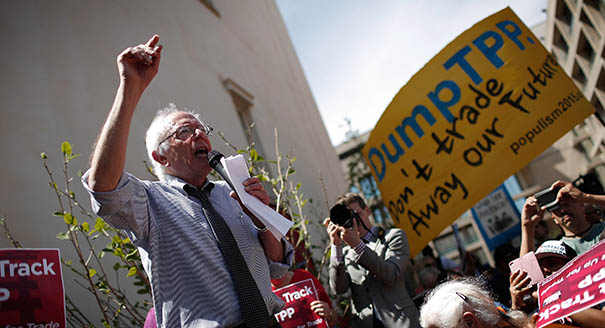
American voters are more concerned about economic issues in the 2016 presidential election.
Source: CCTV
Carnegie’s Uri Dadush spoke to CCTV America’s Rachelle Akuffo about how voters are considering economic factors going into the 2016 presidential election. Compared to the 2008 election, voters are more concerned with income inequality, jobs, and trade negotiations, he said. Dadush also discussed how to improve sluggish economic growth, infrastructural investments, and monetary policy.

Former Senior Associate, International Economics Program
Dadush was a senior associate at the Carnegie Endowment for International Peace. He focuses on trends in the global economy and is currently tracking developments in the eurozone crisis.
Recent Work
Uri Dadush
Uri Dadush
Carnegie does not take institutional positions on public policy issues; the views represented herein are those of the author(s) and do not necessarily reflect the views of Carnegie, its staff, or its trustees.

Policy proposals on sovereign debt must both match the scale of the challenge and be implementable within existing political constraints.
David McNair

Despite a new textbook, an influx of Russian teachers and managers, and an end to the teaching of Ukrainian, the Kremlin is unlikely to have “reprogrammed” locals.

Konstantin Skorkin

For every ruble allocated to social policy, health, and education in 2027, double that amount is earmarked for the army, the police, and the security services.

Alexandra Prokopenko

The acknowledgment has sparked fears of a new arms race with China and Russia.

Chris O’Meara

Smaller powers cannot go it alone, but Canadian history shows that integration with the United States will not always be benign.
Paul Samson