

Commentary
Washington’s decision to support some UN functions while letting others wither is pulling the organization apart at the seams.
Stewart Patrick, Theodore Zaritsky
{
  "authors": [
    "Andrey Kortunov",
    "Mikhail Minakov",
    "Steven Pifer"
  ],
  "type": "commentary",
  "centerAffiliationAll": "",
  "centers": [
    "Carnegie Endowment for International Peace",
    "Carnegie Russia Eurasia Center"
  ],
  "collections": [],
  "englishNewsletterAll": "",
  "nonEnglishNewsletterAll": "",
  "primaryCenter": "Carnegie Russia Eurasia Center",
  "programAffiliation": "",
  "programs": [],
  "projects": [
    "Eurasia in Transition"
  ],
  "regions": [
    "North America",
    "United States",
    "Eastern Europe",
    "Ukraine"
  ],
  "topics": [
    "Foreign Policy",
    "Economy"
  ]
}
Source: Getty
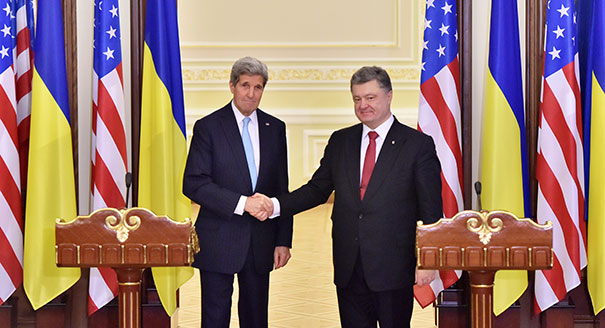
Following Donald Trump’s victory, Carnegie.ru asked three experts, one in Russia, one in Ukraine, and one in the United States, to comment on the question: “What impact will Trump’s victory have on Ukraine?”
Director General of the Russian International Affairs Council
Ukraine could be Trump’s trump card
Ukraine is unlikely to be one of President-elect Donald Trump’s main foreign-policy priorities, when set against other issues such as China and the fight against international terrorism. Trump also sees the Ukrainian situation as a primarily European problem to be dealt with by European leaders. And, as a man who is known for harboring a grudge, Trump is unlikely to give much attention to the political establishment of a country which gave its open support to Hillary Clinton.
We can safely predict several initiatives that a Trump administration will not take. The White House will not substantially increase economic aid to Kiev—just as it will not give more funding to U.S. aid programs overall. A Trump administration will see it has nothing to gain by lobbying for Ukraine’s speedy accession into NATO.
Moreover, when it comes to the conflict in south-eastern Ukraine, Washington will not want to join the peace process, let alone ask to join the Normandy Format. And, as far as we can tell, we will not hear any rhetoric about a clash between “good and evil” from the new president of the United States, as we have from other American politicians.
All this however does not mean that Trump is getting ready to “surrender” Ukraine to President Vladimir Putin. That would be a bad business deal. We won’t see the new U.S. administration seek to have sanctions on Russia lifted in early 2017 or reverse its position on the territorial integrity of Ukraine. The most the Kremlin can expect in the near future is a decision not to send lethal weapons to Kiev, or another symbolic gesture of that sort.
If the conflict in south-eastern Ukraine continues at its current low level, that most probably suits the Trump administration well. That will force America’s European allies to mobilize themselves more both militarily and politically. It will also be a very useful trump card for Washington in negotiations with Moscow on other issues that the new administration regards as more important. This trump card will be played only when the main points in the new agenda in U.S.-Russian relations have all been determined.
Editor-in-chief, Ideology and Politics Journal, Kyiv
Trump is a ‘known unknown’
To use the famous expression of another famous Donald – Donald Rumsfeld--Donald Trump is a “known unknown” for Ukraine.
Overall, Trump’s future foreign policy and appointees are so unpredictable that we cannot forecast what will be his real policy toward Ukraine, Russia, Crimea, the conflict in Donbas war and Eastern Europe as a whole. This uncertainty should be a cause of both worry and hope for Ukraine’s current government.
Trump may appear to be a pro-Russian politician and he has famously praised Vladimir Putin’s leadership style. He has also talked of reducing U.S. support to NATO member-states in Eastern Europe. These statements have led many to conclude that Trump’s victory will negatively impact the United States’ stance of supporting Ukraine’s fight for its independence and sovereignty.
But we have seen recently how little logic and contemporary U.S. politics have in common. So those expecting that U.S.–Russia relations will improve and U.S.–Ukraine ties will deteriorate would be advised to watch how the president-elect is already recruiting to his administration figures well known for their anti-Russian views, who favor an expansion of US missile defense programs or an increase in defense spending.
In Ukraine, experts and public politicians split roughly into two groups. One group is full of horror as leaders whom they regard as “friends of Putin” have won recent elections in Moldova and Bulgaria as well as the United States. Others, on the other hand predict that Trump will be a “pro-American” who will inevitably turn into an enemy of Putin.
Trump’s victory also strengthens another trend amongst the ruling elite, by creating a prevailing mood that the world is entering an era of autocratic rulers. Many leading figures in Kyiv look on populist leaders with authoritarian temperaments such as Trump and Turkish president Recep Tayyip Erdoğan as role models in contemporary politics whose example they should follow.
Senior Fellow, Brookings Institution
Two extreme scenarios and much in between
President-elect Trump said things during the campaign that suggested a radical change in U.S. policy toward Ukraine: possible recognition of the Kremlin’s illegal annexation of Crimea and an easing of sanctions on Russia, in a bid to build a better relationship with Moscow. Whether he will pursue such a change in office remains to be seen.
Two scenarios define the spectrum of possible approaches in a Trump administration.
On one end, the Republican foreign policy mainstream in Congress strongly supports Kyiv and is suspicious of Russia. Vice President-elect Pence shares those views, as do most names floated as candidates for secretaries of state and defense. If—to repeat, if—Mr. Trump heeds such counsel, there might be some modification of U.S. policy toward Ukraine and Russia, but nothing dramatic.
Another factor is the Russian president. Mr. Trump says he wants to do deals. Mr. Putin has made clear what he wants from the United States, but he has not indicated where he is prepared to give. Mr. Trump might find there is little basis for a deal.
The second scenario, at the other end of the spectrum, is grim. That is that Mr. Trump as president behaves as Mr. Trump as candidate, relying on his instincts and believing he is smarter than the generals, diplomats and Republican mainstream. After all, he won an election by ignoring advice from experts. Moreover, those Republicans who merely pay lip service to NATO and Ukraine go along with him. In that case, one could see a major—and dangerous—departure in U.S. policy toward Ukraine, Russia and Europe.
I hope Mr. Trump’s policy in office will be close to the first scenario but worry that it will land near the second.
Andrey Kortunov
Kortunov is director general of the Russian International Affairs Council.
Mikhail Minakov
Steven Pifer
Carnegie does not take institutional positions on public policy issues; the views represented herein are those of the author(s) and do not necessarily reflect the views of Carnegie, its staff, or its trustees.

Washington’s decision to support some UN functions while letting others wither is pulling the organization apart at the seams.

Stewart Patrick, Theodore Zaritsky

While there are notable demographic, economic, and geographic divides over AI, there is also substantial alignment between Republicans and Democrats.


Ian Klaus, Mark Baldassare, Rachel George, …

Are Germany’s economic, industrial, and political struggles becoming a liability for the EU’s ability to rise to the geopolitical moment?

Rym Momtaz, ed.

China’s police training infrastructure construction projects provide benefits to recipient countries, promote China’s image as a major global security provider, and are likely to reinforce alignment between Beijing’s security priorities and those of countries in the Global South.


Cameron Waltz, Sheena Chestnut Greitens, Kim Nguyen, …
AI capabilities are moving fast. Most institutions—including governments—can’t keep up.


Anton Leicht, Scott Singer