

Commentary
The Horn of Africa countries are among those facing a new security calculus.
Andrew Leber, Lesley Anne Warner
{
  "authors": [
    "Zhang Chuanjie"
  ],
  "type": "legacyinthemedia",
  "centerAffiliationAll": "",
  "centers": [
    "Carnegie Endowment for International Peace",
    "Carnegie China"
  ],
  "collections": [
    "U.S.-China Relations",
    "China’s Foreign Relations"
  ],
  "englishNewsletterAll": "",
  "nonEnglishNewsletterAll": "",
  "primaryCenter": "Carnegie China",
  "programAffiliation": "",
  "programs": [],
  "projects": [],
  "regions": [
    "North America",
    "United States",
    "East Asia",
    "China"
  ],
  "topics": [
    "Foreign Policy"
  ]
}
Source: Getty
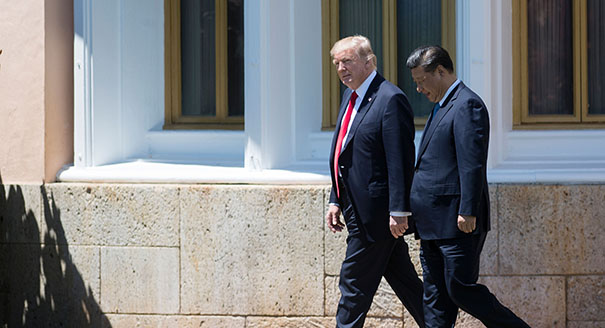
The future of the U.S.-China relationship depends largely on the relationship between presidents Xi Jinping and Donald Trump and attitudes in their respective countries.
Source: Global Times
It is no coincidence that Donald Trump’s visit to Beijing comes two weeks after the conclusion of the 19th National Congress of the Communist Party of China (CPC). The party has decided that socialism with Chinese characteristics has rolled into a new era. Not only was Xi Jinping unanimously re-elected the general secretary of the party’s central committee, but also his thought was officially enshrined in the newly amended CPC constitution. When Xi led other newly-elected members of the Standing Committee of the 19th CPC Central Committee Political Bureau before global media, it was a clear sign of his strengthened leadership of China.
Now, Beijing is making preparations for Trump’s meeting with his Chinese counterpart. Will the new era of China’s development open a new era of China-U.S. relations? The answer will be largely decided by the leadership of Xi and Trump. What Xi and Trump’s predecessors have historically contributed to this increasingly consequential bilateral relationship can serve as good examples.
Political leadership mean many things, but what constitutes the most important dimensions of effective political leadership for U.S.-China relations? It involves at least two things, both related to the opinions at home in each country.
First, leaders spend time and patience to build consensus and use that consensus as political capital to take the bilateral relationship forward. While Richard Nixon managed to persuade both congress and the public that the United States and China could work together, Mao Zedong also took efforts to convince his colleagues and the public that the Mei Di Guo Zhu Yi (“American imperialism,” aka the United States) may sometimes be regarded as a partner in international politics in order to deal with other greater evils.
During times of difficulties when consensus is impossible and public mood can seriously constrain leaders’ policy choices, leadership entails political courage and craft to prevent the yielding to short-term impulses from derailing strategic interests in the long haul. Thus in the aftermath of June 4th incident of 1989, then-U.S. President George H. W. Bush told Chinese leader Deng Xiaoping through General Brent Scowcroft that his administration still valued the strategic and economic interests of the bilateral relationship but only needed some time to cope with negative opinion about China in the United States. Meanwhile in China, Deng warned leftist factions that reversing the process of economic liberalization may lead the country nowhere. Both leaders were making efforts to keep the relationship from going into choppy waters because of strong opposition at home.
Now is the turn of Xi and Trump. Xi is building consensus at home, and given his more consolidated position, is capable of firewalling the bilateral relationship from the vicissitudes of domestic moods when necessary. The question remains open for Trump.
Reports from the Pew Research Center in recent years point to an increasingly polarized America. Political scientists have identified polarization in congressional ideology, partisan sorting, and negative inter-group affect that the left and the right attribute to each other. Trump certainly is not the cause of political polarization, but what he is doing can hardly reverse that trend either. Against this background of increasing polarization, he is unlikely to have consensus on any salient political issue, including the China-U.S. relationship. Now the question seems to focus on the second aspect of leadership. Is Trump willing to stabilize and carefully manage the overall relationship at a time when playing the blame game on issues such as North Korea or trade is more convenient to please supporters at home?
This does not mean that the two countries should dodge difficult issues for the sake of a pretentiously healthy relationship. North Korea and trade will surely be high on the agenda of Xi and Trump. But Trump’s troubled domestic political situation and his unclear willingness to lead may be a source of major uncertainty in the future of the bilateral relationship. Such moments were seen early during the terms of Ronald Reagan, Bill Clinton, and George W. Bush, but all three of them soon changed course, showing similar learning curves in their China policy.
As many in the United States are concerned, if not worried, as to the direction in which Trump is leading the country, many in China are also curious to know how Trump’s leadership or the absence of it will impact the China-U.S. relationship. Perhaps this month’s meeting will provide some clues.
A version of this article was originally published in Global Times.

Zhang Chuanjie
Former Resident Scholar, Carnegie-Tsinghua Center for Global Policy
Zhang Chuanjie was a resident scholar at the Carnegie-Tsinghua Center until June 2020.
Carnegie does not take institutional positions on public policy issues; the views represented herein are those of the author(s) and do not necessarily reflect the views of Carnegie, its staff, or its trustees.

The Horn of Africa countries are among those facing a new security calculus.


Andrew Leber, Lesley Anne Warner

The European far right might fail to steer EU policy in the direction Russia wants, but they will create enough chaos inside Europe to benefit the Kremlin.

Dimitar Bechev

The nuclear relationship between China and the United States is increasingly shaped by widening perception gaps rather than deliberate strategic design.

Tong Zhao
Washington needs to recognize that influence in the Western Hemisphere comes from presence, delivery, and reliability. It also must recognize that while the United States remains the key external actor, it no longer operates in a permissive environment and cannot presume deference from regional players who have other options, namely China.
Juan S. Gonzalez

Minsk clearly expected the dialogue with Washington to yield more results, in particular the lifting of EU sanctions and permission to export potash.

Artyom Shraibman