

Commentary
Russian strikes are weakening the economy sustaining Ukraine’s war effort. Closing the growing funding gap will require more European support and politically contentious reforms in Kyiv.
Balázs Jarábik
{
  "authors": [
    "Emil Avdaliani"
  ],
  "type": "commentary",
  "blog": "Carnegie Politika",
  "centerAffiliationAll": "dc",
  "centers": [
    "Carnegie Endowment for International Peace",
    "Carnegie Russia Eurasia Center"
  ],
  "collections": [
    "Aso Tavitian Initiative"
  ],
  "englishNewsletterAll": "ctw",
  "nonEnglishNewsletterAll": "",
  "primaryCenter": "Carnegie Russia Eurasia Center",
  "programAffiliation": "russia",
  "programs": [
    "Russia and Eurasia"
  ],
  "projects": [],
  "regions": [
    "East Asia",
    "Caucasus",
    "Georgia"
  ],
  "topics": [
    "Economy"
  ]
}
Source: Getty
With Western powers distracted by the war in Ukraine, China appears to be making cautious moves to cement its position in the wider Black Sea region.
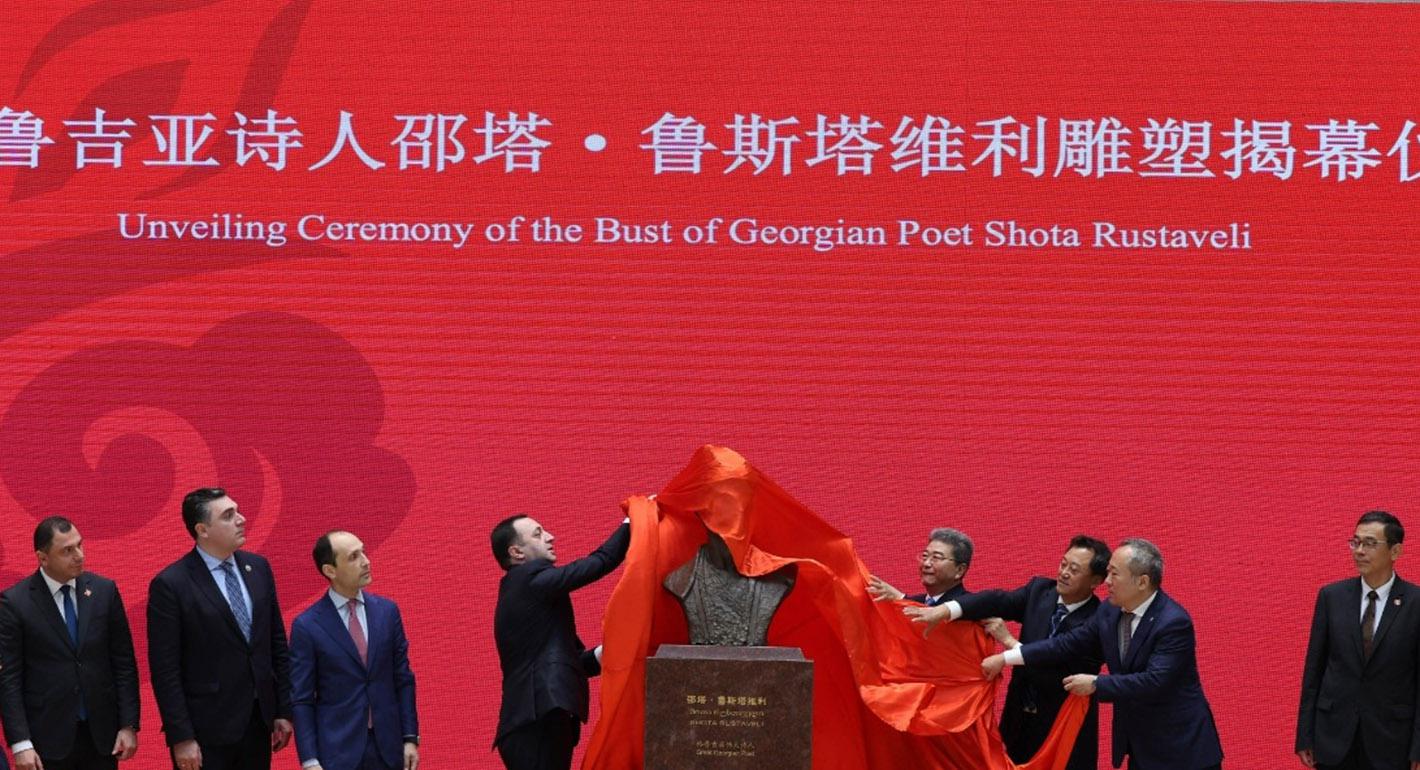
The strategic partnership agreement released by Beijing and Tbilisi on July 31 surprised many in Georgia and in the West. While this diplomatic advance comes amid traditionally warm relations between China and Georgia, which signed a free trade agreement back in 2017, the reasons for and timing of the strategic cooperation document’s release highlight the fluid geopolitical situation in the South Caucasus; China’s attempts to advance its position in the unstable region; and, more importantly, Georgia’s efforts to maneuver between the collective West and the East, especially ahead of the crucial decision by the EU on whether to grant Tbilisi its long-coveted candidate status.
The document, signed during Georgian Prime Minister Irakli Garibashvili’s visit to China, lays out a vision for expanded bilateral economic and political cooperation, as well as on infrastructure and education. The two sides have agreed to “strengthen coordination and collaboration in regional and international affairs,” including on China’s global projects such as the Belt and Road and Global Security initiatives.
For China, expanded relations with Georgia could pave the way for a larger presence in the South Caucasus. Beijing has traditionally regarded the region as part of Russia’s sphere of influence, and has been reluctant to take any major steps there. The South Caucasus did not even feature among the corridors covered by the Belt and Road Initiative.
Yet the wider Black Sea region has proved to be a vital geopolitical area where the competition between Russia and the West creates fertile ground for other major powers to increase their profile. It also makes sense for Beijing to pursue a greater role in the region as it seeks to enlarge its maritime presence around the globe. Many believe that the expanded partnership with Tbilisi will focus on constructing Georgia’s Anaklia port, which sits on the shortest route from China to Europe.
China’s push for closer ties with Georgia should perhaps also be seen from a Central Asian perspective. That region has for nearly two centuries been connected to the outside world by infrastructure exclusively linked northward to Russia. Now, China is disrupting that pattern by developing east-west connectivity through railways, roads, and trade. Central Asia is a big market, but expansion into the region is also a first step in pursuit of Beijing’s grander goal of going west: building multiple land links to the EU and serving as an alternative to the Russian route, whose efficacy has been undermined by Russia’s invasion of Ukraine and ensuing Western sanctions.
The South Caucasus is one such alternative. Geographically, the shortest connection is from Xinjiang in China to EU member state Romania. This Middle Corridor, running through Central Asia and the Caspian Sea, and then through the Black Sea or overland through Turkey, is now increasingly seen as a viable substitute to the traditional northern route via Russia.
China was initially hesitant to support the Middle Corridor, perhaps hoping that the war would soon be over, but as time went on, the need to find a stable alternative grew stronger. Tentative progress on the long-stalled China-Kyrgyzstan-Uzbekistan railway was the first strong signal from Beijing. In early 2023, the Chinese ambassador to Georgia openly supported the idea of developing the Middle Corridor, to the surprise of many. Moreover, various memorandums and political consultations have been signed and held to facilitate transit between Georgia and Turkey, Azerbaijan, Kazakhstan, and Uzbekistan. Indeed, following his visit to China, the Georgian prime minister went to Kazakhstan to discuss the Middle Corridor.
Although Beijing might be presumed the leader in the relations upgrade with Georgia, the latter also has multiple reasons to revitalize relations with China right now. Since the full-scale war in Ukraine began, Tbilisi has found itself in a difficult spot. The ongoing Russian occupation of two Georgian territories since Russia’s invasion in 2008 and fear of renewed Russian military moves have pushed Tbilisi to seek a somewhat surprising solution: rapprochement with Russia on security and sanctions issues. Tbilisi has toned down its public eagerness to join NATO and abstained from anti-Russian sanctions.
Many denigrate this approach as betrayal, while others call it pragmatism. Either way, it has prompted criticism from Tbilisi’s Western partners and jeopardized the country’s bid to gain much delayed EU candidate status. The final decision will be made in late 2023, but the repercussions from the year-long degradation of trust between the two sides are already in evidence.
Georgia has gradually diminished its fixation on the West and begun looking elsewhere, both as a potential balance to Russia and, more importantly, because it wants to extract concessions from Brussels by increasing its alignment with other geopolitical poles. The timing of the strategic cooperation agreement’s signing with China suggests that Tbilisi is deliberately raising the stakes in order to push the EU into making a positive decision later this year. The repercussions, however, may be even bigger. We might be witnessing the birth of Georgia’s multi-vector foreign policy, or at least some initial attempts at it.
Still, China-Georgia strategic cooperation does not guarantee greater or even unhampered Chinese influence in Georgia. The latter is still a major partner for the United States and the EU. Both Washington and Brussels, to varying degrees, regard Beijing as a systemic rival, and this would obviously take a toll on Tbilisi. This geopolitical dichotomy also risks undermining the effective operation of the Middle Corridor, which, for the moment, is supported by the EU and China. Their overlapping interests would ideally serve as a major driver behind the expansion of the route, but this is far from guaranteed. Brussels and Beijing will likely have different agendas for who is to play a major role in infrastructure development in Georgia, Azerbaijan, and elsewhere along the route.
Nor is Russia likely to welcome China’s moves. Although Moscow regards the South Caucasus as part of its uncontested sphere of influence, the Kremlin has witnessed a gradual erosion of its power and prestige in the region. Taking advantage of Moscow’s preoccupation with its war against Ukraine, powers like Turkey, Iran, and now China have made significant inroads into the South Caucasus to fill the emerging vacuum. As a result, a multi-aligned South Caucasus has emerged, and the recent China-Georgia agreement further exacerbates this trend.

Emil Avdaliani
Professor of international relations at European University in Tbilisi, Georgia

Russian strikes are weakening the economy sustaining Ukraine’s war effort. Closing the growing funding gap will require more European support and politically contentious reforms in Kyiv.

Balázs Jarábik

For every ruble allocated to social policy, health, and education in 2027, double that amount is earmarked for the army, the police, and the security services.

Alexandra Prokopenko

Depleted financial reserves and a shrinking tax base mean it is no longer possible to simultaneously deliver high defense spending, price stability, and economic growth.
Alexandra Prokopenko

Pashinyan’s pro-European party has been re-elected with a decisive victory. But the pro-Russian opposition could still slow Armenia’s progress toward peace with Azerbaijan and rapprochement with Europe.

Mikayel Zolyan
For all the menacing rhetoric, the Armenian prime minister remains a leader with whom Putin is prepared to interact: not as an ally, but as a partner, albeit a problematic one.

Alexander Atasuntsev