

Commentary
Dimitar Bechev
{
  "authors": [
    "Dimitar Bechev"
  ],
  "type": "commentary",
  "blog": "Carnegie Politika",
  "centerAffiliationAll": "",
  "centers": [
    "Carnegie Endowment for International Peace",
    "Carnegie Russia Eurasia Center"
  ],
  "englishNewsletterAll": "",
  "nonEnglishNewsletterAll": "",
  "primaryCenter": "Carnegie Russia Eurasia Center",
  "programAffiliation": "",
  "programs": [],
  "projects": [],
  "regions": [
    "China",
    "Eastern Europe"
  ],
  "topics": [
    "Foreign Policy",
    "EU"
  ]
}
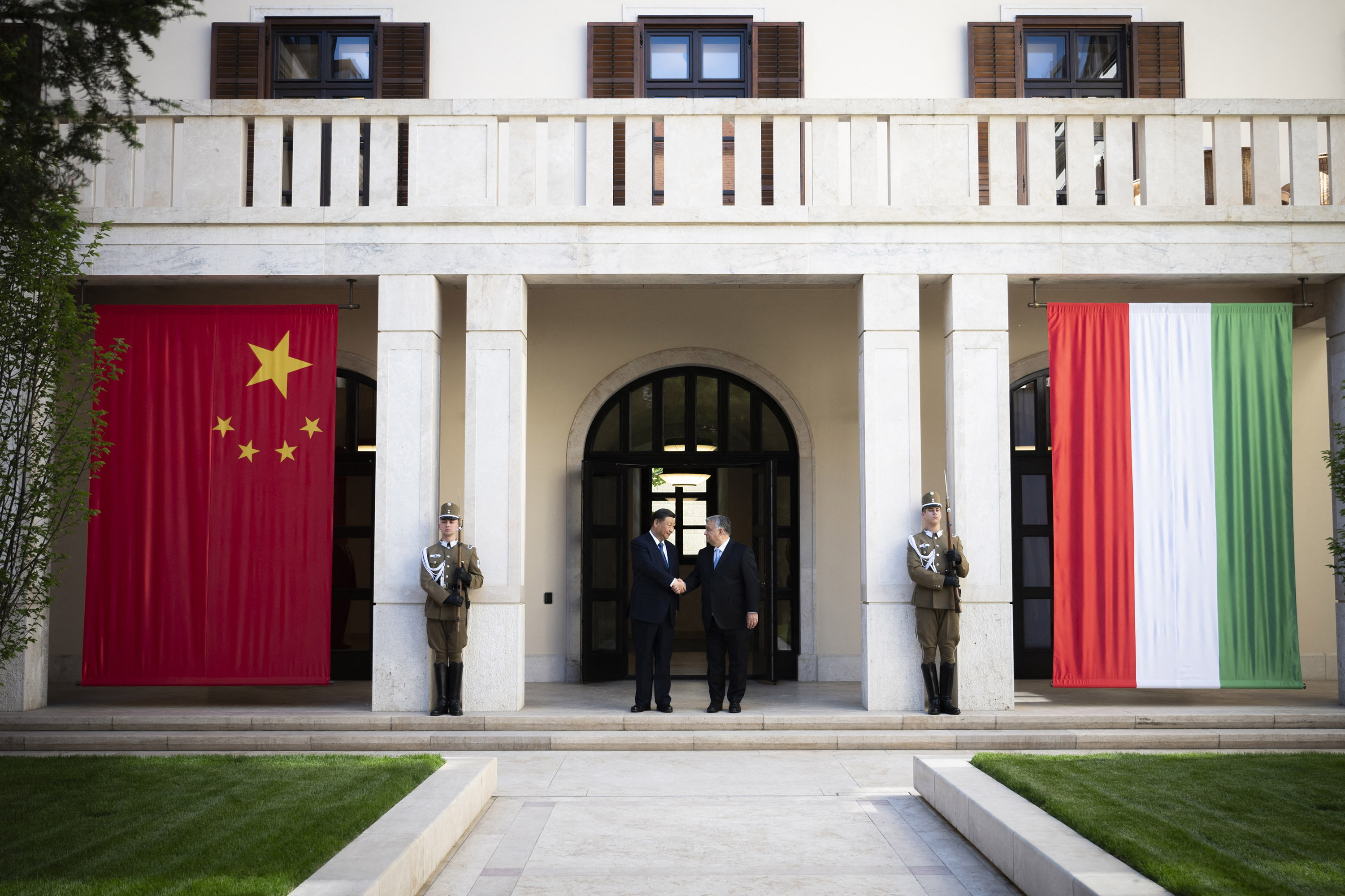
Source: Vivien Cher Benko / AFP via Getty Images
The full-scale invasion of Ukraine is accelerating the process of China edging out Russia from Central and Eastern Europe.
China’s Xi Jinping had a good time touring Europe last week. Admittedly, talks in Paris with French President Emmanuel Macron and Ursula von der Leyen, head of the European Commission, were hardly a shining success. Both Xi and his interlocutors largely stuck to their guns—whether on China’s ambivalent position on the war in Ukraine or the ongoing dispute regarding the import of electric vehicles into Europe.
But then came the Serbian and Hungarian legs of Xi’s European visit. In both Belgrade and Budapest, the Chinese leader received a hero’s welcome: crowds cheering his arrival at Palata Srbije and at the Buda Castle, his op-eds gracing the pages of Belgrade’s daily Politika and the Magyar Nemzet, and talk of a “shared future.” The visits to two of China’s closest friends in Europe yielded substance too, with Serbia signing a host of cooperation agreements, while Hungary continued discussions on a major greenfield project by carmaker Great Wall.
There are key differences between Hungary and Serbia, of course. One is a member of the EU and the other, at least on paper, a candidate country. Hungary has benefited tremendously from Brussels’s lavish subsidies and from full access to the European market, which has turned it into a manufacturing hub, a fact appreciated by German automakers such as Audi, Opel, and Daimler.
Serbia has likewise profited from an inflow of European investment, free trade, and its geographical location next to core EU countries. But from its position outside of the EU, it has neither the political clout nor the economic heft wielded by Viktor Orban’s Hungary. It is no coincidence that Chinese companies such as Tesla’s rival BYD and battery maker CATL have set up shop in the latter.
What the two countries have in common, however, is a tangled relationship with Brussels. Illiberal populism, state capture, and cozy relations with Russia have made Orban a maverick for the rest of the EU. Much of the European funding for Hungary was frozen in 2022. Serbia has also come under criticism over tainted local elections last December, and for the uptick in violence in northern Kosovo that has all but killed EU-mediated normalization talks between Pristina and Belgrade.
At a more fundamental level, Orban and Serbian President Aleksandar Vucic are aligned in betting on the emerging multipolar order. They have invested in relations with Russia in order to improve their bargaining positions with the EU and the West in general. That worked for the Hungarians last March when Orban succeeded in trading his veto on EU financial aid to Ukraine for unfreezing 10 billion euros in cohesion funds. Hungarian Foreign Minister Peter Szijjarto, one of the rare EU member state officials who still visits Moscow, was heard saying at a recent Chatham House event that Hungary would veto Ukraine’s EU membership if Kyiv did not fulfill certain demands posed by Budapest.
Vucic has also been pursuing an intricate balancing act between Moscow and the West, reportedly sending arms to Ukraine through third countries but keeping Serbia very much open for business for the Russians. These days, Russian can be heard on every corner in downtown Belgrade.
The common denominator is a mix-and-match approach. Hungary and Serbia cherry-pick the aspects of the EU they like and reject those they don’t, painting them as an unjust imposition on their sovereignty or, worse, a Soros conspiracy. In the same vein, they pick and choose the elements of Russian foreign policy they find useful: welcoming continued energy deals, but declining to use Hungary’s veto on EU sanctions, for instance, or using Russia as an ally in fighting Kosovo’s independence, but voting against Moscow in the UN General Assembly and refusing to support the annexation of parts of Ukraine.
Xi’s tour is a timely reminder that there is a third pole in this relationship: China. The last decade has brought home to Eastern Europe’s neo-Titoists that Russia is often all about brotherly love rather than hard cash. China, on the other hand, has the financial muscle, despite the fact that its signature policy, the Belt and Road Initiative, has been scaled down.
Pro-government media in both Belgrade and Budapest were jubilant last week counting all the billions committed in Chinese foreign direct investment. The notion that foreign policy, recalibrated to a post-Western world, yields jobs and adds to welfare has become central to the rhetoric of deeply populist regimes such as Orban’s and Vucic’s. It adds to their legitimacy and makes for good headlines. China fills a gap that Russia and—at least at the level of perceptions—the West have left. One should not forget Beijing’s COVID diplomacy in 2020, which Vucic in due course hijacked to score points with Serbia’s neighbors too.
The full-scale invasion of Ukraine is accelerating the process of China edging out Russia from Central and Eastern Europe. Putin has become toxic in a way that the Chinese leadership is not. Vucic and Orban would rather be seen in the company of Xi.
Last October, the Serbian president tried to gloss over journalists’ questions about whether he would have a bilateral meeting with Putin at the tenth anniversary summit of the Belt and Road Initiative. After all, it’s one thing to have the odd phone call with Putin and even appoint pro-Russian figures in the Serbian government. But what’s the point of unnecessarily antagonizing the West by, say, attending the Victory Day public holiday military parade on Red Square on May 9 if the Russians are unable to offer much in return?
China, in contrast, may be turning into a strategic rival for the EU, but an economic decoupling is not in the cards. The cost of deepening ties with Beijing is not prohibitively high so long as the EU trades with and invests heavily in the Chinese economy. The benefits are palpable. Xi is prepared to play divide-and-conquer in order to prevent Europe, China’s top market, from acting in unison. In Hungary and Serbia, he is knocking on an open door. Expect the lovefest to carry on.

Senior Fellow, Carnegie Europe
Dimitar Bechev is a senior fellow at Carnegie Europe, where he focuses on EU enlargement, the Western Balkans, and Eastern Europe.
Recent Work
Dimitar Bechev
Dimitar Bechev
Carnegie does not take institutional positions on public policy issues; the views represented herein are those of the author(s) and do not necessarily reflect the views of Carnegie, its staff, or its trustees.

The European far right might fail to steer EU policy in the direction Russia wants, but they will create enough chaos inside Europe to benefit the Kremlin.
Dimitar Bechev

Minsk clearly expected the dialogue with Washington to yield more results, in particular the lifting of EU sanctions and permission to export potash.

Artyom Shraibman

If the Russian-speaking community in Latvia cannot articulate their interests without being seen as disloyal, they could end up embracing a pro-Kremlin agenda.

Sergejs Potapkins

With the growth in points of friction between the great powers, organizations like the SCO will continue to play a role in the strategic adaptation of the smaller powers caught between them.

Temur Umarov

When faced with fuel shortages in the past, Central Asian governments could always count on additional supplies from Moscow. That safety net no longer exists.

Galiya Ibragimova