

Commentary
Konstantin Skorkin
{
  "authors": [
    "Konstantin Skorkin"
  ],
  "type": "commentary",
  "blog": "Carnegie Politika",
  "centerAffiliationAll": "",
  "centers": [
    "Carnegie Endowment for International Peace",
    "Carnegie Russia Eurasia Center"
  ],
  "englishNewsletterAll": "",
  "nonEnglishNewsletterAll": "",
  "primaryCenter": "Carnegie Russia Eurasia Center",
  "programAffiliation": "",
  "regions": [
    "Russia",
    "Ukraine"
  ],
  "topics": [
    "Political Reform",
    "Defense",
    "Foreign Policy"
  ]
}
Source: Getty
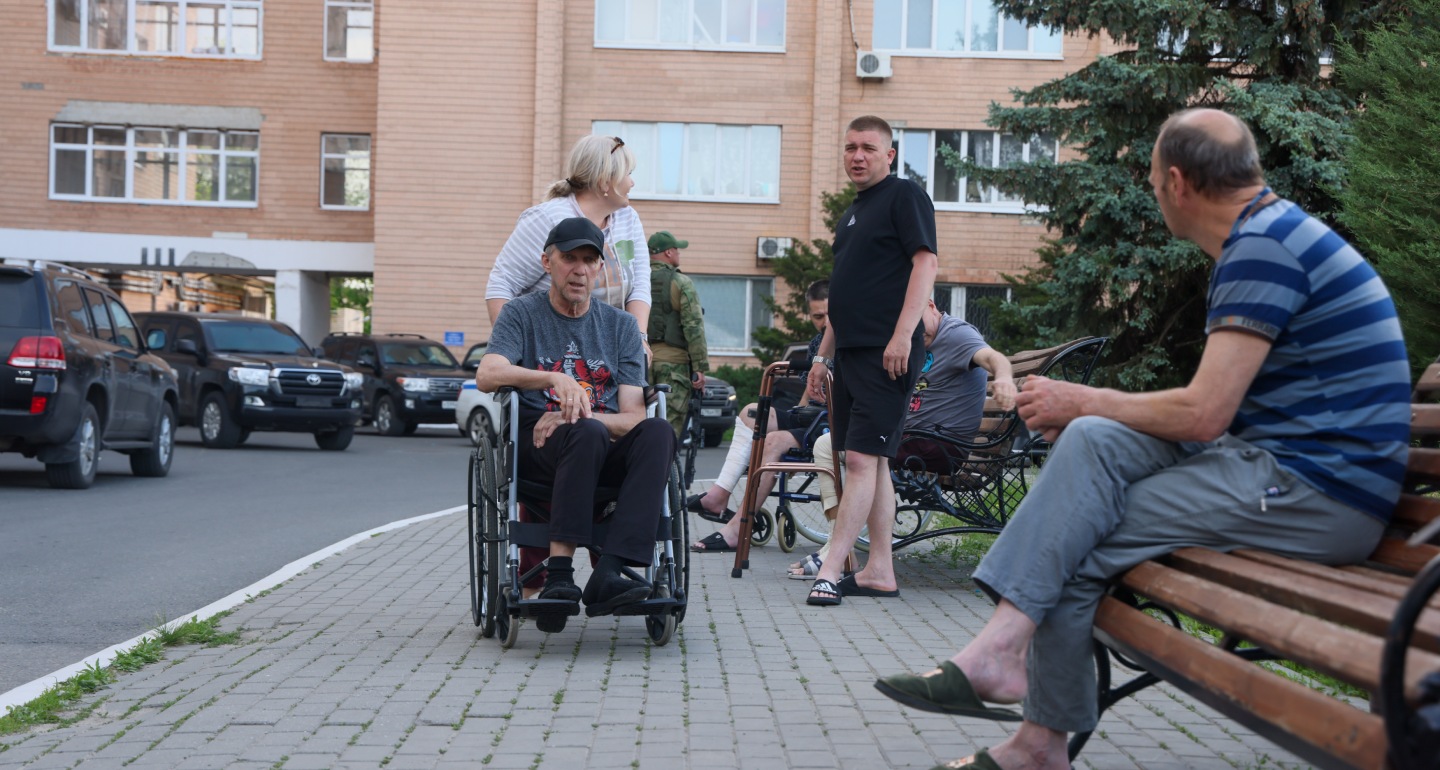
Despite unhappiness on the ground, Moscow is determined to use both carrot and stick to ensure there is record support for United Russia in occupied Ukraine.
The Kremlin is counting on State Duma elections going ahead in occupied Ukraine in September. The vast majority of people living in the Donbas region now hold Russian passports, but the ongoing fighting, social and economic issues, and the fallout from the local elite being pushed out by officials from Russia will make it harder for Kremlin managers to deliver the required result.
After the full-scale invasion of Ukraine in 2022, Russian citizenship was made compulsory for all those living under occupation. In the 2024 Russian presidential election, the annexed Donetsk People’s Republic (DNR) and Luhansk People’s Republic (LNR) delivered sky-high levels of support for Vladimir Putin. He got 95.3 percent in the DNR and 94.1 percent in the LNR—exceeded only by his results in Chechnya (98.9 percent) and the Siberian region of Tuva (95.3 percent).
However, the September parliamentary elections come at a tricky moment. The situation in the rear has worsened dramatically in recent months because of Ukrainian drone attacks on military infrastructure and logistical targets. Once considered a relatively safe city, Luhansk now experiences air raid sirens several times a day.
Both Luhansk and Donetsk have suffered regular supply chain disruptions, as well as fuel shortages. There have also been difficulties getting food to towns closer to the front: Rubizhne in the north of the Luhansk region, for example, was unable to procure enough bread.
In addition to war-related issues, economic decline and decaying infrastructure are fueling a social crisis. The fallout from a water supply breakdown in Donetsk during the summer of 2025 is ongoing (the pipeline supposed to deliver water is ineffective because construction was rushed and plagued by corruption). Instability has been exacerbated by Russian investors announcing plans to close most of the still-functioning coal mines. And there is a shortage of hospital beds because wounded soldiers are being redirected from overflowing military hospitals.
Nevertheless, the occupation authorities continue to encourage people from Russia to move to eastern Ukraine, luring them with relocation bonuses and generous salaries. This has led to rising property prices in Luhansk, Donetsk, and Mariupol, and anger at relatively wealthy Russians pricing locals out of the housing market.
The worsening security situation also risks compromising the elections. Theoretically, the security problems could be solved by switching to electronic voting, but that requires a reliable internet connection—and internet access is frequently blocked in an attempt to thwart the navigation capacity of Ukrainian attack drones. Martial law could be used as a reason to cancel elections, but that seems highly unlikely. The electoral process is already underway, and the Kremlin wants to show—at any cost—that all is well in the Donbas region, its poster child for neo-imperialist expansionism.
Local political managers responsible for delivering the electoral result required by the Kremlin are increasingly Russian bureaucrats who have replaced local elites. Between 2014 and 2026, the proportion of Russian officials in the DNR government rose from 13 percent to 48 percent, and from 3 percent to 35 percent in the LNR. All of the key positions in the DNR government are now occupied by Russians—mostly graduates of training programs set up by Kremlin deputy chief of staff Sergei Kiriyenko. They include DNR prime minister Andrei Chertkov (previously utilities minister in the Nizhny Novgorod region), first deputy prime minister Vladislav Ochnev (formerly an official in the Altai region), and deputy prime minister Vladimir Yezhikov (formerly at Russia’s trade and industry ministry).
The greater role played by “mainland” Russians has impacted United Russia’s party lists for the upcoming elections. The lists for Russia’s “new regions” (LNR, DNR and the occupied parts of Ukraine’s Zaporizhzhia and Kherson regions) all give top spots to federal-level politicians: State Duma deputy Viktor Vodolatsky, former human rights commissioner Tatyana Moskalkova, Russkiy Mir foundation head Vyacheslav Nikonov, and naval commander Vladimir Kasatonov.
In contravention of United Russia’s standard practice of giving the top spot on regional lists to local governors, the “new regions” lists do not include DNR head Denis Pushilin, LNR head Leonid Pasechnik, occupied Zaporizhzhia governor Yevgeny Balitsky, or occupied Kherson governor Vladimir Saldo.
Despite residents of the Donbas having every reason to be unhappy, the Kremlin appears determined to use both carrot and stick to ensure there is record turnout and record support for United Russia. As voting approaches, the authorities are likely to indulge in populism and fervent propaganda. At a recent meeting, Putin was shown talking about a huge building program in the occupied regions and demanding that officials ensure Russian-level living standards.
For those who might be tempted to go public with criticism of the authorities, officials have a wide range of repressive measures at their disposal. The remit of the security services is enormous, and “Ukrainian saboteurs” are regularly put on trial. While the DNR and LNR no longer have an international border with Russia, in reality it continues to exist—with all the attendant checks, interrogations, and searches.
It is true that the authoritarian political model of the LNR and DNR lends itself to modern Russian elections, where there is no competition and the results are determined in advance. Unlike other parts of occupied Ukraine—such as Russia-controlled Zaporizhzhia, where there was a public spat about the makeup of the local election commission in 2025—the system in the DNR and LNR is well established.
It is vulnerable, however. Increasingly dominated by appointees from the Russian “mainland,” the occupation authorities are losing touch with ordinary people. The military victory promised by the Kremlin appears more distant than ever, and no amount of populism can offset the mounting hardships of life in a combat zone. In such a situation, high turnout and overwhelming support for United Russia—the inevitable official result—is likely to be interpreted not as a sign of stability, but as hiding political failure with fakery.
The Kremlin’s determination to hold elections during wartime is part of its strategy of normalizing the conflict with Ukraine. But the longer the fighting goes on, the more this becomes a strategy of self-delusion—particularly when people can see the success of Kyiv’s drone campaign from the windows of their own apartments.

An independent journalist.
Recent Work
Konstantin Skorkin
Konstantin Skorkin
Carnegie does not take institutional positions on public policy issues; the views represented herein are those of the author(s) and do not necessarily reflect the views of Carnegie, its staff, or its trustees.

Japan’s long-term security policy is driven by concerns about China, and there is little appetite for (or interest in) pursuing a confrontation with Moscow.

James D.J. Brown
The truth of the strategic situation is that Europe and Russia are extremely unlikely to be able to “turn the page” on their confrontation within the next two decades.
Arkady Moshes

Russia spent years building a “sovereign internet,” concentrating web infrastructure exclusively within Russian territory. Ukrainian drone attacks have shown how vulnerable that approach has left the Russian internet.

Maria Kolomychenko

Putin’s conservative staffing policies and search for ever greater control have cemented parliament’s transformation into a bureaucratic appendage of the executive branch.

Andrey Pertsev

Russia’s AI-driven propaganda campaigns operate in a fragmented, chaotic, and often illogical manner. That’s not necessarily a problem for the Kremlin, though: It’s much easier to mimic genuine public debate that way.

Ilya Klishin