

Commentary
Galiya Ibragimova
{
  "authors": [
    "Galiya Ibragimova"
  ],
  "type": "commentary",
  "blog": "Carnegie Politika",
  "centerAffiliationAll": "",
  "centers": [
    "Carnegie Endowment for International Peace",
    "Carnegie Russia Eurasia Center"
  ],
  "englishNewsletterAll": "",
  "nonEnglishNewsletterAll": "",
  "primaryCenter": "Carnegie Russia Eurasia Center",
  "programAffiliation": "",
  "programs": [],
  "projects": [],
  "regions": [
    "Moldova",
    "Russia",
    "United States"
  ],
  "topics": [
    "Foreign Policy",
    "Security",
    "EU",
    "Global Governance"
  ]
}
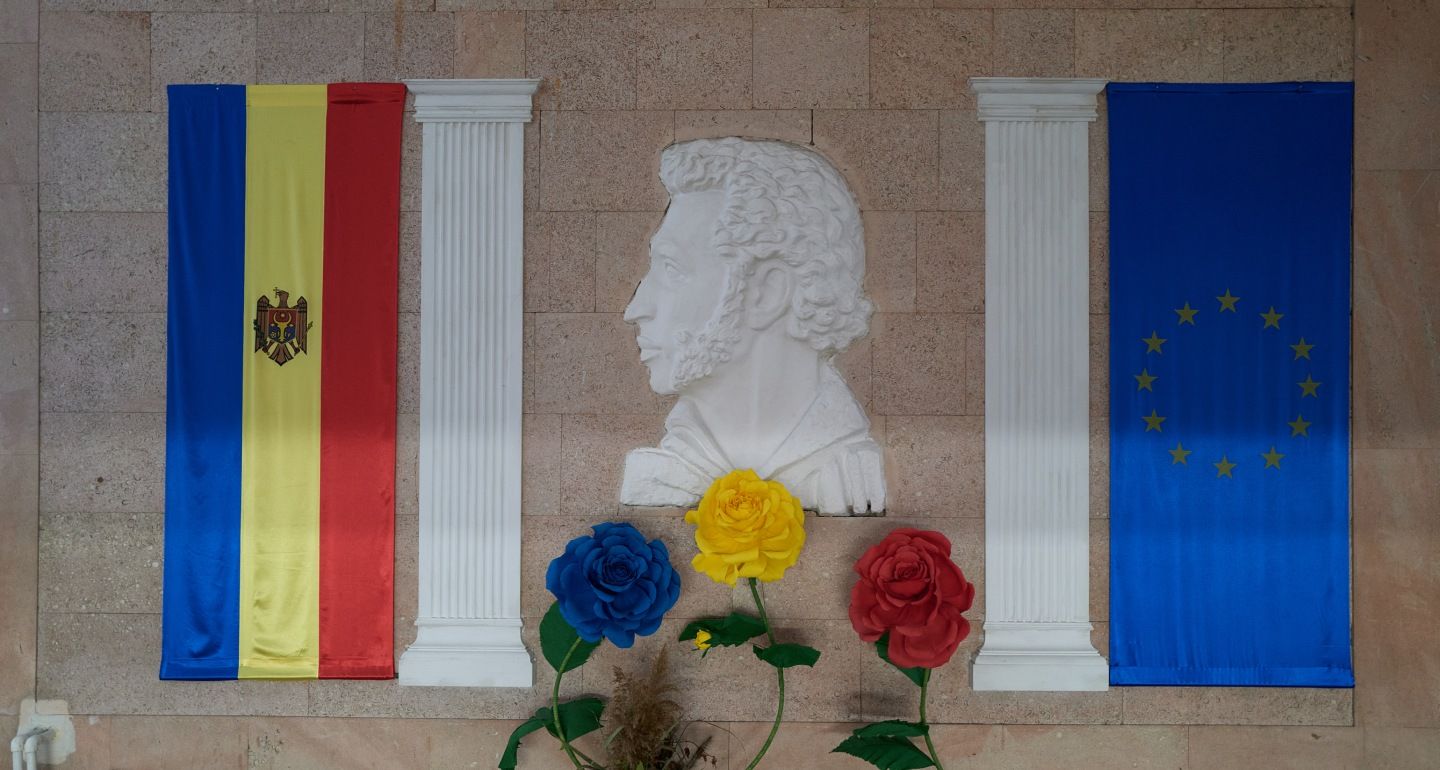
Source: Getty
A rebranded opposition and U.S. foreign policy are creating headwinds for Moldova’s pro-EU parties ahead of September elections.
Moldova has been anxiously following U.S. President Donald Trump’s pursuit of a deal with Russia to end the war in Ukraine. Until the Russian military threat to Kyiv is eliminated, Moldova is also at risk—whether that’s from a major military conflict in a neighboring country or Moscow’s constant attempts to destabilize the situation inside Moldova itself.
If the talks between Russia and the United States reach a stalemate, Washington is likely to lose interest in both Ukraine and the wider region. In that case, Chisinau would likely have to pursue EU integration without U.S. support—and in the face of growing Russian influence.
Unlike the post-Soviet countries of the South Caucasus and Central Asia, which were careful not to condemn Moscow for its full-scale invasion of Ukraine in 2022, Moldova quickly came out in full support of Kyiv, and to all intents and purposes froze relations with Russia. At the time, that seemed both morally justified and prescient. But today, amid the ongoing Russia-U.S. negotiations, it raises a thorny question: How will it impact Moldova’s foreign policy if Moscow ends up as Washington’s partner rather than its adversary?
Moldova’s anti-Russia stance means the country might find itself in Moscow’s crosshairs if there is even a short ceasefire in Ukraine. It’s unlikely to entail Russian military intervention, but political and media warfare is possible.
Furthermore, the West is no longer in a position to support Moldova as actively as it did after the full-scale invasion of Ukraine. Between February and October 2022, the United States gave Moldova over $250 million in aid, much of which went toward military modernization. In late 2024, Washington said it would soon have sent a total of $949 million to Moldova since February 2022, including for economic and humanitarian projects.
One of the projects due to receive funding from the U.S. Agency for International Development (USAID) was the construction of another power line between Romania and Moldova, designed to make Chisinau less dependent on the electricity, which Transnistria generates from imported Russian gas. The fate of that aid is now unclear after Trump slashed USAID funding. Independent media outlets, human rights organizations, and civil society initiatives in Moldova have also been affected by the USAID cuts, which will play into Moscow’s hands.
Of course, Moldova also has a close partnership with the European Union. But it’s unclear whether Brussels, which already allocates a large amount of funding to Moldova itself, is prepared to replace the lost U.S. aid.
Moldova’s response to Trump’s foreign policy is also complicated by domestic political divisions. The pro-EU Maia Sandu’s laborious path to victory in the 2024 presidential elections revealed that many Moldovans do not perceive Russia as a threat. For them, Trump’s calls for a normalization of relations with Moscow are more appealing than the Moldovan government’s uncompromising pursuit of EU membership.
One of the reasons for this is that Moldovans have enjoyed many of the advantages of EU integration—a visa-free regime and free trade—for many years already. Consequently, they are more angered by their government’s failure to address domestic problems (like corruption and inflation) than they are pleased by technical progress toward joining the bloc. In 2024, Moldovan GDP grew just 0.1 percent, and inflation hit 7 percent. Although the authorities successfully managed to stabilize the situation after the cessation of Russian gas supplies at the beginning of this year, they have not found a permanent solution to the energy issue.
All of this increases the opposition’s chances in September’s parliamentary elections. In addition, Moldova’s opposition is adapting to the new reality. If the main opponents of Moldova’s pro-EU politicians were once openly supportive of Russia, they have now repackaged themselves as advocates for national sovereignty, conservative values, and foreign policy pragmatism. Even ex-president Igor Dodon, who has never hidden his pro-Russian views, has indulged in this rebranding.
Those calling for pragmatic relations with both Russia and Europe include former prosecutor general Alexandr Stoianoglo, who narrowly lost to Sandu in the 2024 presidential runoff. He will take part in parliamentary elections as a member of the Alternative coalition alongside Chisinau Mayor Ion Ceban, ex-prime minister Ion Chicu, and the former Communist party ideologue Mark Tkachuk.
The coalition positions itself as an alternative to both the ruling pro-EU Party of Action and Solidarity (PAS) and Moldova’s traditional pro-Russian opposition. It has much in common with the rhetoric of European and U.S. conservatives who insist that international relations should be calibrated to the national interest. Symbolically, Ceban published a photo from an April meeting with Donald Trump Jr. in Romania with the caption “MAKE MOLDOVA GREAT AGAIN.”
PAS does not appear to have taken heed of these changes. Its main message—that only EU membership can ensure Moldova’s stable development—has remained unchanged since 2021. PAS likes to trumpet the fact that it secured EU candidate status for Moldova and the start of EU accession negotiations. The EU has also become a major source of financing for Moldova in recent years: Brussels has allocated money for roadbuilding, healthcare, education, and energy—and every visit by an EU official is accompanied by an announcement of more cash.
However, neither financial handouts nor symbolic gestures by the EU will be enough to ensure victory for PAS in September. If the ruling party does not adapt to the new reality by overhauling its political program, it risks electoral defeat.
Indeed, the chances of PAS getting an absolute majority in the parliamentary elections and forming a new government on its own are looking increasingly slim. A coalition government would inevitably lead to endless bickering and trade-offs, which would stall pro-EU reforms and possibly lead to waning interest in Brussels in advancing Moldova’s membership bid. For the moment, Trump’s foreign policy agenda means Brussels is focused on security issues and maintaining internal unity. There would be little appetite for getting involved in internal Moldovan disputes.
There is a growing possibility, therefore, that the issue of Moldova’s accession to the EU could slip back down the political agenda. That would once again leave Chisinau at risk of getting stuck in a gray zone—in both foreign and domestic policy.

Expert on Central Asia and Eastern Europe
Recent Work
Galiya Ibragimova
Galiya Ibragimova
Carnegie does not take institutional positions on public policy issues; the views represented herein are those of the author(s) and do not necessarily reflect the views of Carnegie, its staff, or its trustees.

Trump has promised Belarus a massive potash deal. But Minsk is seeking something greater: restored Western transit and greater room for maneuver from Russia.

Balázs Jarábik

The European far right might fail to steer EU policy in the direction Russia wants, but they will create enough chaos inside Europe to benefit the Kremlin.

Dimitar Bechev

Minsk clearly expected the dialogue with Washington to yield more results, in particular the lifting of EU sanctions and permission to export potash.

Artyom Shraibman

Russia’s ruling party would have benefited from Putin appearing as its distant patron, but as an active frontman imposing his views on the public, he has done nothing but harm both the party’s election campaign and the ruling system overall.

Andrey Pertsev

Depleted financial reserves and a shrinking tax base mean it is no longer possible to simultaneously deliver high defense spending, price stability, and economic growth.

Alexandra Prokopenko