

Commentary
James D.J. Brown
{
  "authors": [
    "James D.J. Brown"
  ],
  "type": "commentary",
  "blog": "Carnegie Politika",
  "centerAffiliationAll": "",
  "centers": [
    "Carnegie Endowment for International Peace",
    "Carnegie Russia Eurasia Center"
  ],
  "englishNewsletterAll": "",
  "nonEnglishNewsletterAll": "",
  "primaryCenter": "Carnegie Russia Eurasia Center",
  "programAffiliation": "",
  "regions": [
    "Japan",
    "Asia",
    "Russia",
    "China"
  ],
  "topics": [
    "Defense",
    "Security",
    "Political Reform",
    "Global Governance",
    "Foreign Policy"
  ]
}
Source: Getty
For a real example of political forces engaged in the militarization of society, the Russian leadership might consider looking closer to home.
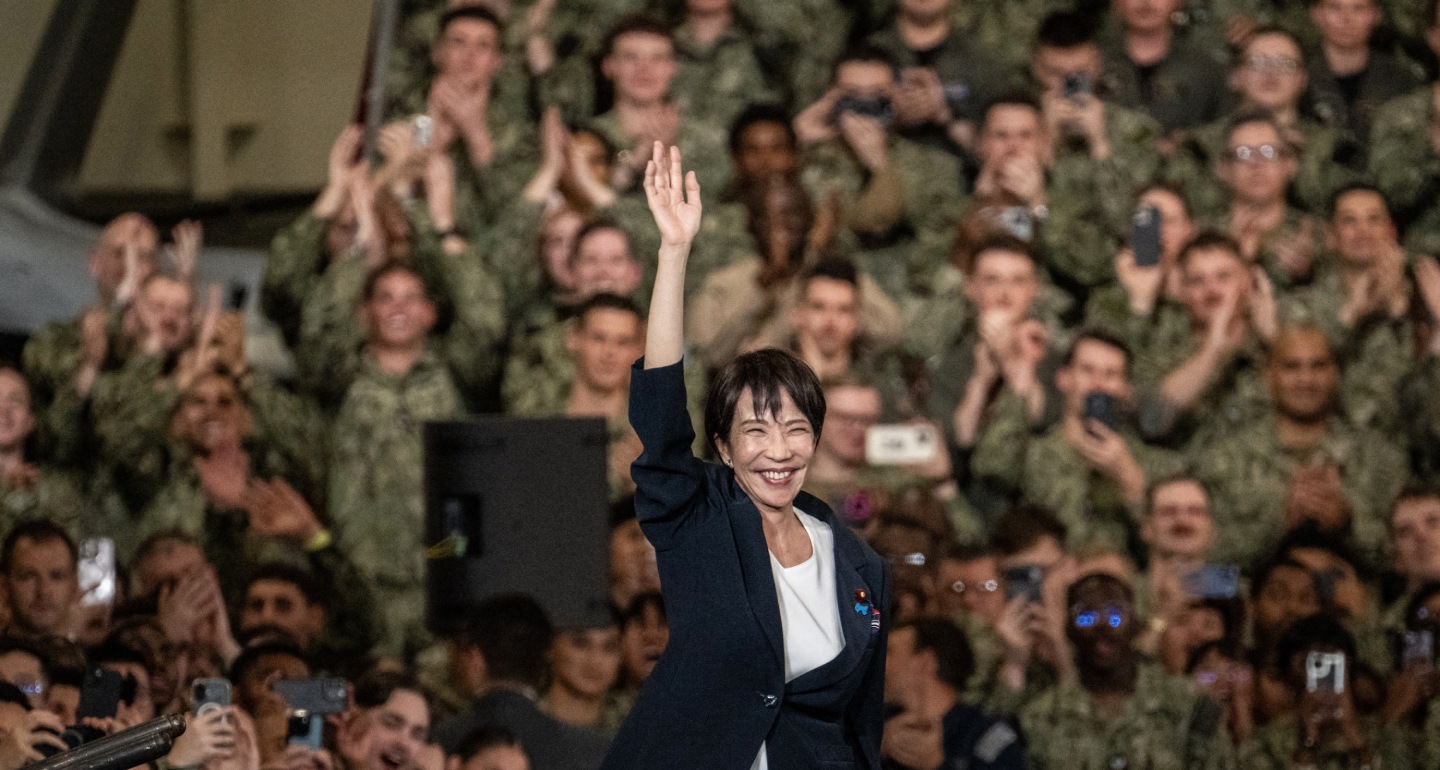
Japan goes to the polls on February 8. Prime Minister Sanae Takaichi called the snap general election just three months after taking power. Her calculation is that she can exploit the popularity of her honeymoon period to transform her government’s slim working majority into a commanding mandate for change.
With the approval rating of her cabinet at more than 60 percent at the end of January, most political commentators expect Takaichi’s gamble to pay off and for her Liberal Democratic Party, in combination with coalition partner Nippon Ishin no Kai (Japan Innovation Party), to be returned to government with a ringing public endorsement.
Not everyone welcomes this prospect. There are some who regard the conservative Takaichi as a threat to Japan’s postwar democracy and regional stability. In their view, she is an apologist for Imperialist Japan, and her hawkish foreign policy risks taking Japan back to the 1930s.
One of these critics is Sergey Lavrov. Speaking on January 20, the Russian foreign minister expressed “concern that, alongside Germany, certain unhealthy trends are also emerging in Japan, linked to the desire of some political forces to return to the militarization of society.”
Lavrov accused Takaichi’s government of seeking to change the country’s pacifist constitution and of building up offensive military potential. He also alleged that Japan’s leadership is discussing revision of the country’s non-nuclear status. Furthermore, Lavrov condemned Japan for conducting joint military activities with NATO members close to Russia’s borders. He took particular umbrage at Japan’s decision to permit the deployment on its territory of U.S. ground-launched intermediate-range Typhon missiles.
China similarly portrays Takaichi as a belligerent reactionary. On November 7, the Japanese prime minister told parliament that China’s use of force against Taiwan could constitute a “survival-threatening situation,” thus implying that Japan could deploy its Self-Defense Forces.
This provoked a fierce reaction from Beijing. A commentary in People’s Daily, the official mouthpiece of the Chinese Communist Party, condemned what it saw as interference in China’s domestic affairs. It stated that Takaichi’s comment “appears designed to justify Japan’s military expansion and carries the dangerous signal of a potential resurgence of militaristic tendencies in Japanese policy.”
Takaichi attracts domestic criticism too. Much of this centers on her proposal to introduce an anti-espionage law, a foreign agents’ registration law, and a National Intelligence Agency. Mizuho Fukushima of the opposition Social Democratic Party condemned these plans, saying: “This would create a surveillance society; it’s preparation for war.”
So, will a reelected Takaichi set Japan back on the path to authoritarianism and aggression? Will Japanese forces soon be threatening the Russian Far East and preparing to seize the disputed Southern Kuril Islands by force?
Nothing could be further from the truth.
First, while it is the case that Takaichi has brought forward the timeline to double Japan’s defense budget, that will merely take Japan’s defense spending to 2 percent of GDP. That is modest compared with the 3.5 percent that NATO members have committed to spend on core defense requirements by 2035, not to mention the 7 percent that Russia currently spends.
One might also note the irony of a Russian regime that started a war that has caused an estimated 1.8 million military casualties (both killed and wounded) accusing Japan, whose Self-Defense Forces (SDF) have never killed anyone since their creation in 1954, of militarism.
Japan’s increased defense expenditure is a matter of necessity, not choice. Japan is facing its most insecure international environment since 1945. It is surrounded by Russia, China, and North Korea: three nuclear-armed authoritarian regimes that regard Japan with hostility and are increasingly making common cause against it.
Russia exacerbates Japan’s insecurity through its military cooperation with North Korea. This was reiterated on January 29 by Defense Minister Shinjiro Koizumi when he stated: “What is North Korea aiming at with the new combat experience and know-how they have brought back from Ukraine? We must squarely face the fact that Japan is one of the targets.”
The situation is also made worse by Russia’s frequent military provocations. The latest came on January 21, when Russia sent two Tu-95MS strategic bombers toward Japan’s airspace, forcing the scramble of SDF jets.
Any government that did not strengthen its defenses in these circumstances would be negligent.
Second, Lavrov’s claim that Japan’s leadership is discussing revision of the country’s non-nuclear status is misleading. Prime Minister Takaichi remains committed to not possessing or producing nuclear weapons.
What is being debated is whether the United States should be permitted to introduce nuclear weapons onto Japanese territory during a crisis. Nothing has yet been decided. Moreover, since the United States has long been committed to defending Japan with nuclear weapons, this change is less fundamental than it seems.
Third, although Takaichi does aim to revise Article 9, the famous peace clause of Japan’s constitution, there is nothing new in that. Revision of this article has been the consistent ambition of the Liberal Democratic Party throughout the nearly seven decades it has ruled Japan since 1955.
Furthermore, revision is long overdue. The current clause states that “land, sea, and air forces, as well as other war potential, will never be maintained.” This causes confusion, since Japan already does possess land, sea, and air forces—albeit they are called Self-Defense Forces, instead of being referred to as a military. As such, a revision that acknowledges the existence of the SDF would not be an aggressive step, but merely bring the constitution in line with reality.
Lastly, there is nothing radical in Takaichi’s proposal to strengthen Japan’s defenses against foreign espionage. Currently, Japan is an oddity in being a major industrialized economy that does not have an explicit law against spying. This absence of legislation, along with the weakness of the country’s counterintelligence capabilities, has given Japan the reputation of a spy paradise. Moscow took great advantage of this during the Soviet era, including by allegedly recruiting Hirohide Ishida, a Japanese cabinet minister, during the 1970s.
Such espionage activities continue to this day. On January 20, the Tokyo police announced they had identified a suspected SVR (Russia’s foreign intelligence agency) officer who was posing as a trade official and had allegedly recruited a Japanese employee of a machine tool maker. In the absence of an anti-espionage law, the best the authorities could do was to charge the pair with violating Japan’s law on unfair competition.
Despite these unfriendly actions by the Russian state, there remains no sign of retaliatory Russophobia from the Japanese authorities. Tourist visas remain freely available, contributing to the record number of Russians who visited Japan in 2025. Furthermore, the Japanese government has again permitted the annual Festival of Russian Culture to be held in Japan in 2026.
Overall, rather than taking a militarist turn, Takaichi, like her immediate predecessors, is making reasonable defensive reforms to adapt Japan to a deteriorating security situation. For a real example of political forces engaged in the militarization of society, the Russian leadership might consider looking closer to home.

Professor of Political Science at Temple University
Recent Work
James D.J. Brown
James D.J. Brown
Carnegie does not take institutional positions on public policy issues; the views represented herein are those of the author(s) and do not necessarily reflect the views of Carnegie, its staff, or its trustees.
A leak of Russian gas price data helps establish that China is paying Russia far less than Central Asian countries and Gazprom’s former European customers.

Sergey Vakulenko

Japan’s long-term security policy is driven by concerns about China, and there is little appetite for (or interest in) pursuing a confrontation with Moscow.
James D.J. Brown

The truth of the strategic situation is that Europe and Russia are extremely unlikely to be able to “turn the page” on their confrontation within the next two decades.

Arkady Moshes

Russia spent years building a “sovereign internet,” concentrating web infrastructure exclusively within Russian territory. Ukrainian drone attacks have shown how vulnerable that approach has left the Russian internet.

Maria Kolomychenko

Putin’s conservative staffing policies and search for ever greater control have cemented parliament’s transformation into a bureaucratic appendage of the executive branch.

Andrey Pertsev