

Commentary
Vladimir Solovyov
{
  "authors": [
    "Vladimir Solovyov"
  ],
  "type": "commentary",
  "blog": "Carnegie Politika",
  "centerAffiliationAll": "",
  "centers": [
    "Carnegie Endowment for International Peace",
    "Carnegie Russia Eurasia Center"
  ],
  "collections": [
    "Politika: The Best of 2025"
  ],
  "englishNewsletterAll": "",
  "nonEnglishNewsletterAll": "",
  "primaryCenter": "Carnegie Russia Eurasia Center",
  "programAffiliation": "",
  "programs": [],
  "projects": [],
  "regions": [
    "Moldova",
    "Russia",
    "Europe"
  ],
  "topics": [
    "EU Foreign Policy",
    "Foreign Policy",
    "Security",
    "EU Enlargement"
  ]
}
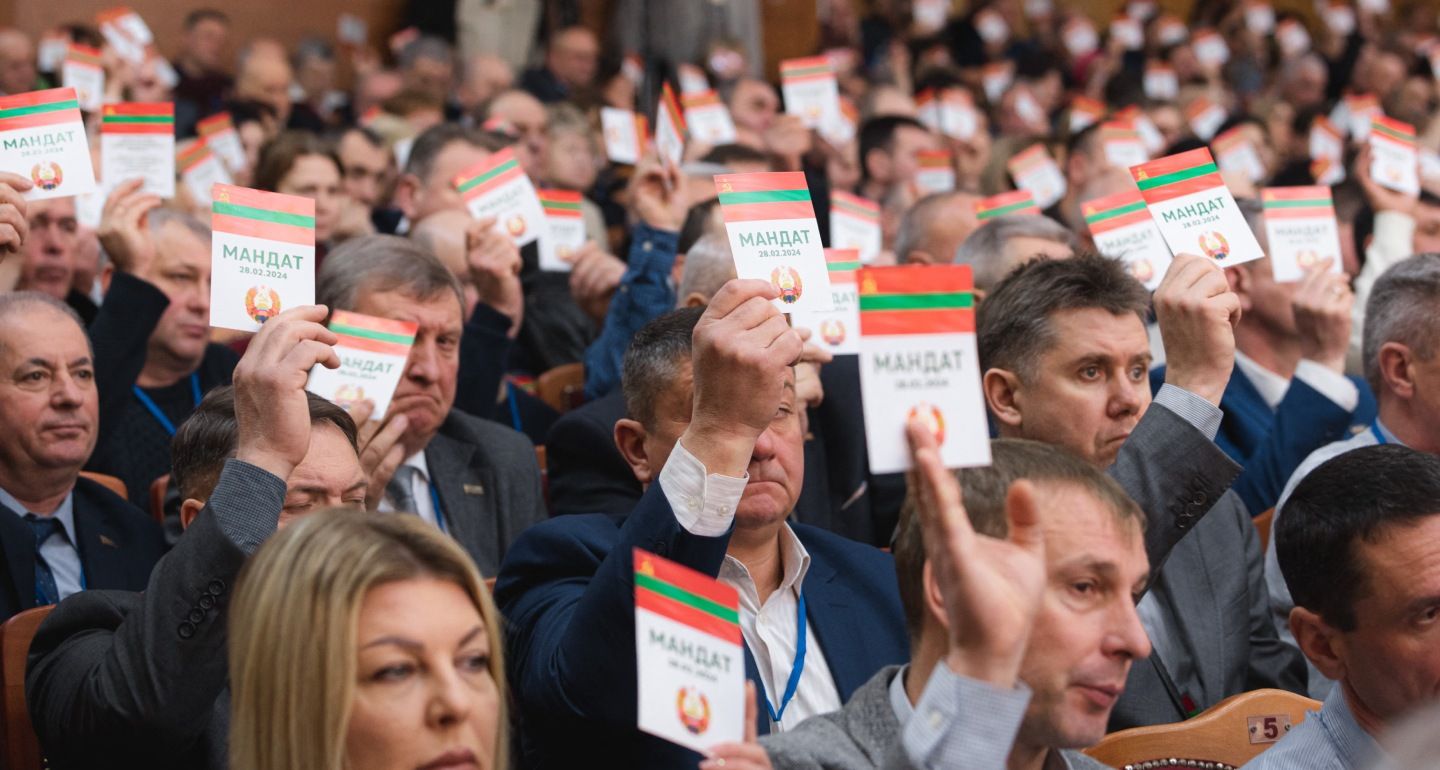
Source: Getty
The issue of withdrawing troops and tons of ammunition from the left bank of the Dniester River requires discussion with Russia, and the Moldovan authorities are not yet ready for that.
Following the victory of pro-EU forces in Moldova’s parliamentary elections this fall, the European Union has increasingly been pushing Chișinău to work on reintegrating the breakaway region of Transnistria. This month, the EU ambassador to Moldova, Iwona Piorko, made it clear that Brussels does not intend to divide the country’s EU integration into two stages, with the issue of Transnistria’s integration into the EU being resolved at a later date to that of the rest of the country. “There is only one Moldova, and negotiations are being conducted with it. We support reintegration efforts and expect the government to show increasing determination in this regard,” the diplomat said.
This is a reversal of Brussels’s previous position. Before the September parliamentary elections, EU representatives at various levels stated repeatedly that EU integration was a higher priority than Transnistria’s reintegration, and that the former could not and should not be dependent on the latter.
The old approach more than suited Chișinău: the current Moldovan authorities have shown little interest in a Transnistrian settlement. Until now, Chișinău’s tactic has been to avoid negotiations with Tiraspol and to gradually extend its economic jurisdiction over the region, which broke away amid a brief war during the collapse of the Soviet Union. The closure of the Transnistrian section of the Moldova–Ukraine border since the start of Russia’s war against Ukraine has enabled the Moldovan government to control imports into the unrecognized republic and to impose tariffs.
Eventually, however—and sooner rather than later, since Chișinău plans to join the EU in the next few years—the Moldovan authorities will have to grasp the nettle of the political component of integration.
Back in 2005, the Moldovan government passed a law establishing an “autonomous territorial entity with a special legal status—Transnistria—within Moldova,” with its own parliament (the Supreme Council). That law has never been repealed, but the current Moldovan government has avoided even mentioning the possibility of granting Transnistria special status.
Recently, Deputy Prime Minister for Reintegration Valeriu Chiveri said that the Moldovan government was developing a plan for the country’s reintegration with support from the EU and the United States, though he did not give any details. “We cannot disclose all the actions being taken in real time, as that could undermine the final outcome,” the official said.
Meanwhile, over the past few years, the Moldovan government has passed a raft of laws that could complicate any peace initiatives. In 2023, it made separatism a criminal offense. No one has yet been prosecuted under the law, but the possibility is there.
Secondly, amendments to Moldova’s law on citizenship will come into force on December 24 this year that will allow the country’s president to strip those who have joined “illegal armed formations, or the armed forces of an unconstitutional entity or an aggressor state” of their Moldovan citizenship. It’s not hard to guess that this is a thinly veiled reference to Transnistria and the contingent of Russia-backed peacekeepers stationed there.
The previous version of the law allowed the head of state to revoke the citizenship of those who had voluntarily enlisted in the armed forces of another state. President Maia Sandu has made use of that power, and recently issued a decree revoking the Moldovan citizenship of five residents of Transnistria serving in the Russia-led military contingent there.
Since the law doesn’t define the term “armed formations,” once the new amendments come into force, the president will be able to revoke the citizenship not only of those serving in the unrecognized republic’s army, but also of those working for the Transnistrian police, customs, penitentiary service, and other security agencies. With over 90 percent of Transnistria’s residents holding Moldovan citizenship, about 30,000 people could fall under the new law’s scope.
The apparent goal of tightening the law was to discourage Transnistrians from joining the security forces. But the problem is that while there’s a stick, there’s no carrot being offered in the form of alternative employment.
In addition, if Transnistrians start being stripped of their citizenship en masse, that could have the opposite effect and help consolidate the thousands-strong security services in Transnistria, which is unlikely to help the reintegration process. It also risks leaving thousands of people living in Moldova without citizenship.
As for Transnistria itself, its ruling authorities have repeatedly stated their willingness to negotiate with Chișinău on reintegration. For local elites, the ideal situation was the prewar period when the border with Ukraine was open, but those days are gone forever. The political leadership of the unrecognized republic may formally be allied with Moscow, but Transnistrian businesses have long been trading with the EU, and residents of the region are finding employment en masse on the right bank of the Dniester River—i.e., in territory controlled by Chișinău.
Access to European markets has become indispensable for maintaining the successful running of the Sheriff holding company that has established a regime of oligarchic authoritarianism in Transnistria. The region’s president and recently reelected Supreme Council are completely controlled by Sheriff, headed by former police officer Viktor Gushan.
The oligarch, who has been in charge of almost all matters (excluding the Russian military presence) in the self-proclaimed state since 2016, rules from the shadows and does not hold any official posts, but nothing is done in Transnistria without Gushan’s knowledge. In the changed geopolitical context, Sheriff’s omnipotence could paradoxically facilitate the reunification of Transnistria with Moldova, since there is effectively only one person required to get on board. It’s no coincidence that the EU has not yet imposed any sanctions against Gushan. The threat of sanctions, as is well known, is a more effective negotiating tool than restrictions that are already in place.
Moldovan Deputy Prime Minister Chiveri has said that Moldova’s key goal in the first stage of reintegration is the withdrawal of Russia-controlled troops from Transnistria. Chișinău constantly talks about this at various levels. The problem is that the issue of withdrawing troops and removing or disposing of the tens of thousands of tons of ammunition stored on the left bank of the Dniester requires discussion with Russia, and the Moldovan authorities are not yet ready for that. In Russia’s war against Ukraine, Chișinău is fully on Kyiv’s side and considers Moscow an enemy.
If the Washington-driven peace talks succeed in bringing an end to the war in Ukraine, that will inevitably revive the Transnistria issue. Moscow’s position on it has not changed: Russia believes Transnistria must be granted special status.
It was previously believed that a resolution to the conflict built upon this premise could if not halt then at least slow down or seriously complicate Moldova’s drift toward the West, and derail its pro-EU course. But the notion that the majority of residents of the unrecognized republic are exclusively pro-Russian is a cliché. In fact, when not prevented by the Moldovan authorities from getting to the polls, Transnistrians often vote for pro-EU forces during elections in Moldova.
In any case, it is now clearer than ever that the unresolved Transnistrian issue is an obstacle along Moldova’s path to EU membership—and Chișinău can no longer ignore it.
Journalist
Recent Work
Vladimir Solovyov
Vladimir Solovyov
Carnegie does not take institutional positions on public policy issues; the views represented herein are those of the author(s) and do not necessarily reflect the views of Carnegie, its staff, or its trustees.

Russia’s ruling party would have benefited from Putin appearing as its distant patron, but as an active frontman imposing his views on the public, he has done nothing but harm both the party’s election campaign and the ruling system overall.

Andrey Pertsev

Depleted financial reserves and a shrinking tax base mean it is no longer possible to simultaneously deliver high defense spending, price stability, and economic growth.

Alexandra Prokopenko
Blurring the line between humans and animals is a long-standing tradition in social utopian prose. In his latest novel, Leonid Bershidsky reminds us that in social experiments, people are often treated no differently than animals.

Alexander Baunov
While France and Australia are seeking to establish the legal obligations of messaging apps like Telegram, Russia wants total subordination.

Maria Kolomychenko
The recent uncovering of Dmitry Donskoy’s relics in the Cathedral of the Archangel is yet another attempt by the Russian Orthodox Church to help the state solve its problems. However, parroting the state’s version of Russian history leaves the Church with no message except “patriotism.”
Alexander Zanemonets