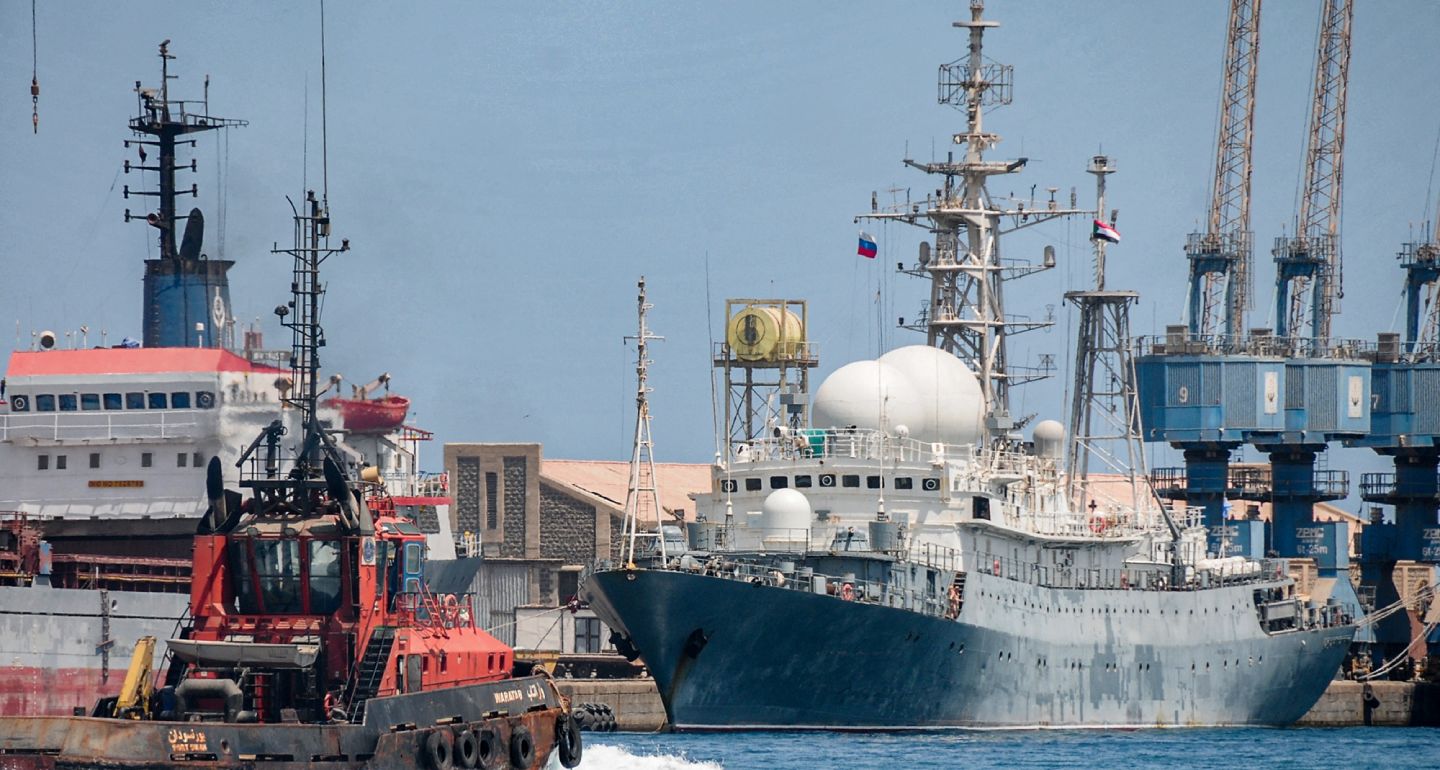
It will soon be ten years since Russia proudly announced that it would open a naval base in Sudan and become one of the powers controlling the Red Sea. Since then, Sudan has witnessed several regime overhauls and a civil war, while Russia itself has invaded neighboring Ukraine. Furthermore, a global shipping crisis is unfolding—not just in the Strait of Hormuz, but in the Red Sea as well.
The base has not been built, but nor has it been officially scrapped. Russia, adjusting to its current semi-pariah status, is trying to play its own game in Africa.
Russia’s actions in recent weeks might suggest that it has finally picked a side in the Sudanese civil war. At the UN on September 11, Russia blocked a U.S.-backed proposal to extend the arms embargo on Sudan’s Darfur region—which has been in place since 2005—to the entire country, stating that it “will not allow even a hint of broadening the restrictions.” Then, on September 25, Russian Foreign Minister Sergey Lavrov pointedly met with his Sudanese counterpart Mohi al-Din Salem five days after Massad Boulos, the U.S. presidential advisor on Africa, noted that Washington does not recognize the government behind the Sudanese army and maintains contact with it only as the de facto authority.
In reality, Moscow has simply sided with the people it thinks are winning now. As a former Russian diplomat stationed in Khartoum from 2014–2018, I can attest that this is typical of Moscow’s policy in Sudan and across Africa more broadly. At every turn in Sudan’s recent history, the Kremlin has merely reacted to events unfolding there—belatedly every time. Russia’s Red Sea base has fallen victim to its erratic policy.
There are no Russian–Sudanese relations as such, nor have there ever been. There is only the personal relationship between Russian President Vladimir Putin and whoever happens to be ruling Sudan at a given time. The Kremlin has been forced to negotiate at the highest level with at least three different people over the past nine years. Every upheaval in Sudan wiped out everything both sides had agreed upon prior to it, forcing Moscow to build its relations from scratch each time.
Blood Gold
Moscow began negotiations on establishing a naval base on the Red Sea at a time when Sudan was still ruled by Omar al-Bashir, who had come to power through a coup d’état in 1989. According to the Kremlin’s transcript, during a November 2017 visit to Sochi, al-Bashir said: “We need protection from aggressive U.S. actions,” and proposed discussing “the use of military bases in the Red Sea.”
Around the same time, according to the U.S. Treasury, the infamous Russian mercenary leader Yevgeny Prigozhin’s company, M-Invest, secured concessions for gold exploration in Sudan. Its Sudanese subsidiary, Meroe Gold, was registered that summer.
To cut costs and increase profits, mining at the Meroe Gold deposits utilized primitive methods and relied on cheap—in effect, slave—labor provided by hundreds of local residents. Despite the dangerous use of mercury, Sudanese workers were not provided with any protective equipment. According to my sources, many of them suffered severe chemical poisoning and even died. Sudanese citizens who attempted to protest against these abuses by the Russians were subjected to brutal persecution by Prigozhin’s Wagner Group mercenary army—with the tacit complicity of the al-Bashir regime’s law enforcement agencies.
The most high-profile of these incidents occurred near the settlement and gold mine of the same name, Abu Hamad, in the River Nile State. In 2017, a major protest broke out there against Russian gold miners and the environmental pollution they were causing. While suppressing the protest, mercenaries from the Wagner Group fired on demonstrators with automatic weapons.
According to unofficial reports, at least seventy-three people, including children, were killed in the shooting at Abu Hamad. Russia, which regularly accuses European countries of colonial crimes committed in past centuries, behaved no better in 21st-century Sudan. Not only did the Khartoum government do nothing to prevent the massacre of its own citizens, it also went to great lengths to conceal information about this and similar incidents.
According to documents obtained by the Organized Crime and Corruption Reporting Project (OCCRP) and Le Monde, M-Invest paid millions of dollars to Aswar Multi Activities, a company run by Sudanese military intelligence. In addition, the country’s presidential administration ceded the state’s right to a 30 percent stake in a number of projects to Meroe Gold. The Russian gold miners’ aircraft flew under military call signs and were not subject to tracking, which would not have been possible without patronage from the highest echelons of Sudanese power.
Change at the Top
Apparently, the Kremlin only needed to buy off one person in Sudan to achieve all this. However, that meant that when that person went, so did all Russia’s gains. In April 2019, amid mass street protests involving thousands of people, Sudanese generals, including Muhammad Hamdan Dagalo Musa, known as Hemedti, overthrew President al-Bashir.
Following the coup, power in Sudan formally passed to General Abdel Fattah al-Burhan, chairman of the Transitional Sovereignty Council. Hemedti became his deputy. Unlike Hemedti, who was well known for his ties to Prigozhin’s private military company, al-Burhan was a complete unknown to the Russian government. Even in the numerous reports, briefings, and coded telegrams my colleagues and I prepared for Moscow, his name never came up. No one understood who he was or whose side he was on. This little-known figure had suddenly been catapulted into Sudan’s highest office.
It is therefore not surprising that Putin’s foreign policy—which is both ultra-personalistic and overly conformist—did not immediately know what to do with someone like al-Burhan. For a long time afterward, the Kremlin continued to liaise with Hemedti, whom they knew from the al-Bashir regime, while formally supporting al-Burhan’s Transitional Sovereignty Council.
No one saw this as a problem at the time. It would become one later, when the two men declared war on each other. In the early 2020s, however, a potential conflict was completely off the Kremlin’s radar.
In 2020—the same year the U.S. Treasury sanctioned M-Invest and Meroe Gold for serving as fronts for the Wagner Group in Sudan and developing “plans to suppress protesters calling for democratic reforms”—the Russian government submitted an agreement on establishing a naval logistics base in the Red Sea for Putin’s approval. The president accepted the proposal, and the agreement was signed in December.
The agreement granted Russia the right to station up to 300 military or civilian personnel in Port Sudan, as well as up to four ships at any given time, including nuclear-powered vessels. It was valid for twenty-five years. Sudan gave Russia use of the stretch of coastline with the docks free of charge.
However, this arrangement began to unravel as early as 2021. The Sudanese signature was affixed in Khartoum on July 23, 2019 on the Transitional Sovereignty Council’s behalf, three months after al-Bashir’s ouster. The Russian one came much later—in Moscow on December 1, 2020. Putin submitted the agreement to the State Duma for ratification in July 2021—and almost immediately afterward, Khartoum announced that it would revise the agreement. They claimed that the document had been drafted under the previous regime without taking current national interests into account and had not been approved by the Sudanese parliament.
In October of that same year, al-Burhan and Hemedti dismantled the civilian wing of the Sudanese government, which had been the last remaining counterweight to Sudan’s warring security forces. Each of them set out to seize full power for himself.
In Moscow, officials continued to pretend that nothing was afoot. Deputy Foreign Minister Mikhail Bogdanov told Interfax that the Russian military was handling the issue of a Red Sea base, and that according to them, “everything is proceeding as planned.”
In February 2023, Lavrov flew to Khartoum to meet separately with al-Burhan and Hemedti. Following the visit, he announced that the base agreement had been revised and that the document was now awaiting ratification by the Sudanese parliament. The minister was, of course, aware that the Sudanese parliament no longer existed. He may have even suspected that his interlocutors would start shooting at each other in a couple of months.
All-Out War
On April 15, 2023, Hemedti’s Rapid Support Forces (RSF) attacked the army, and Sudan plunged into a brutal civil war that continues to this day. The Kremlin initially found itself on a side it had not chosen. That decision had been made back in 2017 by Prigozhin, for whom it was more advantageous to deal with President al-Bashir and his associate Hemedti, who controlled gold mining operations.
Prigozhin was killed in 2023, and his armed units were reorganized into the “Africa Corps” now controlled by the Russian Defense Ministry. All that remains of Prigozhin’s legacy in Sudan today is a smattering of fighters—possibly no more than a few hundred, according to independent estimates. The only tool Prigozhin used to execute Putin’s entire Sudan “policy” disappeared along with him—and that was all the Kremlin had.
Speaking at the UN Security Council on March 7, 2024, Moscow spoke for the first time about the “Sudanese government’s” (Al-Burhan’s) willingness to compromise and called on the “other side” (Hemedti) to put national interests before “personal ambitions.” The next day, Russia abstained from voting on a resolution calling for a ceasefire during Ramadan, which would be disadvantageous to the army, which at that time was fighting the RSF to retake the suburbs of Khartoum.
Since then, every subsequent move by the Kremlin in Sudan has followed frontline developments almost beat for beat. In late April, Russian Deputy Foreign Minister Mikhail Bogdanov visited Port Sudan and affirmed that Russia recognized the Transitional Sovereignty Council as the legitimate representative of the Sudanese people. A week earlier, Moscow had hosted Ahmed Mufaddal—the head of Sudanese intelligence under al-Burhan’s government—through whom Russia reportedly offered the Sudanese army “unlimited high-quality military aid.”
On October 21, 2024, the RSF shot down an Il-76 cargo plane over North Darfur that was carrying supplies for the army from Port Sudan to the besieged city of El Fasher, with two Russians and three Sudanese military personnel on board. Using flight-tracking data, Reuters journalists established that the plane had until November 2023 been carrying RSF cargo via Chad, before switching sides in December to serve the army.
Changing Allegiances
On November 18, 2024, Russia cast its first solo veto in the UN Security Council in support of the Transitional Sovereignty Council—opposing a British draft resolution calling for a ceasefire in Sudan. One diplomat on the Security Council, speaking to AFP on condition of anonymity before the vote, noted that Russia had appeared to become “visibly more aligned” with al-Burhan’s camp. Al-Burhan himself officially welcomed the Kremlin’s decision that same day, and three weeks later, his acting foreign minister personally thanked Russian Ambassador Andrei Chernovol for Russia’s alleged “foiling of a major conspiracy aimed at foreign interference.”
According to UN data, as of October 2026, there were approximately 11.3 million forcibly displaced people in Sudan—more than the combined total of refugees and internally displaced persons from Ukraine. More than 150,000 people have been killed. On October 26, 2025, after an eighteen-month siege, the RSF captured El Fasher, the capital of North Darfur state. The UN Human Rights Office documented more than 6,000 killings in the first three days and at least 60,000 over the course of three weeks.
This violence in Darfur, which the United States officially recognizes as a genocide, was carried out by the very same Janjaweed militants, now known as the RSF, whom the Kremlin had long considered its main partners in Sudan. While Hemedti’s militants were massacring the residents of El Fasher, al-Burhan’s government submitted a new proposal to Moscow regarding the naval base.
By 2026, the army had recaptured Khartoum and most of Kordofan—and Russia stood as a bulwark against the expansion of the arms embargo. Moscow’s explanations in the Security Council are disarming in their candor. Why, they ask, did no one raise the issue of the embargo in 2023, “when the RSF threatened to capture Khartoum?” Is it being raised today because “the government and its armed forces have an indisputable advantage on the ground?”
Moscow is openly admitting that the Kremlin is willing to support only those who can win even without its backing. Russia’s “policy” sails in whichever direction the circumstances take it. The only real question is who is doing the steering.
In February 2024, Chernovol, the ambassador, explained that Sudan “had not yet been able to complete” the ratification of the naval base agreement “due to the dissolution of parliament.” A year later, Sudanese Foreign Minister Ali Yousif, standing next to Lavrov in Moscow, reported that “Sudan and Russia have reached a mutual understanding on the agreement regarding the Russian naval base.” In November 2025, Chernovol stated: “Given the current military conflict, progress on this issue has been suspended for now.”
The Wall Street Journal listed the main provisions of the new Sudanese proposal the following month. It is an exact replica of the 2020 draft agreement. In the five years since the document’s inception, absolutely nothing has changed—except the people who signed and commented on it.
Bargaining Chip
According to the Sudan Tribune, during a meeting with Saudi Arabia’s Crown Prince Mohammed bin Salman in December 2025, al-Burhan assured Riyadh that the plan for a Russian base had been put on hold and promised to keep it that way for as long as necessary. It would appear that the Sudanese pull talk of the coveted Red Sea base out of their pockets whenever they need to bargain with Western countries, only to tuck it away again as soon as they get a rebuke from Riyadh.
From 2022 to 2024, Sudan consistently abstained from voting on all UN General Assembly resolutions regarding Ukraine. On February 24, 2025, it voted against both European and American resolutions. In December 2025, it voted against a resolution on the return of Ukrainian children (joining the dubious ranks of just twelve countries). Even Egypt and Saudi Arabia—the very countries that are currently arming the Sudanese army—abstained.
In other words, Khartoum has been voting more strongly in favor of Moscow than its own sponsors—presumably as a way of settling all its accounts with Russia. It is doing so using the cheapest currency in international politics: its UN vote, which carries no real weight. Yet the Kremlin appears to be willing to accept even this as payment—its room for maneuver in Sudan has shrunk that much.
Al-Burhan’s army currently enjoys the support of several sponsors: Egypt, Saudi Arabia, Türkiye, and Iran. The table is already crowded, even without Russia. The RSF is backed by the United Arab Emirates—the main hub for circumventing sanctions against both Russia and Sudan, including those related to the gold trade.
Taking the army’s side once and for all would bring Russia into conflict with Abu Dhabi. Remaining on the RSF’s side is also out of the question—they are losing. As a result, the Kremlin finds itself a junior partner in a foreign coalition, capable only of leasing out its UN Security Council veto power.
It is easy to see why Russia failed to establish a base in Sudan. For one, the base was not conceived as an extension of Russia’s Sudan policy; rather, it was one more step in its confrontation with the West. Two coups and a major civil war threw a monkey wrench in the Kremlin’s plans, and it has not caught up since. Every major turning point in Sudan’s history has found Moscow several steps behind. Bad luck isn’t to blame: This is what happens when state-to-state relations are replaced with personal ties under an ineffective, corrupt leader.
It is now obvious that a Russian base in Port Sudan is off the table as long as the country is embroiled in civil war. Riyadh and Washington will not allow that to happen, and al-Burhan needs them—not Moscow—above all else.
Nor will there be any base even after the war, however. If the Sudanese army emerges victorious, it will chiefly need to settle its accounts with Cairo, Riyadh, and Ankara, who supplied weapons. At best, Russia might receive a flowery telegram thanking it for exercising its veto power. The Kremlin’s vision of Red Sea dominance is—and perhaps will remain—a mirage.