

Q&A
Suzanne Maloney, Aaron David Miller, Karim Sadjadpour
{
  "authors": [
    "Karim Sadjadpour"
  ],
  "type": "legacyinthemedia",
  "centerAffiliationAll": "dc",
  "centers": [
    "Carnegie Endowment for International Peace"
  ],
  "collections": [],
  "englishNewsletterAll": "menaTransitions",
  "nonEnglishNewsletterAll": "",
  "primaryCenter": "Carnegie Endowment for International Peace",
  "programAffiliation": "MEP",
  "programs": [
    "Middle East"
  ],
  "projects": [],
  "regions": [
    "North America",
    "United States",
    "Middle East",
    "Iran"
  ],
  "topics": [
    "Political Reform",
    "Foreign Policy"
  ]
}
Source: Getty
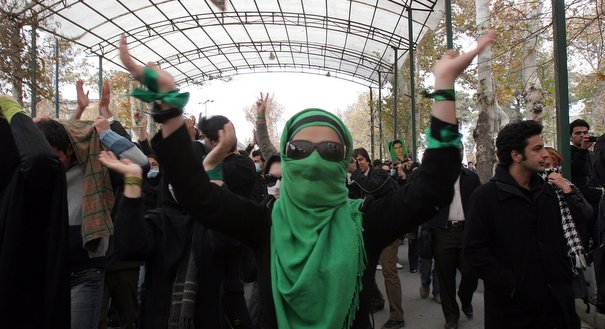
The large crowds we witnessed last week in Tehran may have subsided for now, but the uneasy calm is misleading.
Source: The Independent

The Iranian regime -- which increasingly implies Supreme Leader Ayatollah Ali Khamenei, a turbaned Shah with a medieval mindset -- has not left itself much room to maneuver. Khamenei strongly supported President Ahmadinejad’s bid for reelection, referred to his “victory” as a “divine blessing,” and denounced allegations of fraud.
Despite the popular outcry, Khamenei is unlikely to cede ground, believing that compromise projects weakness and could embolden the opposition and the population. The Guardian Council—an important governmental organ which Khamenei has at his disposal—said Friday that allegations of election fraud by the opposition had proved groundless. “After ten days of examination we did not see any major irregularities,” said spokesperson Abbasali Kadkhodai, quite predictably. “I can say with certainty that there was no fraud in the election.”
In order to enforce Khamenei’s edicts, the regime’s shock troops will continue to have full authorization to use force, and the more radical elements of the Bassij militia -- kind of a cross between the Hell’s Angels and Al-Qaeda -- continue to do so with great enthusiasm.
Despite the popular outcry, Khamenei is unlikely to cede ground, believing that compromise projects weakness and could embolden the opposition and the population
What's significant, however, is that Khamenei's normally trusted servants have begun publicly expressing their misgivings about an election result which privately left many of them simmering. Ali Larijani, the powerful speaker of the parliament, declared that opposition leader Mir Hossein Mousavi should be given a chance to voice his views on official state TV.
The popular mayor of Tehran, former Revolutionary Guard commander and Ahmadinejad foe Mohammed Bagher Ghalibaf, has asked that people be allowed to protest peacefully. And though the conservative Iranian parliament was invited to attend a celebration for Ahmadinejad’s victory, only 105 of 280 MPs bothered to show up.
This is not to mention the sense of outrage and injustice among the opposition, as well as wide swaths of Iranian society, which is unlikely to subside anytime soon. On the contrary, the regime’s indiscriminate use of violence -- graphic videos show how women, the elderly, and even children have been targeted -- has only further eroded people’s respect for the government.
The scale of the demonstrations has decreased, given the regime’s use of overwhelming force and its ability to limit people’s movements in Tehran -- a sprawling city not unlike Los Angeles -- preventing large masses from gathering in the same place.
Making predictions about Iranian politics has always been a fool’s errand, but suffice it to say, the future of the Islamic Republic as we know it has never appeared more tenuous
The crackdown has moved the opposition into a new phase. Instead of mass rallies, they are now focusing on civil disobedience, including strikes among merchants (bazaaris), laborers, and key arteries of the Iranian economy (like the petroleum industry and oil ministry). So far, these strikes have seemingly failed to pick up steam, given that much of the opposition is either in prison, under house arrest, or unable to communicate. But in suppressing the opposition, the regime has been forced to show its true colors.
Making predictions about Iranian politics has always been a fool’s errand, but suffice it to say, the future of the Islamic Republic as we know it has never appeared more tenuous.


Senior Fellow, Middle East Program
Karim Sadjadpour is a senior fellow at the Carnegie Endowment for International Peace, where he focuses on Iran and U.S. foreign policy toward the Middle East.
Recent Work


Suzanne Maloney, Aaron David Miller, Karim Sadjadpour

Aaron David Miller, Karim Sadjadpour, Robin Wright
Carnegie does not take institutional positions on public policy issues; the views represented herein are those of the author(s) and do not necessarily reflect the views of Carnegie, its staff, or its trustees.

If the Russian-speaking community in Latvia cannot articulate their interests without being seen as disloyal, they could end up embracing a pro-Kremlin agenda.

Sergejs Potapkins

Russia’s ruling party would have benefited from Putin appearing as its distant patron, but as an active frontman imposing his views on the public, he has done nothing but harm both the party’s election campaign and the ruling system overall.

Andrey Pertsev

In the tenth year of his presidency, President Mirziyoyev’s system is becoming even more personalized than that of his predecessor Karimov.

Galiya Ibragimova

With the growth in points of friction between the great powers, organizations like the SCO will continue to play a role in the strategic adaptation of the smaller powers caught between them.

Temur Umarov

The greater threat to Zelensky comes not from Fedorov alone, but from the convergence between the former defense minister’s political campaign and the anti-corruption investigations moving ever closer to the presidential administration.

Balázs Jarábik