

Commentary
Sergey Vakulenko
{
  "authors": [
    "Sergey Vakulenko"
  ],
  "type": "commentary",
  "blog": "Carnegie Politika",
  "centerAffiliationAll": "",
  "centers": [
    "Carnegie Endowment for International Peace",
    "Carnegie Russia Eurasia Center"
  ],
  "englishNewsletterAll": "",
  "nonEnglishNewsletterAll": "",
  "primaryCenter": "Carnegie Russia Eurasia Center",
  "programAffiliation": "",
  "projects": [
    "The Future of Russian Power"
  ],
  "regions": [
    "Russia"
  ],
  "topics": [
    "Energy",
    "Climate Change",
    "Trade",
    "Global Governance",
    "Foreign Policy"
  ]
}
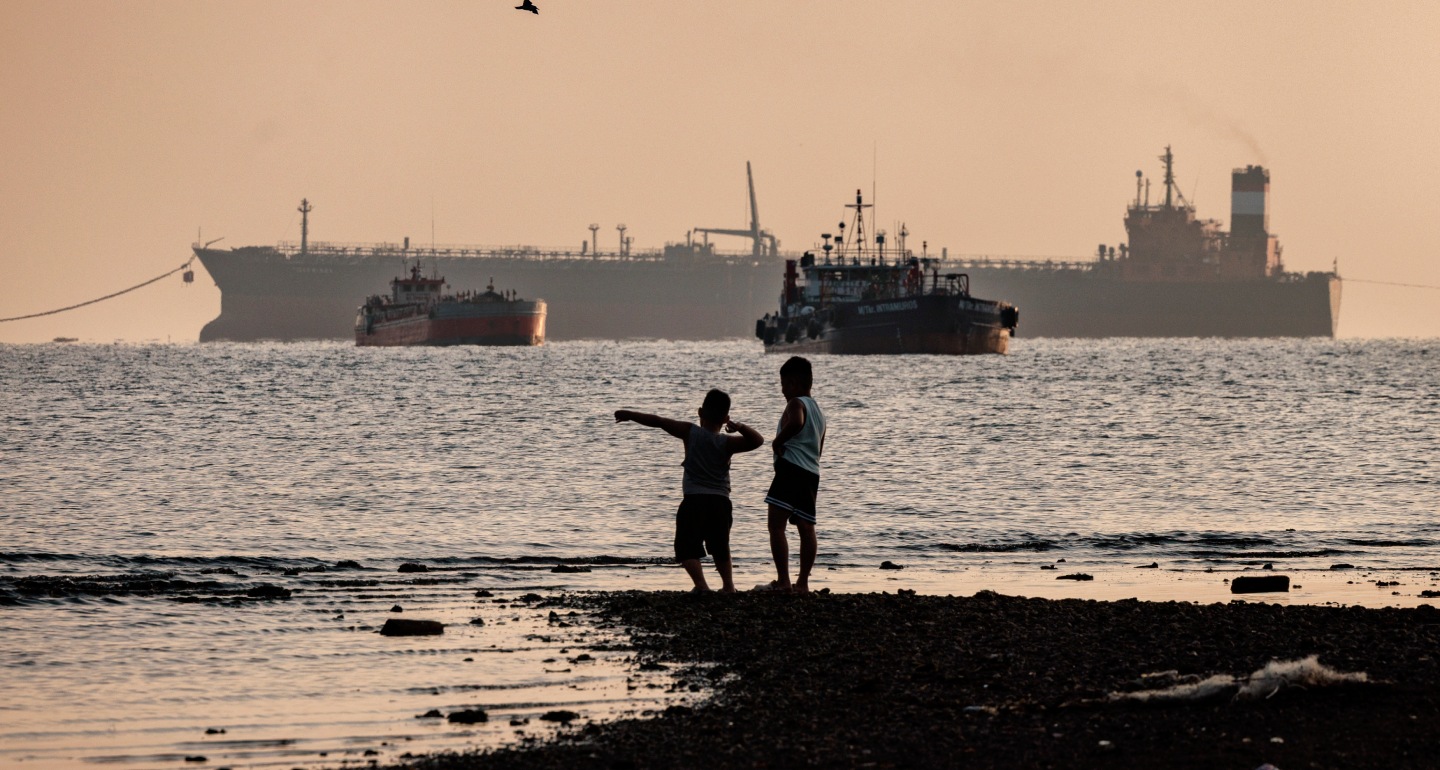
Source: Getty
Although Ukrainian strikes have led to a noticeable decline in the physical volume of Russian oil exports, the rise in prices has more than made up for it.
Russia’s oil industry has faced two contradictory trends in recent weeks. On the one hand, Iran partially closed the Strait of Hormuz in response to U.S. and Israeli strikes, prompting a rise in global energy prices—including of Russian oil. On the other hand, Ukraine stepped up its attacks on Russia’s oil export infrastructure, including key ports, in an effort to reduce Moscow’s energy revenues. What is the net effect of these two opposing trends?
Repeated attacks by Ukraine’s armed forces between March 25 and April 11 caused the daily volume of Russian oil and petroleum products shipped from Russian ports to fall to an average of 3.5 million barrels per day: a very significant decline from the average 5.2 million barrels per day shipped between January 1 and March 24 of this year.
In total, Russia lost about 30 million barrels (4.2 million tons) in foreign sales from March 25 to April 11. Combined with market data on prices and ship tracking system data, this figure makes it possible to assess the scale of Russia’s losses.
Some of the lost volumes simply burned up in storage tanks in the ports of Primorsk and Ust-Luga during the attacks. Assuming a worst-case scenario for Moscow in which all the damaged tanks were filled to the brim and nothing was salvaged, those losses would amount to 0.55 million tons.
The rest of the export shortfall likely accumulated in the tank farms of Transneft and other oil companies. They certainly have sufficient capacity: according to 2021 data, Transneft alone had storage capacity for 20 million tons. Refineries also have comparable total capacity, and it’s unlikely that all of them were more than 90 percent full, so Russia had no need to reduce production.
That means that the oil not exported due to the Ukrainian strikes was not lost per se, but will simply be sold at a later date. The most badly damaged terminal in Ust-Luga had resumed loading by April 7, and over the following two weeks managed to send out half of the pre-strike volumes.
When fully operational, the terminals can get very large volumes of oil on their way to market at a high speed: on some days in 2025 and 2026, Russia’s marine terminals together shipped more than 8.5 million barrels per day. Of course, that could change if the attacks continue and lead to extended terminal shutdowns. But there are no grounds yet to believe that Russia has already been forced to reduce production or is close to doing so.
Still, even under these circumstances, Ukraine’s attacks could result in losses for Russia: if the sale of some oil has to be postponed during this period of high prices caused by the war in the Middle East to a later date when the situation may have stabilized and global prices may have fallen, for example. However, the opposite is also possible: that over time, the conflict could worsen, pushing prices even higher, thereby making delayed exports more profitable for Moscow.
Calculating who in Russia is losing out from reduced exports—and by how much—is not straightforward. For the state, the volume of exports is not the most important factor, since payments into the state budget are calculated based on upstream production volumes and average monthly prices for Russian oil in the Baltic and Black seas and in the Pacific. As long as the fall in exports doesn’t lead to a fall in production, the Russian budget may even benefit from the strikes on port terminals, since reduced supply leads to higher prices.
For companies, the calculations are more complicated. Only a small proportion of Russian oil is sold at Russian ports: most sales take place six to eight weeks later when the oil arrives at ports in China and India. There, oil is sold either at local spot prices or, more commonly, according to pricing formulas, which are calculated based on the prices of benchmark crude grades with some averaging.
In March, for example, Russian exporters received higher, post-Iran war prices for oil that was shipped back in January 2026 or even December 2025. Similarly, the decline in shipments at the end of March will have minimal impact on real revenue until May.
With this in mind, it is still possible to make an indicative calculation based on shipping data and daily Urals crude prices at the Baltic port of Primorsk (assuming the same prices in Ust-Luga, Russia’s other primary Baltic hub for oil exports) and Black Sea port of Novorossiysk, as well as the price of ESPO crude oil at the Far Eastern (Pacific) port of Kozmino.
Another simplification is that volumes for all oil products are converted from tons to barrels using a single conversion factor, and the price for all products is assumed to be the same as per barrel of oil. For diesel, this approach underestimates revenue, while for fuel oil, it inflates it. Still, if the goal is to compare revenue across different periods using a single methodology, then this approach is valid.
The results of the calculation are illustrated in the graph, which clearly shows that despite a significant decline in Russian seaborne oil exports, the price increase more than offset the decline in volumes. When revenue from pipeline exports to China is factored in, the effect of the price increase is even more pronounced. Weekly revenues almost doubled compared with February levels. In the two weeks after March 23, when the effect of the attacks was the most visible, notional revenues were 17 percent lower than in the preceding two weeks, but still 62 percent higher than in the last two weeks of February.
The graph also shows that without the attacks on Russian export infrastructure, the revenues of oil exporters would have been even higher. If the Ukrainian attacks continue for another month or two on the same scale as in late March, that could force Russia to reduce oil production and prevent it from swiftly making up for the previous declines in export volumes.
For now, however, despite the consequences of the largest attack yet on its oil-exporting ports during the war with Ukraine, Russia continues to receive significant dividends from rising energy prices.

Senior Fellow, Carnegie Russia Eurasia Center
Sergey Vakulenko is a senior fellow at the Carnegie Russia Eurasia Center.
Recent Work
Sergey Vakulenko
Sergey Vakulenko
Carnegie does not take institutional positions on public policy issues; the views represented herein are those of the author(s) and do not necessarily reflect the views of Carnegie, its staff, or its trustees.

Without a ceasefire with Ukraine on attacking each other’s energy infrastructure—to which the Kremlin is unlikely to agree—the diesel agreement between Putin and Trump is largely for show, rather than representing a genuine increase in the volumes of Russian diesel on the global market.
Sergey Vakulenko
An analysis of traffic accident data suggests that Ukrainian drone attacks caused a material but not disastrous fall in Russian gasoline consumption over the summer.
Sergey Vakulenko
Official discussions about mini oil refineries are unlikely to come to anything—but the mere fact they’re happening reveals the regime is failing to deliver a functioning economy.
Sergey Vakulenko
If it proves impossible for the Russian authorities to avoid a gasoline deficit, the question then becomes how they will organize the distribution of a scarce resource.
Sergey Vakulenko
With no key agreement signed on the Power of Siberia 2 gas pipeline, there is a risk that the window of opportunity for Russia will close if Chinese power generation becomes so green that new gas sources are no longer of any interest to Beijing.

Alexander Gabuev