

Commentary
Depleted financial reserves and a shrinking tax base mean it is no longer possible to simultaneously deliver high defense spending, price stability, and economic growth.
Alexandra Prokopenko
{
  "authors": [
    "Uri Dadush",
    "William Shaw"
  ],
  "type": "legacyinthemedia",
  "centerAffiliationAll": "",
  "centers": [
    "Carnegie Endowment for International Peace",
    "Carnegie Europe",
    "Carnegie Russia Eurasia Center"
  ],
  "collections": [
    "Transatlantic Cooperation"
  ],
  "englishNewsletterAll": "",
  "nonEnglishNewsletterAll": "",
  "primaryCenter": "Carnegie Endowment for International Peace",
  "programAffiliation": "",
  "programs": [],
  "projects": [],
  "regions": [
    "North America",
    "United States",
    "Western Europe",
    "France",
    "Germany",
    "Europe",
    "Eastern Europe"
  ],
  "topics": [
    "Economy",
    "EU"
  ]
}
Source: Getty
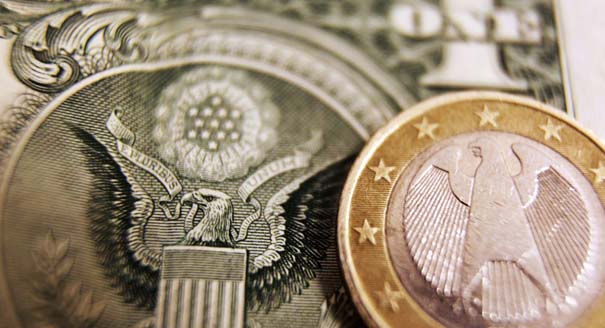
The euro crisis has grown too big for Europeans to handle alone. The United States must act to help save the euro—or risk paying a much bigger price if it collapses.
Source: National Interest

His fellow finance ministers will grow impatient. “We understand that you have a fiscal mess, but we don’t have a lot of time right now. We really need to prepare for the meetings with the Chinese, Brazilian and Mexican delegations. After all, as you and your president keep repeating, this is Europe’s crisis to deal with.”
This is more than ironic. It is unreal, tragic in fact, because everyone around the conference table will know that a collapse of the euro would not only be a calamity for Europe but also a disaster for the United States.
This article was originally published by the National Interest. Click here to continue reading.

Former Senior Associate, International Economics Program
Dadush was a senior associate at the Carnegie Endowment for International Peace. He focuses on trends in the global economy and is currently tracking developments in the eurozone crisis.
Former Visiting Scholar, International Economics Program
Shaw was a visiting scholar in Carnegie’s International Economics Program. He is the co-author of Juggernaut: How Emerging Markets Are Reshaping Globalization.
Carnegie does not take institutional positions on public policy issues; the views represented herein are those of the author(s) and do not necessarily reflect the views of Carnegie, its staff, or its trustees.

Depleted financial reserves and a shrinking tax base mean it is no longer possible to simultaneously deliver high defense spending, price stability, and economic growth.

Alexandra Prokopenko

Andrey Melnichenko’s essay offers no answer to the fundamental question of how, under any kind of negotiated settlement, Europe can protect itself from the Russian ressentiment that is inevitable in all scenarios except for an outright victory for Putin.

Leonid Bershidsky

Whether PAS can refocus on the unfinished business of state-building may ultimately prove more consequential for Moldova’s European future than the pace of its accession negotiations.

Balázs Jarábik
Ongoing uncertainty in the Middle East allows Moscow to both increase its influence in Tehran and continue to enjoy the financial windfall of higher oil prices.

Nikita Smagin

A much-discussed disagreement over internet restrictions in Russia was never an existential threat for Putin: It was about elite groups protecting their interests.
Alexandra Prokopenko