

Commentary
Alexandra Prokopenko
{
  "authors": [
    "Alexandra Prokopenko"
  ],
  "type": "commentary",
  "blog": "Carnegie Politika",
  "centerAffiliationAll": "",
  "centers": [
    "Carnegie Endowment for International Peace",
    "Carnegie Russia Eurasia Center"
  ],
  "collections": [
    "The Iran War’s Global Reach"
  ],
  "englishNewsletterAll": "",
  "nonEnglishNewsletterAll": "",
  "primaryCenter": "Carnegie Russia Eurasia Center",
  "programAffiliation": "",
  "regions": [
    "Russia",
    "Iran",
    "United States"
  ],
  "topics": [
    "Trade",
    "Global Governance",
    "Foreign Policy"
  ]
}
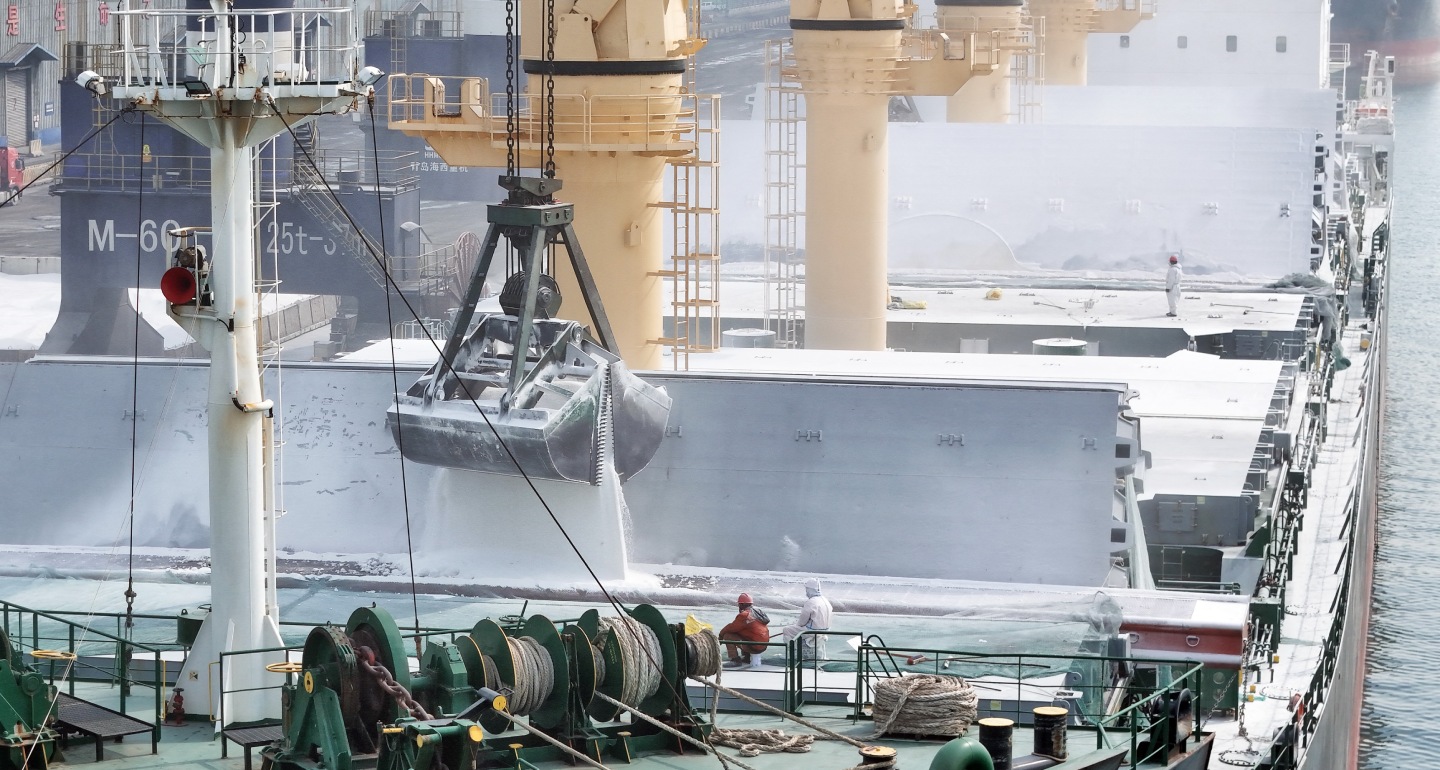
Source: Getty
The Kremlin expects to not only profit from rising fertilizer prices but also exact revenge for the collapse of the 2023 grain deal.
Despite U.S. President Donald Trump’s frequent statements that victory in Iran is close, there is no end in sight to the hostilities in the Persian Gulf. On the contrary, new approaches to limited traffic through the Strait of Hormuz are gradually being implemented. The Islamic Revolutionary Guard Corps has started issuing paid transit permits to vessels unaligned with the United States or Israel, and a growing number of countries want to discuss “safe passage of their vessels.”
The consequences of restricted transit for the oil market are already clear and well known. Not as much attention is being paid to the impact on the global fertilizer market. The changes there will be more gradual, but irreversible. Food prices will take six to nine months to react to the supply shock in the fertilizer market resulting from the closure of the Strait of Hormuz. Meanwhile, Russia might enjoy more lasting benefits than temporarily lining its pockets with petrodollars.
The Strait of Hormuz is the most important transit route not just for oil but also for fertilizers. Persian Gulf countries account for about 46 percent of global seaborne urea transit and around 30 percent of ammonia transit. These nitrogen compounds are integral for efficient cultivation of almost every food crop. However, their shipping from the Persian Gulf is almost completely paralyzed.
Disruptions to maritime transit through the strait have already triggered a sharp surge in nitrogen and phosphorus fertilizer prices. According to Platts, as of March 19, the free on board (FOB) price for Middle East granular urea rose to $604–710 per ton, up from $436–494 before the start of the war. The Southeast Asia granular urea was at $750 per ton on March 19, up from $490–498 in late February. While these prices are still below the 2022 record highs, they continue to grow.
Furthermore, unlike with oil, there are no strategic reserves of urea, no alternate pipelines for ammonia, and no military escort programs. Saudi Arabia has created infrastructure to export oil bypassing the Strait of Hormuz, but no such solutions exist for fertilizers.
The lag between disruptions in fertilizer supply and rising food prices is measured in seasons rather than days. A farmer who doesn’t have access to urea at the start of the planting season might use less fertilizer, switch to a different crop, or forgo planting altogether. This decision affects the harvest in three to six months, and takes longer still to impact supermarket prices. Today we are at the very beginning of this cycle.
The UN World Food Program estimates that the number of people experiencing acute food insecurity could rise by 45 million to a record-high 363 million if the war in Iran doesn’t end by mid-2026, and oil prices remain above $100 a barrel.
The geographic distribution of this increase is predictable and politically significant: an additional 17.7 million people in East and Southern Africa, 10.4 million in West and Central Africa, and 9.1 million in Asia. Many in these regions will be happy to buy not just Russian fertilizers, but also the Kremlin’s narrative that Moscow is the best guarantor of food security for the Global South.
Similar dynamics played out in 2022, when Russia’s full-scale invasion of Ukraine had also hit the fertilizer market hard. However, back then, the disruptions in Black Sea shipping had simultaneously driven up grain prices, which partially offset the rising cost of fertilizers for farmers.
Today, the grain prices are only growing a little, because Iran is not a major agricultural producer. Thus, higher expenses for farmers at the start of the planting season aren’t being compensated with higher crop values, and the consequences for the food market will emerge later and last longer.
As with the oil market, Russia is one of the main beneficiaries of the turmoil in the fertilizer market. Russia accounts for about 23 percent of global ammonia exports, 14 percent of global urea exports, and—together with Belarus—40 percent of global potash exports. Furthermore, its export infrastructure is completely independent of the Strait of Hormuz. Moscow doesn’t need a ceasefire, a military escort, or a diplomatic breakthrough to ramp up its deliveries. All it needs is orders, and it is getting more and more of these.
Importers in Nigeria and Ghana are already pre-purchasing Russian fertilizers for the third quarter of 2026. This is a rational market response to the disappearance of competing supply, and once established, these connections will solidify into a dependency that could outlast any ceasefire.
Moscow has already employed this tactic. In 2022–2023, the Kremlin used the Black Sea Grain Initiative as diplomatic leverage in Africa and the Middle East, pushing importer countries for friendlier positions and corresponding votes in the UN as an unofficial precondition for resuming deliveries.
Fertilizers are even more convenient as leverage. They receive less media attention in the West than wheat, and they are more critical for the agricultural sector. The bureaucrats responsible for fertilizer procurement in Ethiopia and Bangladesh don’t think about the Ukraine conflict when they need urea before the monsoon season arrives. They call the Kremlin, and the Kremlin answers.
Moscow is well aware of these new opportunities. In a March 18 interview with Kommersant, presidential aide Nikolai Patrushev said that the U.S. war with Iran is not a temporary crisis, but a structural realignment that should be leveraged. According to Patrushev, the U.S.-Israeli operation is a “catalyst for the redistribution of the global energy market and the disruption of maritime logistics” and has “unpredictable humanitarian and economic consequences.”
Patrushev made no mention of Ukraine in the interview. However, he did propose providing naval convoys to protect merchant ships. In August 2024, Patrushev was appointed chairman of the newly established Russian Maritime Board. Meanwhile, his son Dmitry Patrushev is a deputy prime minister for agriculture and fertilizer production.
The closure of the Strait of Hormuz triggers a chain reaction of three consecutive shocks in the agricultural sector. The first—a surge in fertilizer prices—is already under way. Even farmers in developed nations are feeling it, albeit less acutely due to existing stockpiles and access to financing.
The second—reduced crop yields as a result of high fertilizer prices—will come in the fall. Its impact will be uneven: agricultural producers in the United States and the EU will find it easier to diversify their suppliers than those in many countries of Africa and Asia.
The third—food inflation—will follow in 2027. Food is a commodity with a very low price elasticity of demand, particularly in poorer nations. A supply shock translates almost entirely into higher prices rather than lower consumption, and lower consumption is itself a catastrophe: in poorer nations, lower consumption means famine and not just changes in the composition of the consumer basket.
For Russia, each of these three shocks is important in its own way. Moscow imposed export quotas on fertilizers back in 2025 in order to stabilize the domestic market. A rapid increase in exports would require corresponding government decisions and could run up against infrastructure constraints at the ports.
Historically, Russia was the world’s largest exporter of anhydrous ammonia; however, the Togliatti–Odesa ammonia pipeline is not currently operating due to the war in Ukraine. A new terminal on the Taman Peninsula was supposed to partially resolve this issue, but the details on its full capacity remain unclear. Nevertheless, the Kremlin has already declared that “Russia is one of the few countries that can ensure a growing market supply.”
In the long run, the Kremlin will enjoy geopolitical gains from the turmoil in the Persian Gulf and not just financial benefits. Additional oil revenues are likely, but could run out. Meanwhile, higher prices on fertilizers and food are a victory of a different magnitude. Russia won’t just profit from rising prices; it will have the opportunity to convert its market power into political influence and acquire leverage over countries whose neutrality is vital for the West.
The war in Iran will probably end before most people see its connection with the rise in food prices in 2027. By that point, Russia will be able to position itself as an indispensable supplier that saved the world from starvation. The Kremlin did not sow this harvest, but it will most likely reap it.

Senior Fellow, Carnegie Russia Eurasia Center
Alexandra Prokopenko is a senior fellow at the Carnegie Russia Eurasia Center.
Recent Work
Alexandra Prokopenko
Alexandra Prokopenko
Carnegie does not take institutional positions on public policy issues; the views represented herein are those of the author(s) and do not necessarily reflect the views of Carnegie, its staff, or its trustees.

For every ruble allocated to social policy, health, and education in 2027, double that amount is earmarked for the army, the police, and the security services.
Alexandra Prokopenko

Cargo traffic through Russia’s Northern Sea Route has increased because of the disruption caused by the conflict in the Middle East, the Ukraine war, and U.S.-China tensions.

Mikhail Korostikov
An analysis of traffic accident data suggests that Ukrainian drone attacks caused a material but not disastrous fall in Russian gasoline consumption over the summer.

Sergey Vakulenko

Sergei Kiriyenko used Russia’s parliamentary vote to further hone his strategy of corporate mobilization that is designed to maximize votes for United Russia.

Andrey Pertsev

Trump has promised Belarus a massive potash deal. But Minsk is seeking something greater: restored Western transit and greater room for maneuver from Russia.

Balázs Jarábik