

Commentary
Uri Dadush
{
  "authors": [
    "Uri Dadush"
  ],
  "type": "legacyinthemedia",
  "centerAffiliationAll": "",
  "centers": [
    "Carnegie Endowment for International Peace",
    "Carnegie Europe"
  ],
  "collections": [],
  "englishNewsletterAll": "",
  "nonEnglishNewsletterAll": "",
  "primaryCenter": "Carnegie Endowment for International Peace",
  "programAffiliation": "",
  "programs": [],
  "projects": [],
  "regions": [
    "Western Europe",
    "North America"
  ],
  "topics": [
    "Economy",
    "EU"
  ]
}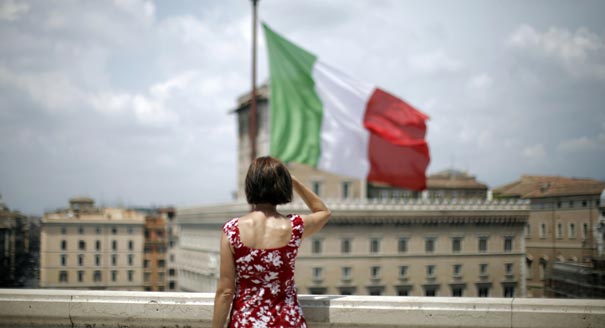
Source: Getty
Europe needs to help, but even with help, Italy faces big changes and, assuming all goes well, two or three difficult years lie ahead.
Source: L’Espresso

Based on the experience of other crisis countries thus far, Italians’ fear is justified by facts. Italian unemployment is up by forty percent since the crisis erupted, but the unemployment rate in Greece, Ireland, and Spain, where the adjustment is still far from over, has already doubled or tripled. Domestic demand in Italy is down five percent since its peak in 2007, but it has already fallen by between ten percent and twenty-five percent in the other crisis countries.
Do these comparisons apply? No one can know exactly. It is true that Italy has a smaller fiscal deficit and its banks are in better shape than any of these problem countries, but Italy has a high debt, has lost competitiveness and the capacity to grow, and, moreover, is in a much earlier phase of its adjustment.
So, let me be clear: Europe needs to help, but even with help, Italy faces big changes and, assuming all goes well, two or three difficult years lie ahead. The relevant question is how the inevitable hardship can be mitigated in impact and duration.Everyone knows that Italy must restore its fiscal balance and reestablish growth. Achieving fiscal balance is tough, but reigniting growth in austerity and without devaluing is even tougher. In fact, it cannot be done quickly and a recession this year appears inevitable. However, given time, productivity can be boosted, resources can shift from the sclerotic public to the private sector, and from the moribund domestic sector—such as services and construction—to the traded sector, towards the world’s most dynamic sources of demand, especially to emerging markets. So Italy needs to step up its investment in machinery, tourism, design, other exportable services, and in food processing and agriculture. A big part of the difference between a dynamic Germany and a stagnant Italy is that the former’s share of exports in GDP has increased by seventeen percentage points of GDP since 2000, while the share of Italy’s exports in GDP has increased by just two percentage points.
How does one make sure these needed changes occur as rapidly as possible and in a way that minimizes the pain? Experience in both advanced and developing countries points to the following four lessons:
There is a connecting thread across these lessons—they entail reforms that are intrinsically equitable—favoring the people instead of specific groups.
For precisely these reasons, the reforms are already and will be increasingly resisted by special interests of all stripes—government agencies, firms, unions, and professions—who all benefit from the currently uncompetitive and inequitable system. So, expect Italy’s highly respected new government to come under more intense attack from multiple directions as the adjustment takes place. The political opposition meanwhile will bide its time.
Italy’s success will ultimately depend on whether its citizens—who know that there is no serious alternative to the current course—make their voices heard. They will be the drivers of Italy’s change.
This article was originally published in Italian in L'Espresso.

Former Senior Associate, International Economics Program
Dadush was a senior associate at the Carnegie Endowment for International Peace. He focuses on trends in the global economy and is currently tracking developments in the eurozone crisis.
Recent Work
Uri Dadush
Uri Dadush
Carnegie does not take institutional positions on public policy issues; the views represented herein are those of the author(s) and do not necessarily reflect the views of Carnegie, its staff, or its trustees.

The European far right might fail to steer EU policy in the direction Russia wants, but they will create enough chaos inside Europe to benefit the Kremlin.

Dimitar Bechev

Depleted financial reserves and a shrinking tax base mean it is no longer possible to simultaneously deliver high defense spending, price stability, and economic growth.

Alexandra Prokopenko

Whether PAS can refocus on the unfinished business of state-building may ultimately prove more consequential for Moldova’s European future than the pace of its accession negotiations.

Balázs Jarábik
A much-discussed disagreement over internet restrictions in Russia was never an existential threat for Putin: It was about elite groups protecting their interests.
Alexandra Prokopenko

The demands of the Kremlin’s war in Ukraine, demographic problems, and public hostility toward Central Asians mean Russia does not have enough workers.

Salavat Abylkalikov