

Commentary
Japan’s long-term security policy is driven by concerns about China, and there is little appetite for (or interest in) pursuing a confrontation with Moscow.
James D.J. Brown
{
  "authors": [
    "Dmitry Kuznets"
  ],
  "type": "commentary",
  "blog": "Carnegie Politika",
  "centerAffiliationAll": "",
  "centers": [
    "Carnegie Endowment for International Peace",
    "Carnegie Russia Eurasia Center"
  ],
  "englishNewsletterAll": "",
  "nonEnglishNewsletterAll": "",
  "primaryCenter": "Carnegie Russia Eurasia Center",
  "programAffiliation": "",
  "regions": [
    "Russia"
  ],
  "topics": [
    "Economy",
    "Domestic Politics"
  ]
}
Source: Getty
The Russian army is not currently struggling to recruit new contract soldiers, though the number of people willing to go to war for money is dwindling.
As the fourth anniversary of Russia’s full-scale invasion of Ukraine fast approaches, many observers believe that Russia is losing since it is unable to achieve its political goals: the occupation of vital Ukrainian population centers and regime change in Kyiv.
In negotiations with the Trump administration, the Kremlin is indeed sending signals that it has tempered its ambitions. That’s not to say, however, that the Kremlin is running out of resources to keep waging war. For now, the Russian military machine—reassembled following the defeats of 2022—is functioning decently: the authorities are able to cover current losses in personnel and equipment. But there is no capacity to significantly increase the volume of resources being deployed.
Estimates of Russian casualties published by everyone from Western intelligence agencies and the Ukrainian General Staff to media and U.S. President Donald Trump have varied enormously throughout the war, and have often been wildly unrealistic. Among the most widespread claims is that by 2026, Russia’s armed forces had lost over 1 million troops, of whom about 400,000 were killed in 2025 alone.
The problem with these estimates lies in their methodological confusion. Sometimes the context suggests that these statistics include the wounded, too. But to assess the army’s true potential, what matters are irrecoverable losses—i.e., those who will never return to the battlefield. That includes those who have been declared dead, the majority of those listed as missing in action (i.e., those who have been killed but not yet officially declared dead), and those who have been left medically unfit for service.
The number of those killed can be estimated thanks to the work of independent research groups analyzing parts of Russia’s once extensive “e-government” system of open databases, along with satellite images, budget reports, and other indirect data.
One obvious indicator is the number of death certificates issued by registry offices. According to analysis by journalists from Mediazona and Meduza, by the end of last summer, about 220,000 deaths of Russian troops were beyond doubt. Nationals of other countries fighting in the Russian armed forces, including those mobilized in the occupied territories of Ukraine, are not included in these statistics.
At the same time, personal data were collected from open sources such as obituaries and media reports. The corresponding list for the same timeframe as above compiled by Mediazona contained approximately 125,000 names (by February 2026, it had reached over 168,000).
Estimates for 2022–2023 previously obtained using this method correlated with mortality statistics released by Rosstat, the state statistics service, categorized by sex and age, which suggested excess mortality among working-age men.
Last year, the number of obituaries increased significantly, from an average of 135 per day in 2024 to 220 in 2025. Based on the ratios in the aforementioned statistics for late summer 2025, we can conclude that the average daily number of Russian soldiers killed was 240 in 2024, and 390 in 2025.
Apparently, the Russian army’s rate of losses has increased, but not so rapidly. Official death tolls and obituary databases have begun to include soldiers who were previously listed as missing in action but have now been declared dead by court order—even though their bodies have never been recovered.
The law establishing this procedure came into force in May 2023, but only began to be actively implemented in the fall of 2024. Previously, only relatives of missing soldiers applied to the courts, while now, unit commanders are doing so en masse. Reasons for that are not fully clear, but according to one explanation, this is because it has become more difficult for officers to request replacements from the Defense Ministry for missing soldiers who have not yet officially been declared dead.
By the end of 2025, about 90,000 requests to have missing servicemen declared dead had been lodged with the courts. After that, courts began deleting the data on such cases from their public databases. Defense Minister Andrei Belousov claimed that just under half of the total number of missing persons had been “found” (i.e., formally declared dead). Based on this estimate, the total number of missing Russian servicemen is about 180,000, some of whom have already been officially declared dead by the courts.
This partially explains the likely statistical underestimation of the death toll in previous years and the rapid increase in 2025. The cumulative death toll among Russian military personnel as of the end of last year, according to available data, did not exceed 400,000. On average, about 300 people died per day. Efforts to verify the number of missing persons are ongoing, so it will likely be possible to determine the actual death toll with more accuracy in coming months.
Another poorly measured component of irrecoverable losses is military personnel discharged from service on health grounds. There are no reliable data on their number: information on compensation paid out for serious injuries is published piecemeal in federal and regional budget reports.
The potential scale of this category can be estimated by comparing it with historical data from other conflicts. During World War II, there were 0.55 demobilized soldiers for every one killed (0.43 if those classed as missing in action and those who did not return from captivity are included among the dead). During the Soviet war in Afghanistan, this ratio was approximately 0.66 to one killed.
In more modern conflicts, given improvements in military medicine, personal protective equipment, and evacuation systems, the proportion of seriously wounded could exceed the number of fatalities. According to reports from the British army in Afghanistan, the ratio was 1.3 to 1.
However, such a ratio is unlikely in the war between Russia and Ukraine: evacuating the wounded from the battlefield is extremely difficult due to drone and artillery strikes. Accordingly, taking into account those retired from service on health grounds and those missing in action who have not yet been declared dead, it’s unlikely that the irrecoverable losses of the Russian armed forces over the past year exceeded 600 people per day.
The scale of desertion does not significantly impact overall casualty statistics. In 2025, less than 1,000 such cases were brought to court on average each month, while the average monthly number of those killed in action alone during that same period was close to 10,000.
The real figures for Russia’s losses may be lower than some speculative estimates, but their scale still begs the question: Does Russia have sufficient human resources to compensate for such losses without resorting to a general mobilization?
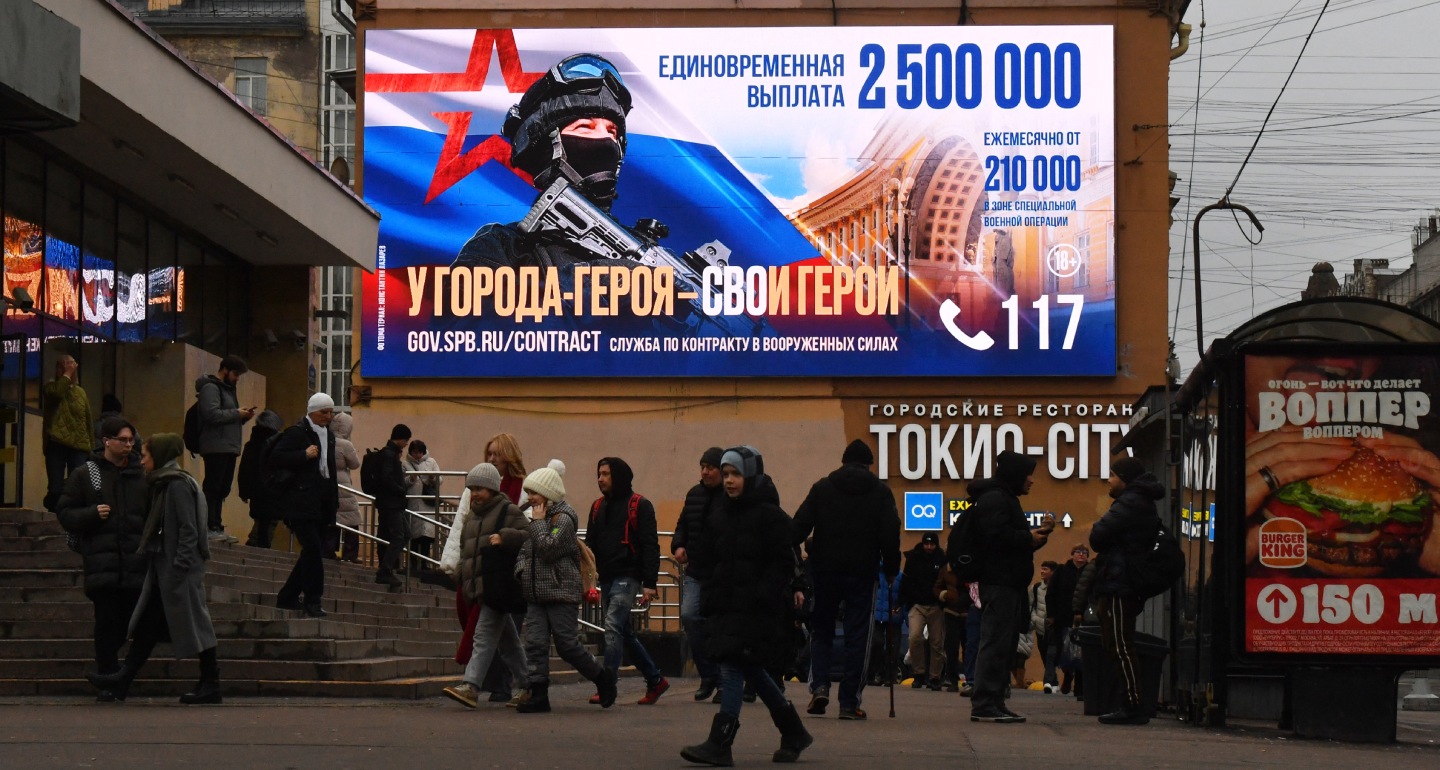
The main sources of data on new recruits signing up are federal and regional budget spending reports, which include a separate section on bonuses paid for signing military contracts. The sizes of the bonuses paid at both the federal and most regional levels are a matter of record, which makes it possible to estimate the numbers of new military recruits on at least a quarterly basis. Based on these data, over the past two years, the Russian armed forces and associated private military companies have recruited 30,000–40,000 contract soldiers every month, or 1,000–1,300 people per day.
Meanwhile, recruitment is becoming increasingly expensive. The federal authorities doubled their payments back in 2024, while the regions, which are set recruitment targets by Moscow, drastically increase signing-up bonuses during periods of candidate shortages and reduce them again once quotas have been met. While the federal budget can still afford to do this, these expenses are becoming a significant burden for the regions.
Regional budgets are increasingly in debt, but their collapse is not imminent. The regions are cutting spending on other, “lower priority” items. The central government is providing top-ups from the federal budget to offset some of these costs.
In other words, the Russian army is not currently struggling to recruit new contract soldiers, though the number of people willing to go to war for money is dwindling. The military is now more concerned about the quality of the “resources” available.
The current recruitment system generally attracts socially disadvantaged people, from the unemployed to prisoners. They are typically individuals with low motivation and limited qualifications and aptitude for learning. Yet the nature of warfare increasingly requires trained specialists rather than mass infantry.
This issue has become particularly pressing following the creation of the Unmanned Systems Forces within the Russian armed forces, which require a large number of motivated and trained personnel. The Russian authorities have launched a separate recruitment drive for drone operators, accompanied by a massive nationwide advertising campaign.
The main advantage for these recruits is the promised opportunity to demobilize after a year (other contract soldiers’ contracts are automatically extended until the war ends). This separate campaign to recruit tens of thousands of troops for the Unmanned Systems Forces will inevitably impact the quality and quantity of contract soldiers joining the traditional ground forces.
The Russian authorities are unlikely to be able to significantly increase the current size of the armed forces or the recruitment rate. Even a new wave of mobilization would not help, as the military will still require trained officers and equipment, while the supply is limited. Under these circumstances, a new mobilization only makes practical sense if the current paid recruitment system collapses. For now, it’s fulfilling its purpose.

Dmitry Kuznets
Editor, Russian independent media "Meduza"
Carnegie does not take institutional positions on public policy issues; the views represented herein are those of the author(s) and do not necessarily reflect the views of Carnegie, its staff, or its trustees.

Japan’s long-term security policy is driven by concerns about China, and there is little appetite for (or interest in) pursuing a confrontation with Moscow.

James D.J. Brown

The truth of the strategic situation is that Europe and Russia are extremely unlikely to be able to “turn the page” on their confrontation within the next two decades.

Arkady Moshes

Russia spent years building a “sovereign internet,” concentrating web infrastructure exclusively within Russian territory. Ukrainian drone attacks have shown how vulnerable that approach has left the Russian internet.

Maria Kolomychenko

Putin’s conservative staffing policies and search for ever greater control have cemented parliament’s transformation into a bureaucratic appendage of the executive branch.

Andrey Pertsev

Russia’s AI-driven propaganda campaigns operate in a fragmented, chaotic, and often illogical manner. That’s not necessarily a problem for the Kremlin, though: It’s much easier to mimic genuine public debate that way.

Ilya Klishin