• Research
  • Politika
  • About
Carnegie Russia Eurasia center logoCarnegie lettermark logo
  • Donate
{
  "authors": [
    "Matthew Rojansky"
  ],
  "type": "legacyinthemedia",
  "centerAffiliationAll": "dc",
  "centers": [
    "Carnegie Endowment for International Peace"
  ],
  "collections": [],
  "englishNewsletterAll": "ctw",
  "nonEnglishNewsletterAll": "",
  "primaryCenter": "Carnegie Endowment for International Peace",
  "programAffiliation": "russia",
  "programs": [
    "Russia and Eurasia"
  ],
  "projects": [],
  "regions": [
    "Caucasus",
    "Russia"
  ],
  "topics": [
    "Political Reform",
    "Foreign Policy"
  ]
}
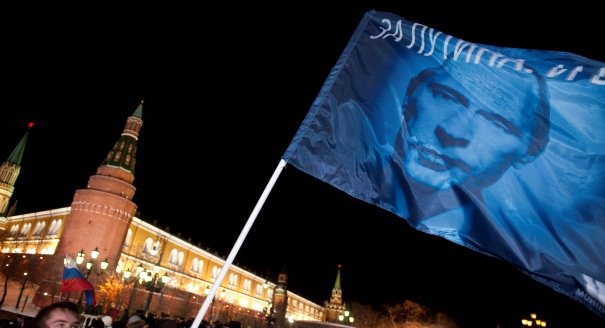
Source: Getty

In The Media

Is Putin's Victory Guaranteed?

It is not certain that Putin will win the elections on Sunday, but it is very likely. If Putin is elected, he will face implications in Russia's domestic policy and its relationship with the United States.

Link Copied
By Matthew Rojansky
Published on Mar 2, 2012

Source: CTV (Canada)

Speaking on CTV (Canada), Carnegie's Matthew Rojansky predicted that it is very likely that Putin will win Russia's upcoming presidential elections on Sunday. “It is possible that he will only win a plurality which is just under 50 percent and he will have to go to a run-off. That said, the polls are looking very good for him,” he added. If Putin is selected President of the Russian Federation for the next six years, Rojansky outlined several domestic and international policy implications that he will have to consider:

  • Medvedev: Putin has made promises that Medvedev will be Prime Minister after the elections. However, “whether Medvedev will stay as Prime Minister I think is unlikely,” said Rojansky, adding that “in some ways, he is the perfect fall guy down the road.”
     
  • Domestic Reforms: Given the extensive protests against Putin’s rule, and the likelihood of renewed protests after the election, “Putin is going to do what he has to do,” said Rojansky. There will be a veneer of modernization and Putin will have to make concessions to some demands, such as improving modern technology and creating more opportunities for IT and high-tech jobs. However, “Putin cannot adjust the basic bargain he has made with the oligarchs and Russia’s elite,” warned Rojansky. "If he starts to shake up that deal, those guys will turn against him.”
     
  • Syria: Once it is clear that the Assad regime is falling, Putin cannot sustain Russia’s major financial and security interests in Syria and has no further reason for Russia to continue to support the Assad regime. “If Putin will, in fact, win on Sunday, it becomes much less important for him to draw that line in the sand that says public protests should never be allowed to bring down what he considers to be a legitimate government,” added Rojansky. 
     
  • U.S.–Russia Relations: There is a good reason to believe that Putin will sustain the reset relationship with the United States, Rojansky stated.
     

This interview was originally aired on CTV (Canada).

About the Author

Matthew Rojansky

Former Deputy Director, Russia and Eurasia Program

Rojansky, formerly executive director of the Partnership for a Secure America, is an expert on U.S. and Russian national security and nuclear-weapon policies.

    Recent Work

  • Paper
    An Opportunity for Ambition: Ukraine’s OSCE Chairmanship

      Matthew Rojansky

  • In The Media
    Presiding Over the OSCE: Challenges and Opportunities

      Matthew Rojansky

Matthew Rojansky
Former Deputy Director, Russia and Eurasia Program
Matthew Rojansky
Political ReformForeign PolicyCaucasusRussia

Carnegie does not take institutional positions on public policy issues; the views represented herein are those of the author(s) and do not necessarily reflect the views of Carnegie, its staff, or its trustees.
More Work from Carnegie Russia Eurasia Center

  • Commentary
    Carnegie Politika
    After Ilia II: What Will a New Patriarch Mean for Georgia?

    The front-runner to succeed Ilia II, Metropolitan Shio, is prone to harsh anti-Western rhetoric and frequent criticism of “liberal ideologies” that he claims threaten the Georgian state. This raises fears that under his leadership the Georgian Orthodox Church will lose its unifying role and become an instrument of ultraconservative ideology.

      Bashir Kitachaev

  • Commentary
    Carnegie Politika
    Lukashenko’s Bromance With Trump Has a Sell-By Date

    Lukashenko is willing to make big sacrifices for an invitation to Mar-a-Lago or the White House. He also knows that the clock is ticking: he must squeeze as much out of the Trump administration as he can before congressional elections in November leave Trump hamstrung or distracted.

      Artyom Shraibman

  • Commentary
    Carnegie Politika
    What the Russian Energy Sector Stands to Gain From War in the Middle East

    The future trajectory of the U.S.-Iran war remains uncertain, but its impact on global energy trade flows and ties will be far-reaching. Moscow is likely to become a key beneficiary of these changes; the crisis in the Gulf also strengthens Russia’s hand in its relationships with China and India, where advantages might prove more durable.

      • Sergey Vakulenko

      Sergey Vakulenko

  • Commentary
    Carnegie Politika
    Beyond Oil: Hormuz Closure Puts Russia in the Lead in the Fertilizer Market

    The Kremlin expects to not only profit from rising fertilizer prices but also exact revenge for the collapse of the 2023 grain deal.

      Alexandra Prokopenko

  • Commentary
    Carnegie Politika
    “Mr. Nobody Against Putin”: A Deep Dive Into Russian Propaganda

    Talankin and Borenstein’s documentary is a unique inside look at a regime that threatens the world and has killed thousands of people in its neighboring country. And many critics and general viewers alike draw parallels between the Putin regime and their own governments.

      Ekaterina Barabash

Get more news and analysis from
Carnegie Russia Eurasia Center
Carnegie Russia Eurasia logo, white
  • Research
  • Politika
  • About
  • Experts
  • Events
  • Contact
  • Privacy
Get more news and analysis from
Carnegie Russia Eurasia Center
© 2026 Carnegie Endowment for International Peace. All rights reserved.