

Paper
Matthew Rojansky
{
  "authors": [
    "Matthew Rojansky"
  ],
  "type": "legacyinthemedia",
  "centerAffiliationAll": "dc",
  "centers": [
    "Carnegie Endowment for International Peace",
    "Carnegie Europe",
    "Carnegie Russia Eurasia Center"
  ],
  "collections": [],
  "englishNewsletterAll": "ctw",
  "nonEnglishNewsletterAll": "",
  "primaryCenter": "Carnegie Endowment for International Peace",
  "programAffiliation": "russia",
  "programs": [
    "Russia and Eurasia"
  ],
  "projects": [],
  "regions": [
    "Caucasus",
    "Russia"
  ],
  "topics": [
    "Political Reform",
    "Foreign Policy"
  ]
}
Source: Getty
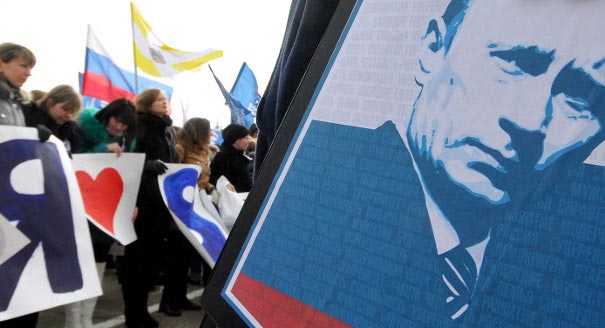
Putin's return to the Kremlin may be good news for Dmitri Medvedev and Russia's oligarchs, but the middle class, especially the younger generation, is less optimistic about his re-election and the country's future.
Source: CNN

On the gridiron of Russian presidential politics, Vladimir Putin was the heavy favorite and he did not disappoint. Despite months of anti-regime protests and a relatively transparent voting process, Putin appears to have won well above 60% of the vote, with a respectable turnout of just over 56%. This means that Putin will not only return to the Kremlin in May, but will claim a mandate to govern based on the will of the Russian people. As in sports betting, this outcome promises a big payoff for some, and a long, cold winter for others.
So who were the winners and losers after Sunday’s blowout?
Dmitri Medvedev: After years of speculation as to the true nature of Russia’s leadership “tandem,” Medvedev removed all doubt last September when he personally called upon Putin to stand for the Presidency, and promised his own loyal support. That loyalty will surely be rewarded. Putin may be many unsavory things, but he is a man of his word, and he has promised that Medvedev will be Prime Minister. How long Medvedev lasts in that job depends in part on how the economy performs - the Prime Minister oversees state industries and the budget - and in part on whether protests continue, which might cause Putin to seek a scapegoat.
The Oligarchs: Despite the poor showing by “independent” presidential candidate Mikhail Prokhorov, one of Russia’s wealthiest oligarchs, he and his neighbors on the Forbes list of Russian billionaires stand to profit handsomely under a new Putin presidency. Putin makes no secret of his disgust for the crooked 1990’s privatization schemes that made Prokhorov and others rich, yet he has no intention of undoing the results. Putin’s message to the oligarchs is simple: make your money but stay out of politics. And they have done so, with the exceptions of Prokhorov, who is suspected to have run on Putin’s orders, and Mikhail Khodorkovsky who lost his company and is rotting in jail. The reward for the oligarchs’ obedience? Putin plans a new round of privatization worth some $50 billion over the next five years.
The Middle Class: The mere existence of a Russian middle class is, according to Putin, proof that his leadership has made life better for ordinary people. While it is true that many Russians live much better today than they did a decade ago, that prosperity is attributable largely to rising energy prices, high state spending, and the lingering effects of reforms undertaken during the 1990’s. Meanwhile, many in the middle class resent the privileges enjoyed by Putin’s retainers, chafe at restrictions on freedom of speech, and above all despise the corruption that pervades practically every level of business and public life in Russia today. If the price of oil returns to last decade’s highs, then decent wages, reliable state services, and freedom to travel are probably enough to keep the middle class busy - but take any one of those away, and the tens of thousands marching on Moscow’s streets could become millions.
Young people: Russia’s post-Soviet generation may be the biggest losers from Putin’s latest victory, but judging by the apparent indifference of the majority or the carnival antics of an outspoken few, their particular plight hasn’t sunk in yet. Think of it this way: If this year is the beginning of two more presidential terms for Putin–who is not yet 60 and could change the constitution to remove term limits altogether–today’s teens and twenty-somethings may be about to spend the best years of their lives in a modern version of the Brezhnev era. One key difference, of course, is that Russians now enjoy the freedom to emigrate, and if Putin’s return does bring Soviet-style stagnation, talented Russians young and old will continue to vote with their suitcases.
The United States: Putin ran a distinctly anti-American campaign and despite lingering goodwill from the 2009 “reset” it will be hard to bury the hatchet with Washington. The Kremlin has depicted Secretary of State Hillary Clinton as a puppet master pulling the strings of Russian liberals and activists who seek to bring about a “color revolution,” or ignite a Libya-style civil war that can justify NATO intervention. Sure, Putin can come across as a bit paranoid, but that doesn’t mean America isn’t out to get him. In the run-up to a U.S. presidential contest, and with Congress preparing to debate granting Russia permanent normal trade relations when it joins the World Trade Organization later this year, there will be more than enough Russophobe rhetoric to go around. The relationship might go off the rails well before next November, since a NATO-Russia summit set for May in Chicago looks unlikely to break the current deadlock over missile defense, to which Putin has threatened a “disproportionate” response.
Some might say that Russia’s democracy is the biggest loser from Sunday’s contest. And indeed, despite a dolled-up veneer of campaigning, protests and counter-demonstrations, most Russians will admit that they only ever had one real choice. But even in his triumph, Putin faces serious challenges to keep Russia on track. And for the democratic opposition, there’s always next season.
Former Deputy Director, Russia and Eurasia Program
Rojansky, formerly executive director of the Partnership for a Secure America, is an expert on U.S. and Russian national security and nuclear-weapon policies.
Recent Work
Matthew Rojansky
Matthew Rojansky
Carnegie does not take institutional positions on public policy issues; the views represented herein are those of the author(s) and do not necessarily reflect the views of Carnegie, its staff, or its trustees.

If the Russian-speaking community in Latvia cannot articulate their interests without being seen as disloyal, they could end up embracing a pro-Kremlin agenda.

Sergejs Potapkins

Russia’s ruling party would have benefited from Putin appearing as its distant patron, but as an active frontman imposing his views on the public, he has done nothing but harm both the party’s election campaign and the ruling system overall.

Andrey Pertsev

Depleted financial reserves and a shrinking tax base mean it is no longer possible to simultaneously deliver high defense spending, price stability, and economic growth.

Alexandra Prokopenko
Blurring the line between humans and animals is a long-standing tradition in social utopian prose. In his latest novel, Leonid Bershidsky reminds us that in social experiments, people are often treated no differently than animals.

Alexander Baunov

In the tenth year of his presidency, President Mirziyoyev’s system is becoming even more personalized than that of his predecessor Karimov.

Galiya Ibragimova