

Commentary
Cargo traffic through Russia’s Northern Sea Route has increased because of the disruption caused by the conflict in the Middle East, the Ukraine war, and U.S.-China tensions.
Mikhail Korostikov
{
  "authors": [
    "Toby Dalton",
    "George Perkovich"
  ],
  "type": "legacyinthemedia",
  "centerAffiliationAll": "dc",
  "centers": [
    "Carnegie Endowment for International Peace"
  ],
  "collections": [
    "U.S. Nuclear Policy"
  ],
  "englishNewsletterAll": "ctw",
  "nonEnglishNewsletterAll": "",
  "primaryCenter": "Carnegie Endowment for International Peace",
  "programAffiliation": "NPP",
  "programs": [
    "Nuclear Policy",
    "South Asia"
  ],
  "projects": [],
  "regions": [
    "North America",
    "United States",
    "South Asia",
    "Pakistan"
  ],
  "topics": [
    "Security",
    "Military",
    "Foreign Policy",
    "Nuclear Policy"
  ]
}
Source: Getty
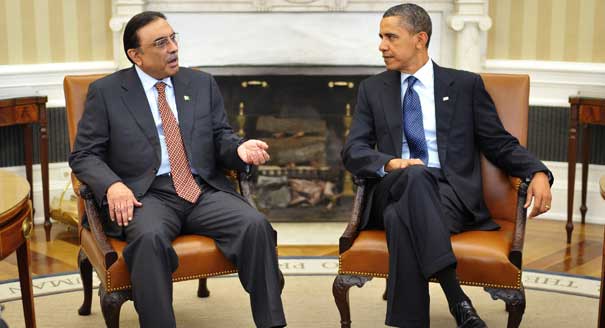
Pakistani legislators announced new guidelines for engagement with the United States and NATO that ban, among other conditions, future American drone strikes inside Pakistan. While the new constraints will handicap international counterterrorism efforts in the short term, they signal an important beneficial shift in Pakistani civil-military relations over the long run.
Source: Hill

American officials now recognize that Pakistan’s future depends on a genuine transition to civilian-led government in which the military is subordinated to the rule of law and laws are made through open political processes. As Secretary of State Hillary Clinton declared in January of this year: “It has been our position to stand strongly in favor of a democratically elected civilian government, which we continue to do, and we expect Pakistan to resolve any of these internal issues in a just and transparent manner that upholds the Pakistani laws and constitution.” This transition is necessary to lead Pakistan away from cycles of military dominance that have weakened its political and economic institutions and eroded domestic stability.
The parliament, and by extension the civilian government, is now asserting for the first time a structured role in national security policy, which has been controlled either directly or indirectly by the Pakistani army since the country’s independence in 1947. The rise of many of the dangers emanating from Pakistan — international terrorism, violent extremism, nuclear proliferation — occurred on the military’s watch.
In some cases, particularly vis-à-vis terrorist groups like Lashkar-e-Taiba, the army and intelligence services actively nurtured actors inimical to Pakistan’s internal well-being. The army’s continued obsession with the threat from India obscures more insidious dangers from within and feeds a military budget that dwarfs spending in other critical areas, such as healthcare and education.
The new guidelines express an aspiration by Pakistan’s legislators for fundamental change in Islamabad’s foreign-policy orientation to benefit the Pakistani people by creating a peaceful region, a healthy relationship with India and economic development and social progress. Parliament pledges Pakistan to combat terrorism and extremism “in pursuance of its national interest” and ensure Pakistani territory will not be used as a launching pad for attacks on other countries.
But as much as the guidelines express aspirations for Pakistan, there is no mention of partnership with the United States. Profound mistrust of American intentions, exacerbated by the American tilt toward India in recent years, renders a strategic partnership beyond imagination. Events in 2011 — the shooting of two Pakistanis in Lahore by a CIA contractor, the American raid that killed Osama bin Laden, and finally the NATO attack on the Salala checkpost that killed 24 Pakistani soldiers — sundered whatever trust might have been left.Building a more realistic U.S.-Pakistan relationship must start with the truth that there are fundamental tensions that cannot be papered over and eased through more aid.
Drone strikes have become emblematic. For several years, the Pakistani government has had it both ways, providing space and intelligence for targeted strikes while publicly decrying the operations as a violation of sovereignty. But as one Pakistani army officer recently remarked in private, the drone strikes are now just a recruitment poster for the Taliban and do more harm than good.
The affront to sovereignty could be mitigated if ways could be found to give Pakistan more authority in deciding when and where to strike. But this would require a change in the CIA’s mindset and a willingness from Pakistani officials to educate the public on why drones are the least-damaging means of targeting shared adversaries.
In any case, as long as the U.S.-Pakistan relationship is defined through war, the United States will be seen more as an adversary than a friend of Pakistan and the democratic aspirations reflected in the parliament’s recent exertions. The new guidelines therefore should be seen more as an opportunity than an obstacle to better relations.

Senior Fellow and Co-director, Nuclear Policy Program
Toby Dalton is a senior fellow and co-director of the Nuclear Policy Program at the Carnegie Endowment. An expert on nonproliferation and nuclear energy, his work addresses regional security challenges and the evolution of the global nuclear order.

Japan Chair for a World Without Nuclear Weapons, Senior Fellow
George Perkovich is the Japan Chair for a World Without Nuclear Weapons and a senior fellow in the Carnegie Endowment for International Peace’s Nuclear Policy Program. He works primarily on nuclear deterrence, nonproliferation, and disarmament issues.
Carnegie does not take institutional positions on public policy issues; the views represented herein are those of the author(s) and do not necessarily reflect the views of Carnegie, its staff, or its trustees.

Cargo traffic through Russia’s Northern Sea Route has increased because of the disruption caused by the conflict in the Middle East, the Ukraine war, and U.S.-China tensions.

Mikhail Korostikov

Trump has promised Belarus a massive potash deal. But Minsk is seeking something greater: restored Western transit and greater room for maneuver from Russia.

Balázs Jarábik

The European far right might fail to steer EU policy in the direction Russia wants, but they will create enough chaos inside Europe to benefit the Kremlin.

Dimitar Bechev

Minsk clearly expected the dialogue with Washington to yield more results, in particular the lifting of EU sanctions and permission to export potash.

Artyom Shraibman

With the growth in points of friction between the great powers, organizations like the SCO will continue to play a role in the strategic adaptation of the smaller powers caught between them.

Temur Umarov