• Research
  • Politika
  • About
Carnegie Russia Eurasia center logoCarnegie lettermark logo
  • Donate
{
  "authors": [
    "Frederic Wehrey"
  ],
  "type": "legacyinthemedia",
  "centerAffiliationAll": "dc",
  "centers": [
    "Carnegie Endowment for International Peace",
    "Malcolm H. Kerr Carnegie Middle East Center"
  ],
  "collections": [
    "Arab Awakening"
  ],
  "englishNewsletterAll": "menaTransitions",
  "nonEnglishNewsletterAll": "",
  "primaryCenter": "Carnegie Endowment for International Peace",
  "programAffiliation": "MEP",
  "programs": [
    "Middle East"
  ],
  "projects": [],
  "regions": [
    "Middle East",
    "Syria",
    "Levant"
  ],
  "topics": [
    "Political Reform",
    "Security"
  ]
}
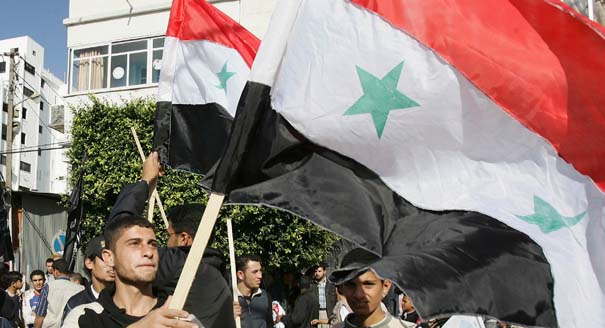
Source: Getty

In The Media

Syria's Increasingly Brutal Civil War

As violence continues to spiral out of control in Syria, all signs point to a protracted struggle for the future of Syria.

Link Copied
By Frederic Wehrey
Published on Aug 1, 2012

Source: BBC

Speaking on the BBC, Frederic Wehrey commented that both the Syrian regime and the rebels have become increasingly brutal in their tactics. After the rebels' assassination of top officials in Damascus, Assad has decidedly increased the draconian crackdown against the protesters and rebel forces. Wehrey noted that “this is a regime that has ruled through fear and an iron fist. Assad is calculating that if he shows any sign of capitulation or weakness that it’s his downfall, it’s a slippery slope.” Moreover, Assad may believe that this civil war is still winnable, Wehrey added. He is surrounded by his own supporters and views himself and his regime as the protectors of the Alawi community. He is protected by the elite Republican Guard Corps, commanded by his brother. With both the rebels and the regimes forces continuing their brutality and evolving their tactics, Wehrey concluded that, for the moment, all signs point to a protracted struggle for the future of Syria.

About the Author

Frederic Wehrey

Senior Fellow, Middle East Program

Frederic Wehrey is a senior fellow in the Middle East Program at the Carnegie Endowment for International Peace, where his research focuses on governance, conflict, and security in Libya, North Africa, and the Persian Gulf.

    Recent Work

  • Research
    Russia in Africa: Examining Moscow’s Influence and Its Limits
      • Nate Reynolds
      • +11

      Frances Z. Brown, Nate Reynolds, Priyal Singh, …

  • Commentary
    How the Flaws of Trump’s Gaza Deal Prevent an Enduring Peace

      Charles H. Johnson, Frederic Wehrey

Frederic Wehrey
Senior Fellow, Middle East Program
Frederic Wehrey
Political ReformSecurityMiddle EastSyriaLevant

Carnegie does not take institutional positions on public policy issues; the views represented herein are those of the author(s) and do not necessarily reflect the views of Carnegie, its staff, or its trustees.

More Work from Carnegie Russia Eurasia Center

  • Commentary
    Carnegie Politika
    Russia Is Meddling for Meddling’s Sake in the Middle East

    The Russian leadership wants to avoid a dangerous precedent in which it is squeezed out of Iran by the United States and Israel—and left powerless to respond in any meaningful way.

      Nikita Smagin

  • Commentary
    Carnegie Politika
    Is Frustration With Armenia’s Pashinyan Enough to Bring the Pro-Russia Opposition to Power?

    It’s true that many Armenians would vote for anyone just to be rid of Pashinyan, whom they blame for the loss of Nagorno-Karabakh, but the pro-Russia opposition is unlikely to be able to channel that frustration into an electoral victory.

      Mikayel Zolyan

  • Commentary
    Carnegie Politika
    The Afghanistan–Pakistan War Poses Awkward Questions for Russia

    Not only does the fighting jeopardize regional security, it undermines Russian attempts to promote alternatives to the Western-dominated world order.

      Ruslan Suleymanov

  • Commentary
    Carnegie Politika
    After Ilia II: What Will a New Patriarch Mean for Georgia?

    The front-runner to succeed Ilia II, Metropolitan Shio, is prone to harsh anti-Western rhetoric and frequent criticism of “liberal ideologies” that he claims threaten the Georgian state. This raises fears that under his leadership the Georgian Orthodox Church will lose its unifying role and become an instrument of ultraconservative ideology.

      Bashir Kitachaev

  • Commentary
    Carnegie Politika
    Tokayev’s New Constitution Is a Bet on Stability—At Freedom’s Expense

    Kazakhstan’s new constitution is an embodiment of the ruling elite’s fears and a self-serving attempt to preserve the status quo while they still can.

      Serik Beysembaev

Get more news and analysis from
Carnegie Russia Eurasia Center
Carnegie Russia Eurasia logo, white
  • Research
  • Politika
  • About
  • Experts
  • Events
  • Contact
  • Privacy
  • For Media
Get more news and analysis from
Carnegie Russia Eurasia Center
© 2026 Carnegie Endowment for International Peace. All rights reserved.