

In The Media
David Rothkopf
{
  "authors": [
    "David Rothkopf"
  ],
  "type": "legacyinthemedia",
  "centerAffiliationAll": "",
  "centers": [
    "Carnegie Endowment for International Peace"
  ],
  "collections": [],
  "englishNewsletterAll": "",
  "nonEnglishNewsletterAll": "",
  "primaryCenter": "Carnegie Endowment for International Peace",
  "programAffiliation": "",
  "programs": [],
  "projects": [],
  "regions": [
    "North America",
    "United States"
  ],
  "topics": [
    "Foreign Policy"
  ]
}
Source: Getty
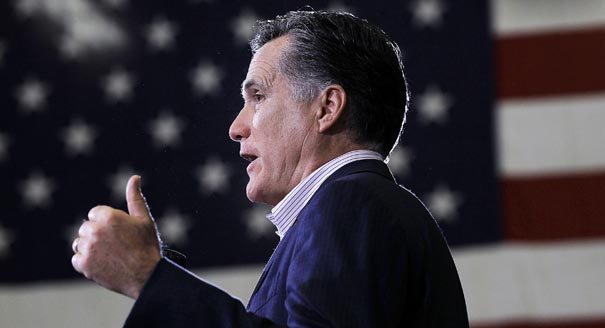
Recent gaffes during his trip abroad to Great Britain, Israel, and Poland may have undermined Mitt Romney's efforts to portray himself as a strong U.S. leader abroad.
Source: Foreign Policy

While the goof you made in England was low-grade -- a classic kerfuffle over a candidate accidentally being honest in public -- it raised questions about your judgment, or the advice you were getting, or both. Had your trip to Israel gone well, it would quickly have settled into the soufflé of stories that pass for news during the summer silly season.
But the Israel trip was marked by an even bigger error. This one was not a classic "gaffe," the Washington word for a gotcha moment that political hacks try to spin to their advantage almost as hard as regular humans try to ignore it. Rather, it was something deeper, a true foreign-policy blunder that revealed both a deep misunderstanding of a critical issue and a willingness to sacrifice U.S. interests in exchange for political cash.The statement, a suggestion that Israel had thrived while Palestinians struggled because of the innate superiority of the Israelis, was also something more. It was racist. There are two possibilities here. One is that Romney was given by bad advice about what to say by his staff. The other is that he either ignored the advice he got or misunderstood it and was personally responsible for saying the stupid thing he said. (The likelihood of this latter possibility goes up, by the way, when it is noted that the language he used is similar to elements of his memoir in which he muses about the reason nations decline. In other words, he may actually believe the awful, damaging statement he made.)
Not only was the statement manifestly untrue, it showed a really deep misunderstanding of the plight of the Palestinians and worse, a failure to grasp that the key to peace in that part of the world will be helping the Palestinians tap their extraordinary human resources and flourish economically on their own. The statement immediately produced a backlash from Palestinians, with whom the United States and Israel must work to achieve a lasting settlement. And that it was all done at a fundraiser to pander to big donors -- including Sheldon Adelson, a casino magnate who once called the Palestinians an "invented people" and likened AIPAC's support for peace talks to "committing suicide" -- somehow managed to cheapen what was pretty dumb to begin with.
If Romney were following the advice of his staff when he made either his London gaffe or his Israel blunder, he should fire them. If they didn't advise him to say these things, but failed to give him useful advice about what not to say, he should fire them. And even if they did give him smart things to say and useful guidance about what not to say, he should fire them -- because he can't quit and he'd better find a team he actually trusts enough to avoid falling victim to his own bad judgment again.
Of course, the trip did not end in Israel, and to add injury to his prior insults, his spokesperson threw a few choice expletives in the direction of Romney's press corps in Poland. Although this too might have been warranted, and while Rick Gorka is certainly not the first press aide to feel campaign journalists ought to kiss his ass or "shove it," he ought to have kept it to himself. He too should be fired.
Firing the foreign-policy team that advised Romney on this trip is not an extreme recommendation. That team is famously riven by divides -- between neocons and moderates, between Boston and Washington, between political advisors and policy wonks. They're the ones who had him frame U.S.-Russian relations in terms suitable for the height of the Cold War. In fact, on a regular basis, they have been promoting the kind of Tarzan America policies that are a throwback to an era for which no one except defense contractors has any nostalgia.
What's more, the repeated foreign-policy misstatements and the missteps on this trip undermine one of Romney's main selling points. Supposedly, his experience as a chief executive and manager has helped prepare him to run a government better than the "community organizer" commander-in-chief he regularly attacks. But to date -- between these problems and the mindboggling mismanagement of his financial disclosure -- there is absolutely no evidence to suggest that this is a well-run campaign. Quite the contrary: It's a mess, regularly producing bad headlines and failing to take advantage of the abysmal state of the economy -- a campaign gift that should, on its own, give him a solid lead in the polls right now.
If Romney recognizes the need to quickly get rid of the baggage he picked up on this trip -- and the people who are responsible for the unpleasant memories of his summer vacation -- then he may someday look back on this whole experience as having had some positive consequences. If he does not, he is likely to face further problems in the future.
Campaigns, like presidents, face 3 a.m. phone calls, too. In the weeks ahead, a major overseas development or more than one could demand a quick, thoughtful reaction that will be seen as a measure of Romney's ability to lead. Remember: It was John McCain's stumble after the Lehman crisis, as much as any of his other errors, that irreversibly eroded any edge he may have had. Whether the call comes on Europe's economy, the collapse of Bashar al-Assad's regime in Syria (or some new atrocity it may commit), a terrorist attack, a problem in the South China Sea, a North Korean provocation, or an incident along the U.S. border with Mexico, the world is volatile enough today that an unprepared campaign is vulnerable to making a fatal error.
This not-so-excellent adventure proved it: Romney's foreign-policy team is not ready for prime time. They're floundering, and with less than 100 days to go in the campaign, the Republican candidate has only a few short weeks to make the changes needed to avoid another series of screw-ups that could cost him the presidency or worse, set him, us, and the world up for a sequence of much more serious problems were he actually to be elected.

Former Visiting Scholar
David Rothkopf was a visiting scholar at the Carnegie Endowment as well as the former CEO and editor in chief of the FP Group.
Recent Work
David Rothkopf
David Rothkopf
Carnegie does not take institutional positions on public policy issues; the views represented herein are those of the author(s) and do not necessarily reflect the views of Carnegie, its staff, or its trustees.
Ongoing uncertainty in the Middle East allows Moscow to both increase its influence in Tehran and continue to enjoy the financial windfall of higher oil prices.

Nikita Smagin

This year’s wars have made alternative routes to transit through Russia no less risky for Central Asian countries.

Galiya Ibragimova
Reestablishing a dialogue with Moscow is not a goal in its own right. The goal is to guarantee the independence of Ukraine and the peace and security of Europe.
Arkady Moshes

By fueling the arguments of both supporters and opponents of Armenian Prime Minister Nikol Pashinyan, Azerbaijan wants to ensure he is re-elected with a weaker mandate.

Bashir Kitachaev
By reminding the world that Lukashenko is a threat to NATO and Ukraine, Kyiv is trying to return the focus to why the Belarusian regime needs to be contained rather than rewarded.

Artyom Shraibman