

Commentary
Yukon Huang, Isaac B. Kardon, Matt Sheehan
{
  "authors": [
    "Yukon Huang"
  ],
  "type": "legacyinthemedia",
  "centerAffiliationAll": "dc",
  "centers": [
    "Carnegie Endowment for International Peace"
  ],
  "collections": [],
  "englishNewsletterAll": "asia",
  "nonEnglishNewsletterAll": "",
  "primaryCenter": "Carnegie Endowment for International Peace",
  "programAffiliation": "AP",
  "programs": [
    "Asia"
  ],
  "projects": [],
  "regions": [
    "East Asia",
    "China"
  ],
  "topics": [
    "Political Reform",
    "Economy"
  ]
}
Source: Getty
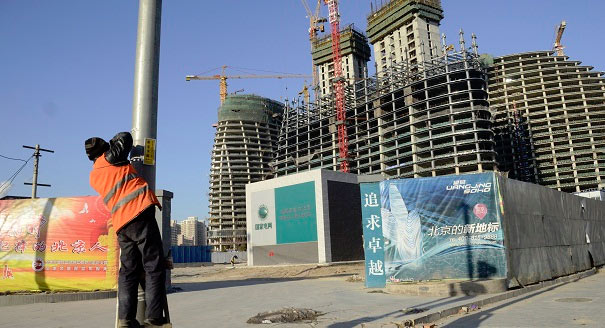
Beijing needs to reform its labor migration policies and use the profits from state enterprises to fund social services.
Source: Wall Street Journal
China's recently announced plan to deal with rising inequalities, or "reform income distribution," was years in the making. The difficulty of reaching a consensus says something about the strength of vested interests in China's political system.
The debate was unusually broad, ranging from the need for property taxes and agricultural support prices to the role of the state in influencing returns to firms and labor. Given the lack of details and firm targets, it's not clear whether this plan will effectively tackle the sources of inequality that are most harmful to development.
Rapidly growing economies tend to experience widening disparities. China's growth has lifted some 600 million out of poverty even as its Gini coefficient, a measure of income inequality, has soared to 0.47 today from 0.25 in the mid-1980s. Although high, China's Gini is comparable to that of the U.S. and other relatively successfully Asian economies such as Singapore and Malaysia.The Gini number is less important than the reasons behind it. Inequality is positive when it emanates from productivity increases, entrepreneurial risk-taking and structural changes that produce sustained growth. Harmful inequality comes from distortions that ultimately undermine the development process.
It is the latter kind of inequality that Beijing has been slow to address. First, policy distortions have exaggerated geographical disparities. Second, the government budget has failed to provide equal access to social services. And finally, links between government-party officials and commercial activities have led to excessive rent-seeking.
China's geographical inequality is extreme compared to other countries. Per capita urban incomes in China are more than three times that of rural residents, and coastal incomes are more than twice that of the interior.
Some of this is the result of fast industrialization as China naturally concentrated export-oriented industries along the coast. These differences are partially self-correcting as economic activity is now moving inland and earnings are increasing more rapidly in the interior.
But some of these geographic imbalances are the result of policies such as the restrictive residency system known as hukou. This prevents more than 200 million migrant workers who have flocked to the major cities from gaining access to social services and jobs on the same basis as established residents. That exacerbates urban to rural and regional income disparities. How serious the new leadership will be in actually liberalizing the hukou system is still uncertain, although the new plan has indicated the intention to do so.
Next, for a socialist economy where the state controls the bulk of resources, the budget plays a surprisingly limited role in providing the level of social services needed to moderate rising disparities. China's budget as a share of the economy is only two-thirds that of other middle-income countries, and half that of the European Union. As a consequence, welfare spending has been inadequate, amounting to about half the level of comparable middle-income countries.
The limited role of the budget reflects, in part, a failure to secure more revenue from the state enterprises that control much of the country's resources. Their profits have soared over the past decade given their favored position, but compared with other countries, China's state enterprises pay much less to the state in the form of dividends. Even these modest amounts were largely allocated to other firms for investment rather than made available to the budget for social services. Thus, the proposal to increase payments by five percentage points is welcome, although this would still be quite low compared to other countries.
The third source of harmful inequality is the linkage between the government-party apparatus, state banks and enterprises. This leads to corrosive practices ranging from clear cases of corruption to grey areas where conflicts of interests and earnings built on relationships generate excessive incomes. Senior leaders recognize that these issues threaten the legitimacy of the political system.
The new plan touches on the symptoms of this problem by demanding that officials report their income and assets, but much more is needed to tackle the underlying causes. At its broadest level, dealing with China's bad inequalities will require a change in the mindset regarding the importance of the rule of law, something that is unlikely to happen quickly.
In the meantime, however, reforms to labor migration and dividend policies could go a long way toward eliminating "bad" inequalities. For instance, channeling one-third of the overall profits of state enterprises to the budget to fund social services for households would help provide the resources necessary to equalize the quality of such programs across regions. Combined with eliminating "hukou" restrictions, this might increase household consumption by several percentage points of GDP.
Such reforms would dramatically affect the nature of global macro imbalances by increasing China's imports. Thus dealing with the harmful sources of income inequality not only addresses a social concern, it also offers a way to reduce trade tensions between China and the West.
This article was originally published in the Wall Street Journal.

Senior Fellow, Asia Program
Huang is a senior fellow in the Carnegie Asia Program where his research focuses on China’s economy and its regional and global impact.
Recent Work

Yukon Huang, Isaac B. Kardon, Matt Sheehan
Yukon Huang, Genevieve Slosberg
Carnegie does not take institutional positions on public policy issues; the views represented herein are those of the author(s) and do not necessarily reflect the views of Carnegie, its staff, or its trustees.

If the Russian-speaking community in Latvia cannot articulate their interests without being seen as disloyal, they could end up embracing a pro-Kremlin agenda.

Sergejs Potapkins

Russia’s ruling party would have benefited from Putin appearing as its distant patron, but as an active frontman imposing his views on the public, he has done nothing but harm both the party’s election campaign and the ruling system overall.

Andrey Pertsev

Depleted financial reserves and a shrinking tax base mean it is no longer possible to simultaneously deliver high defense spending, price stability, and economic growth.

Alexandra Prokopenko

In the tenth year of his presidency, President Mirziyoyev’s system is becoming even more personalized than that of his predecessor Karimov.

Galiya Ibragimova

With the growth in points of friction between the great powers, organizations like the SCO will continue to play a role in the strategic adaptation of the smaller powers caught between them.

Temur Umarov