

Commentary
Uri Dadush
{
  "authors": [
    "Uri Dadush"
  ],
  "type": "legacyinthemedia",
  "centerAffiliationAll": "",
  "centers": [
    "Carnegie Endowment for International Peace",
    "Carnegie Europe"
  ],
  "collections": [],
  "englishNewsletterAll": "",
  "nonEnglishNewsletterAll": "",
  "primaryCenter": "Carnegie Endowment for International Peace",
  "programAffiliation": "",
  "programs": [],
  "projects": [],
  "regions": [
    "Western Europe",
    "Europe",
    "North America"
  ],
  "topics": [
    "Economy",
    "EU"
  ]
}
Source: Getty
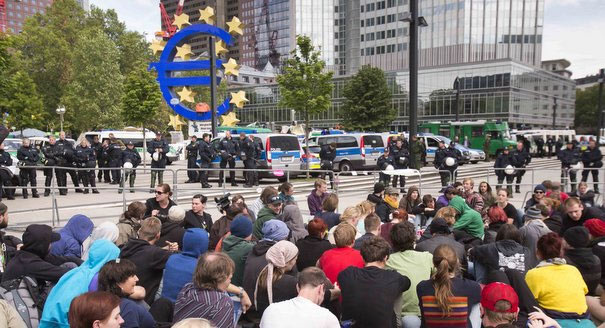
If growth does not return to Europe in the next two years, the political situation will become more difficult.
Source: CRI English
The European economy has exhibited dire trends, explained Carnegie's Uri Dadush on CRI English. Greece continues to cut state positions, Spain has observed its highest unemployment rate ever at 27 percent, the UK's economic growth remains sluggish, and Italy is only now forming a new government. Dadush argued that more can be done by Germany and the center of Europe to reflate the economy and allow wages to rise. Moreover, he stated that the European Central Bank could probably be more aggressive with its quantitative easing. Dadush stressed that it is difficult for countries like Italy and Spain to implement any policies other than austerity, as markets will not lend them the money and governments are unable to finance their budget deficits. Spain and Italy need to regain the confidences in the markets. Only once markets improve significantly and confidence returns, Dadush stated, can they practice more expansionary policies. If growth does not return in the next two years, the political situation will become more difficult, and all bets will be off.

Former Senior Associate, International Economics Program
Dadush was a senior associate at the Carnegie Endowment for International Peace. He focuses on trends in the global economy and is currently tracking developments in the eurozone crisis.
Recent Work
Uri Dadush
Uri Dadush
Carnegie does not take institutional positions on public policy issues; the views represented herein are those of the author(s) and do not necessarily reflect the views of Carnegie, its staff, or its trustees.

For every ruble allocated to social policy, health, and education in 2027, double that amount is earmarked for the army, the police, and the security services.

Alexandra Prokopenko

The European far right might fail to steer EU policy in the direction Russia wants, but they will create enough chaos inside Europe to benefit the Kremlin.

Dimitar Bechev

If the Russian-speaking community in Latvia cannot articulate their interests without being seen as disloyal, they could end up embracing a pro-Kremlin agenda.

Sergejs Potapkins

Depleted financial reserves and a shrinking tax base mean it is no longer possible to simultaneously deliver high defense spending, price stability, and economic growth.
Alexandra Prokopenko
Andrey Melnichenko’s essay offers no answer to the fundamental question of how, under any kind of negotiated settlement, Europe can protect itself from the Russian ressentiment that is inevitable in all scenarios except for an outright victory for Putin.

Leonid Bershidsky