

Commentary
The European far right might fail to steer EU policy in the direction Russia wants, but they will create enough chaos inside Europe to benefit the Kremlin.
Dimitar Bechev
{
  "authors": [
    "Milan Vaishnav",
    "Christophe Jaffrelot"
  ],
  "type": "legacyinthemedia",
  "centerAffiliationAll": "dc",
  "centers": [
    "Carnegie Endowment for International Peace"
  ],
  "collections": [],
  "englishNewsletterAll": "ctw",
  "nonEnglishNewsletterAll": "",
  "primaryCenter": "Carnegie Endowment for International Peace",
  "programAffiliation": "SAP",
  "programs": [
    "South Asia"
  ],
  "projects": [],
  "regions": [
    "South Asia",
    "India"
  ],
  "topics": [
    "Political Reform"
  ]
}
Source: Getty
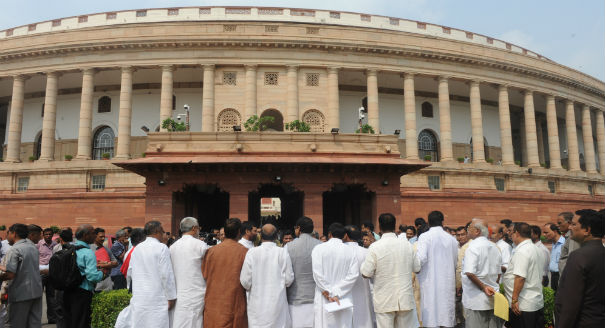
Criminal behavior is rampant across party lines in India, and it threatens to undermine public faith in democracy if left unchecked.
Source: Indian Express
Instances of "grand corruption" have become common in India, increasing in frequency since the Bofors affair. Since then, India has suffered through (among others) the Hawala case, the 1992 securities scam and now the CWG and 2G scams, as well as the swindle commonly known as "Coalgate." The magnitude of these scams has grown even more quickly than India's GDP, from a meager Rs 65 crore in the case of Bofors, to Rs 5,000 crore for the securities scam to a mind-boggling presumptive loss of Rs 57,666 crore in the 2G scam.
This evolution shows that, contrary to the hopes of liberalization proponents, economic reform has created new avenues for large-scale corruption (even as it has choked off old channels, like industrial licensing) and for a simple reason: liberalization involves a transition process in which the state retains considerable discretionary power — it sets the rules of the game, controls the pace of change and regulates the playing field. Further, even after 1991, the state has largely retained control over the "commanding heights" of the economy. Yet, it appears that the price attached to obtaining government clearance has grown—witness the evolution in the telecom sector from Sukh Ram to A. Raja—with the entry of big players (multinational companies from India and abroad) that politicians could approach for covering their expenditures. These expenses are both personal and political in nature, with the cost of elections rising so much that the Election Commission's ceilings have become meaningless.Besides grand corruption, however, the criminalization of politics has also put down roots in India's democracy. Criminalization is a distinct but related concept from corruption: politicians with criminal associations exploit the vacuum presented by the corrupt state, but they also reinforce its pathologies. The data that candidates at the state and national levels now must disclose to the EC, and which one of us (Vaishnav) has extensively analyzed, enables us to measure this phenomenon in many different ways. As many have reported, the data show that out of 543 sitting MPs, 163 (or 30 per cent) face some type of criminal charge. Naturally, one needs to disaggregate criminal charges to separate minor violations from potentially serious ones. To separate "serious" crimes, we discard minor charges, such as those that might be related to elections, campaigning, opinion, lifestyle, speech or assembly — or those plausibly related to a politician's vocation. We are left with charges of a serious nature (a subset of "serious" charges can be called "heinous," which is even narrower in scope). For instance, assault to deter a public servant from discharging his duty is a "serious" charge, while murder and attempted murder qualify for the "heinous" category. Among sitting MPs, 103 (roughly 19 percent) are accused of serious charges and 74 (about 13.5 percent) of heinous charges.
The criminalization of politics affects political parties of all stripes, but with interesting differences of degree. In percentage terms, Shiv Sena tops the list with nine of its 11 MPs (82 per cent) facing criminal charges. Two parties sharing a similar battle field (geographically as well as sociologically), the SP and the JD(U) also share a similar profile insofar as criminalization is concerned, with roughly 40 per cent of MPs under criminal scrutiny. The BSP lags behind with "only" 29 percent of its MPs facing such a dubious distinction.
But the two large, national parties are, for obvious reasons, the most interesting ones to examine. While the BJP claims that it is "a party with a difference," 44 of its 116 MPs (38 percent) stand accused of criminal charges when "only" 22 per cent of the 206 Congress MPs are in this uncomfortable position. The differences remain even when one disaggregates criminal charges: 24 per cent of BJP MPs and 14 percent of Congress MPs are accused of serious crimes, while 16.5 percent and 6 percent respectively are accused of heinous crimes.
In which states are these national parties the most badly affected? Surprisingly, if we go by the clean image of Gujarat after 12 years of a government that has brandished its credentials for tackling corruption and crime, the BJP in Narendra Modi's state is not very different than in UP and Bihar, with respectively 40, 30, and 50 percent of its MPs facing serious charges. The situation is better at the MLA level, however, since "only" 12 percent of Gujarat MLAs are carrying heinous charges (2012 data comes from ADR). The situation is much more precarious in Bihar, where the corresponding figure for the BJP is 32 percent.
By and large, out of 1,200 BJP MLAs (elected before 2010) for which we have collected data, 15 percent stand accused of serious charges and 10 percent of heinous charges. The Congress does slightly better with 8 percent and 6 percent, respectively, accused of these two kinds of charges out of 1,515 MLAs.Clearly, the BJP MPs and MLAs have more to fear from the judiciary than their Congress counterparts. This is not simply the result of the victimization of the opposition; after all, the BJP led all parties in candidates facing criminal charges in the 2010 Bihar elections, even though it had jointly ruled the state for the prior five years. The other conclusion one can draw from these figures pertains to the growing magnitude of the criminalization process along a political career: the share of criminally suspect among MPs is larger than the one we find among MLAs. Lord Acton, a British historian who died more than 100 years ago, famously remarked, "Power corrupts, absolute power corrupts absolutely." He could be paraphrased here: power corrupts, and the more power one gets, the more corrupt one may be.
This is precisely why the rule of law requires a robust, independent judiciary. In the 1990s, the Supreme Court initiated a phase of judicial activism that culminated in the Hawala case. Seven ministers of the P.V. Narasimha Rao government, two governors and the leader of the opposition in Lok Sabha were compelled to resign and some even preferred to let their wives contest the 1996 elections, or to stand as independents. Those who are still alive are all back in politics, with their original party. The court reinvigorated the Central Vigilance Commission and tried hard to emancipate the Central Bureau of Investigation (CBI) from political subordination. Recent allegations regarding the submission of the CBI report to the law minister regarding the Coalgate scam suggests that this problematic link is still strong.
So far, several surveys suggest that citizen confidence in the judiciary remains strong, in spite of recent corruption cases and growing concerns about its capacity, and so far the willingness of the Indian citizens to vote has not been eroded—on the contrary. Yet popular faith in the democratic process and the rule of law should not be taken for granted; criminalization, if not checked, has the capacity to erode trust in both.

Director and Senior Fellow, South Asia Program
Milan Vaishnav is a senior fellow and director of the South Asia Program and the host of the Grand Tamasha podcast at the Carnegie Endowment for International Peace. His primary research focus is the political economy of India, and he examines issues such as corruption and governance, state capacity, federalism, and electoral behavior. He also conducts research on the Indian diaspora.
Former Nonresident Scholar, South Asia Program
Jaffrelot’s core research focuses on theories of nationalism and democracy, mobilization of the lower castes and Dalits (ex-untouchables) in India, the Hindu nationalist movement, and ethnic conflicts in Pakistan.
Carnegie does not take institutional positions on public policy issues; the views represented herein are those of the author(s) and do not necessarily reflect the views of Carnegie, its staff, or its trustees.

The European far right might fail to steer EU policy in the direction Russia wants, but they will create enough chaos inside Europe to benefit the Kremlin.

Dimitar Bechev

If the Russian-speaking community in Latvia cannot articulate their interests without being seen as disloyal, they could end up embracing a pro-Kremlin agenda.

Sergejs Potapkins

Russia’s ruling party would have benefited from Putin appearing as its distant patron, but as an active frontman imposing his views on the public, he has done nothing but harm both the party’s election campaign and the ruling system overall.

Andrey Pertsev

In the tenth year of his presidency, President Mirziyoyev’s system is becoming even more personalized than that of his predecessor Karimov.

Galiya Ibragimova

With the growth in points of friction between the great powers, organizations like the SCO will continue to play a role in the strategic adaptation of the smaller powers caught between them.

Temur Umarov