

Commentary
Temur Umarov
{
  "authors": [
    "Temur Umarov"
  ],
  "type": "commentary",
  "blog": "Carnegie Politika",
  "centerAffiliationAll": "",
  "centers": [
    "Carnegie Endowment for International Peace",
    "Carnegie Russia Eurasia Center"
  ],
  "collections": [
    "Aso Tavitian Initiative"
  ],
  "englishNewsletterAll": "",
  "nonEnglishNewsletterAll": "",
  "primaryCenter": "Carnegie Russia Eurasia Center",
  "programAffiliation": "",
  "regions": [
    "Kyrgyz Republic",
    "Central Asia"
  ],
  "topics": [
    "Political Reform",
    "Domestic Politics"
  ]
}
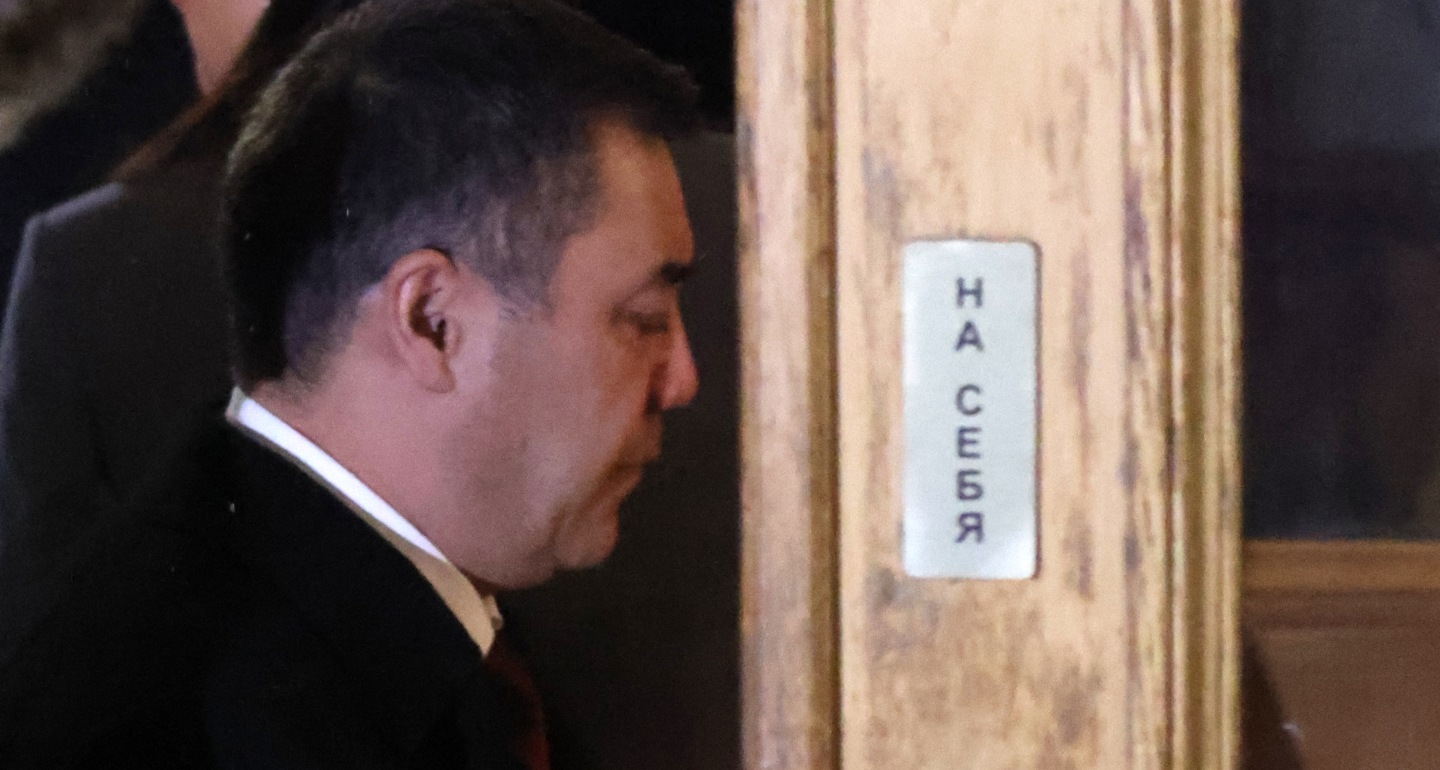
Source: Getty
Despite its reputation as an island of democracy in Central Asia, Kyrgyzstan appears to be on the brink of becoming a personalist autocracy.
In early February, a hospital in the German city of Munich admitted a VIP patient: Kamchybek Tashiev, the powerful head of Kyrgyzstan’s State Committee for National Security (GKNB) and the president’s second-in-command. When he was discharged a few days later, he no longer had any authority or official position. His longtime friend President Sadyr Japarov had used the moment to strip him of his position, fire his deputies, and reform the GKNB.
Tashiev publicly admitted that the news had come as a surprise to him. Japarov’s team explained that Tashiev himself had done nothing wrong, but that people close to him were undermining stability in the country while hiding behind his name. The real reason for the disintegration of Kyrgyzstan’s ruling tandem, however, was more mundane: it was the inevitable culmination of Japarov’s gradual consolidation of his grip on power.
A ruthless security official, Tashiev had spent years doing Japarov’s dirty work: destroying the political opposition and independent journalism, reining in powerful tycoons, and decapitating once-influential crime gangs. Eventually, though, he was no longer needed. With a presidential election scheduled for January 2027, Japarov has to come up with a way of remaining in power. Amid this delicate political maneuvering, any alternative power center is a threat.
For decades, Kyrgyzstan has been dubbed an “island of democracy” in Central Asia. Japarov is the country’s sixth president since the collapse of the Soviet Union: a record for a region in which some leaders cling on for decades. But few of the presidents gave up power voluntarily; most were forced out by street protests.
Indeed, it was opposition protests following parliamentary elections in 2020 that catapulted Japarov to power. However, he would never have become president without his old friend Tashiev, who managed to get him out of prison at just the right moment.
The friendship between the two men dates back to the late 2000s, when they took part in interethnic clashes in the south of the country (neither man has hidden his Kyrgyz nationalism). On the back of their involvement, Japarov and Tashiev ran in the 2010 parliamentary elections with the nationalist Ata-Zhurt (Fatherland) party, which swept to success.
In 2012, they campaigned to nationalize the country’s biggest gold mine, Kumtor, and tried, unsuccessfully, to storm the White House in Bishkek. Afterward, both men were stripped of their status as parliamentarians, and Japarov, after a few years abroad, returned home and was jailed. Tashiev—always the less public figure—remained at liberty, where he created the nationalist party Mekenchil (Patriot).
By 2020, Japarov and Tashiev had emerged as two of the most popular politicians in Kyrgyzstan. Ten days after being released from prison amid unrest that followed parliamentary elections, Japarov was acting president. He immediately appointed Tashiev to head the GKNB. Even at this point there were rumors about tensions—but the two men never admitted to them publicly. “Only Allah can separate us,” Tashiev said of his friendship with Japarov at a 2020 press conference.
Once in charge, Japarov and Tashiev set about “imposing order.” While Japarov ran the economy and foreign policy, Tashiev guaranteed security. The tandem secured the election of a docile parliament, gave themselves additional powers under a new constitution, and kept a firm grip on public life.
With time, however, the friendship became more and more toxic for Japarov—particularly when Tashiev’s nationalism hampered the president’s efforts to improve relations with the country’s neighbors. While Japarov was trying to resolve a border dispute with Tajik President Emomali Rahmon, for example, Tashiev continued to escalate tensions by issuing new threats. His harsh rhetoric also nearly derailed the signing of border agreements with Uzbekistan.
At the same time, Japarov needed Tashiev. One by one, Tashiev dealt with the regime’s opponents. Younger politicians and civil society activists who put up any resistance, along with those who supported previous presidents, were either jailed or fled abroad. Like a sponge, Tashiev soaked up all the anger about this repression, allowing Japarov to preserve his reputation.
Of course, Tashiev did not do all of this out of the goodness of his own heart. In return, he was allowed to turn the GKNB into an enormously influential body, which absorbed the remit and budgets of other agencies. In 2022, the GKNB opened as many as fifty new buildings. Over time, Tashiev became ever more ambitious, involving himself in political decisionmaking across a whole range of issues. He fired government employees and in one case even punched an official.
Japarov had clearly prepared for Tashiev’s dismissal. He chose a moment when his powerful ally was out of the country and in the hospital. And he not only fired Tashiev, but also three of his deputies. At the same time, Japarov redistributed the powers of the GKNB, including to newly created agencies. In other words, Japarov rid himself of his influential friend and ensured that a second Tashiev could never emerge.
From Munich, Tashiev said that he would respect the president’s decision and returned to Kyrgyzstan on February 13. Neither Tashiev nor his relatives have been accused of any wrongdoing. It seems Japarov is offering Tashiev the opportunity to acquiesce and live quietly.
Indeed, the lack of political drama is so unusual for Kyrgyz politics that it has generated speculation that Japarov and Tashiev are just pretending: that in actual fact, they have conspired to allow Tashiev to serve as president before Japarov returns in five years. However, this is unlikely. The reality is that Japarov has no need for such a complicated and risky scheme when he has complete control over the country.
When Japarov was elected, the constitution limited presidents to one six-year term. But the new constitution introduced under Japarov allows for two five-year terms. He has already asked the Constitutional Court whether he can run again in 2027—and is almost certain to get the affirmative decision he seeks on the grounds that the new constitution was adopted when he was already in power.
Today, Japarov appears to be on the brink of achieving what none of his predecessors managed: making Kyrgyzstan a personalist autocracy. He has learned from the mistakes of previous leaders, sought to broker agreements with his enemies, concentrated power in his own hands, and carried out a symbolic national renewal (including changing the country’s flag and launching a competition to find a new national anthem).
However, it’s unclear whether Japarov will ultimately be successful. Tashiev might accept his lot for the moment, but that doesn’t mean his supporters and other members of the Kyrgyz elite will simply forget. The moment they decide there is an opportunity to renegotiate the status quo, or when Japarov shows weakness, these old grudges will resurface—and life will return to Kyrgyz politics.

Fellow, Carnegie Russia Eurasia Center
Temur Umarov is an expert on China and Central Asia, and a fellow at the Carnegie Russia Eurasia Center.
Recent Work
Temur Umarov
Temur Umarov
Carnegie does not take institutional positions on public policy issues; the views represented herein are those of the author(s) and do not necessarily reflect the views of Carnegie, its staff, or its trustees.

Ex-president Gurbanguly Berdimuhamedov remains interested in politics, but his son Serdar, Turkmenistan’s current president, is becoming increasingly independent and willing to break with his father’s legacy. If their covert rivalry goes too far, both risk losing power.

Galiya Ibragimova

For every ruble allocated to social policy, health, and education in 2027, double that amount is earmarked for the army, the police, and the security services.

Alexandra Prokopenko
An analysis of traffic accident data suggests that Ukrainian drone attacks caused a material but not disastrous fall in Russian gasoline consumption over the summer.

Sergey Vakulenko

Sergei Kiriyenko used Russia’s parliamentary vote to further hone his strategy of corporate mobilization that is designed to maximize votes for United Russia.

Andrey Pertsev

The European far right might fail to steer EU policy in the direction Russia wants, but they will create enough chaos inside Europe to benefit the Kremlin.

Dimitar Bechev