

Commentary
Dmitri Trenin
{
  "authors": [
    "Dmitri Trenin"
  ],
  "type": "commentary",
  "centerAffiliationAll": "",
  "centers": [
    "Carnegie Endowment for International Peace",
    "Malcolm H. Kerr Carnegie Middle East Center",
    "Carnegie Russia Eurasia Center"
  ],
  "collections": [],
  "englishNewsletterAll": "",
  "nonEnglishNewsletterAll": "",
  "primaryCenter": "Carnegie Russia Eurasia Center",
  "programAffiliation": "",
  "programs": [],
  "projects": [],
  "regions": [
    "Gulf",
    "Middle East",
    "Iran"
  ],
  "topics": [
    "Political Reform"
  ]
}
Source: Getty
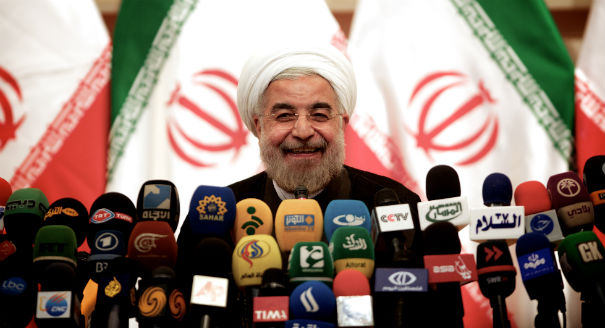
The international community is most interested in the foreign policy implications of the Iranian election. The combination of Rowhani in Tehran and Obama at the White House looks fortunate for diplomacy and peace. The reality will clearly be more complicated.
Iranian voters have confounded Iran experts. Few had predicted a clear first-round win for any candidate, not to speak of the most moderate one of the six. Iran may be a theocracy, but one where election results are not predictable in advance, and where the presumed preference of the supreme leader does not guarantee the outcome.
Yet, Iran is a theocracy, where the president of the Islamic republic is formally subordinated to the religious authority. Presidents may be radical, moderate or pragmatic, but they do not have the last word in Iran. Supreme Leader Khamenei, in power since 1989, does. So, what is the import of the 2013 vote—Iran’s 11th presidential election?
President-elect Rowhani is described as a reformist. What kind of reforms does he intend to initiate in the economic, political, and social spheres? As he proceeds with reforms, how much support is he likely to receive from the various social groups—he was elected with just over 50% of the popular vote—and from the supreme leader? How are other vested interests likely to react to that?
The international community is most interested, of course, in the foreign policy implications of the Iranian election. Rowhani, a former nuclear negotiator, is well known to his Western, Chinese, and Russian counterparts. Iran’s nuclear program will certainly continue, but can Rowhani’s election, essentially approved by Khamenei, lead to an agreement on its parameters in the remaining three years of the Obama Administration?
The combination of Rowhani in Tehran and Obama at the White House looks fortunate for diplomacy and peace. The reality will clearly be more complicated. The situation in the Middle East is getting more serious. The conflict in Syria increasingly appears to be a proxy war between Iran and its Shia Hezbullah ally, on one hand, and the Sunni coalition led by Saudi Arabia, with Qatar’s super-active role, on the other. There can be no settlement in Syria unless Iran and Saudi agree to join the political process.
The positive surprise of the Iranian election should not lead to elation. The fundamentals in Iran have not changed. A moderate president—Mohammad Khatami—did lead Iran before, from 1997 till 2005, and that chance was not used by U.S. Presidents Clinton and George W. Bush to reach out to Iran. Similarly, Iran’s supreme leader failed to reach out to Barack Obama’s outstretched hand in 2009, thus missing another opportunity. Will it be different this time? We will see.
Former Director, Carnegie Moscow Center
Trenin was director of the Carnegie Moscow Center from 2008 to early 2022.
Recent Work
Dmitri Trenin
Dmitri Trenin
Carnegie does not take institutional positions on public policy issues; the views represented herein are those of the author(s) and do not necessarily reflect the views of Carnegie, its staff, or its trustees.
Anger over online restrictions has led to a surge in support for the New People party, which has replaced the Communists as Russia’s second most popular political party.

Andrey Pertsev
The Russian regime is now visibly motivated by fear.

Alexander Baunov
The return of parliamentary politics reflects a broader shift from earlier expectations of a settlement and elections toward the reality of a prolonged war.
Balázs Jarábik
The Russian state has opted for complete ideological control of the internet and is prepared to bear the associated costs.

Maria Kolomychenko
After four years of war, there is no one who can stand up to the security establishment, and President Vladimir Putin is increasingly passive.

Tatiana Stanovaya