

Commentary
Maria Kolomychenko
{
  "authors": [
    "Maria Kolomychenko"
  ],
  "type": "commentary",
  "blog": "Carnegie Politika",
  "centerAffiliationAll": "",
  "centers": [
    "Carnegie Endowment for International Peace",
    "Carnegie Russia Eurasia Center"
  ],
  "englishNewsletterAll": "",
  "nonEnglishNewsletterAll": "",
  "primaryCenter": "Carnegie Russia Eurasia Center",
  "programAffiliation": "",
  "regions": [
    "Russia"
  ],
  "topics": [
    "Technology",
    "Civil Society",
    "Political Reform",
    "Domestic Politics"
  ]
}
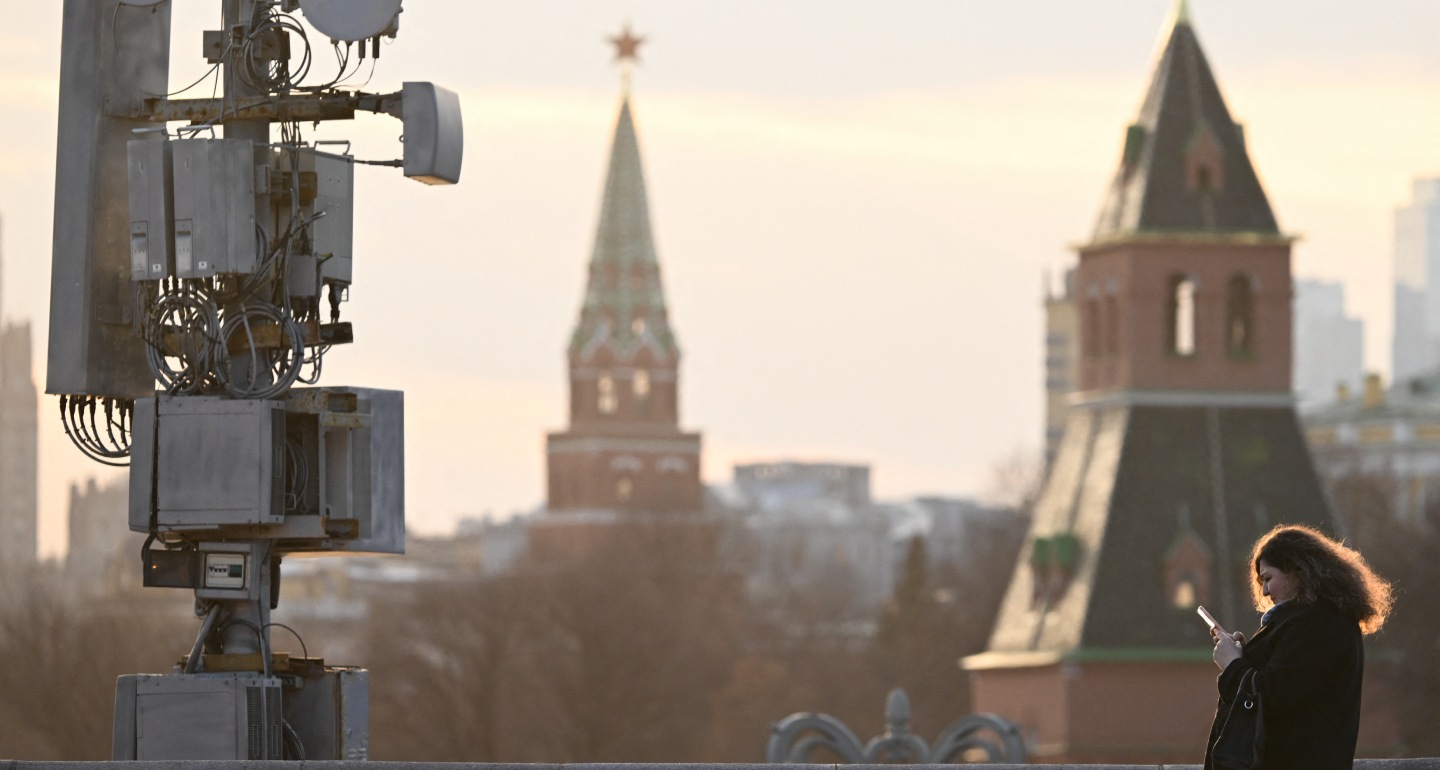
Source: Getty
The Russian state has opted for complete ideological control of the internet and is prepared to bear the associated costs.
Sometimes, when security software like antivirus programs and firewalls install their latest update, a glitch occurs and traffic filtering rules are tightened so far that they suddenly start blocking access to the internet altogether. The entire Russian internet currently finds itself in a similar situation following the transfer of responsibility for its oversight within the Federal Security Service (FSB) in the middle of last year.
The Runet, as the Russian internet is dubbed, is now within the purview of the FSB’s Second Service. Its full name is the Service for the Protection of the Constitutional System and the Fight Against Terrorism, and its most notorious operation was the poisoning of Russian opposition leader Alexei Navalny in 2020. For this, its head, Colonel General Alexei Sedov, was placed on sanctions lists in the United States, United Kingdom, and Canada.
The Second Service’s functions are very broad. It effectively inherited the responsibilities of the Fifth Directorate of the KGB (the FSB’s predecessor), which was responsible for countering “ideological sabotage” and persecuting dissidents. Today, this unit plays a significant role in ensuring “internal political security,” as the Kremlin interprets it. In practice, that means handling extremism cases, persecuting opposition figures, participating in the designation of “undesirable organizations” and “foreign agents,” and monitoring any activity the authorities perceive as a potential threat to the regime.
The transfer of oversight of the Runet from ordinary technical FSB departments to the Second Service has proved to be the kind of software update that interferes with the basic settings. The new FSB handlers are institutionally focused on finding internal enemies, and so, for them, the internet does not represent infrastructure for information exchange or a driver of economic growth, but a suspicious and chaotic environment that requires constant filtration. Their tried and tested toolkit consists of bans, fines, and blocks.
There’s nothing new or surprising about the fact that the Russian internet is overseen by security officers. Every significant aspect of life in Russia is overseen by a corresponding FSB unit, which monitors compliance with legal requirements (primarily security requirements), takes part in formulating regulatory policy, and also places its officers inside key agencies and large companies for the purposes of internal oversight.
For a long time, the Runet was overseen by several technology-focused departments of the FSB. The main one was the Information Security Center (ISC), part of the Counterintelligence Service (First Service). It determined the main approaches to regulation and appointed curators for the Ministry of Digital Development and Communications and major IT companies.
Practical tasks relating to the control of the tech sector were implemented by the FSB’s Scientific and Technical Service (STS, or Third Service). When mobile internet was suddenly shut off in Moscow for nearly three weeks in March, it was STS officers who issued the order to telecom operators. However, according to industry representatives, STS hinted at the time that the initiative had not come from them, and that they were merely following orders from above.
This configuration worked for decades and generally suited the authorities, with FSB tech specialists diligently implementing ideas that came from the presidential administration, from the 2016 so-called Yarovaya Law that obliges telecom companies to store people’s communications content and share it with the FSB, to the 2019 “sovereign internet” law that gave the state powers to restrict traffic on the Runet. But they did so in a way that both satisfied the Kremlin and prevented the industry from becoming completely paralyzed.
The turning point apparently came after the terrorist attack at Moscow’s Crocus City concert hall in March 2024, in which 151 people were killed and over 600 injured. For the intelligence agencies—especially the Second Service, responsible for counterterrorism—this was a deeply shameful episode. They had failed to prevent the biggest terrorist attack in two decades, despite warnings from U.S. intelligence. As a result, the FSB found itself subject to a wave of criticism unprecedented since Russia’s full-scale invasion of Ukraine.
By mid-2025, there were media reports that the terrorists responsible for the Crocus City attack had been recruited and had planned the attack via the Telegram messaging app. It was likely at this time that President Vladimir Putin met with Sedov, and the head of the Second Service offered to “bring order to the internet” and received carte blanche from the president to do so.
The transition to the Second Service ushered in the worst period in the history of the Runet. The scale of the latest bans surpasses even those imposed immediately after the full-scale invasion of Ukraine in 2022. Instead of monitoring and maintenance, FSB overseers now prefer total web filtering, with regular mobile internet shutdowns, whitelists of approved sites, a complete block of WhatsApp and Telegram, fines for reading “extremist” materials, and a crusade against VPNs, which are used to circumvent bans on particular sites.
Now a bureaucratic battle is being fought over the FSB’s latest initiatives. On one side is Sedov, one of the most influential siloviki, or security service officials, who has known Putin since the 1980s. On the other is Prime Minister Mikhail Mishustin, whose protégé at the Ministry of Digital Development, Maksut Shadayev, is trying to propose a less destructive approach to achieving complete control over the internet.
According to Bloomberg, some senior officials have privately criticized the growing wave of restrictions on the Runet, pointing to the political and economic risks. A number of in-system politicians and regional governors have even gone public with their criticism.
Unsurprisingly, these constant problems with the internet also greatly irritate a significant proportion of Russian society. Even amid the highly repressive conditions of wartime life in Russia, there have been attempts to organize protests against the restrictions. The destruction of the Runet has already dealt a painful blow to Putin’s approval ratings—one of the few indicators the Kremlin takes seriously. According to the state pollster VTsIOM, in the past three months the president’s rating has fallen by 7.3 percentage points, while disapproval has increased by 5.7 percentage points.
The cumulative effect of widespread discontent with the current situation could temporarily slow the onslaught of FSB-generated bans. But Putin’s spokesman, Dmitry Peskov, said recently that “the internet restrictions will remain in place for as long as necessary.”
Even if the pressure is temporarily eased, that will not change the Russian authorities’ overall approach to internet governance. The state has already opted for complete ideological control and is prepared to bear the costs: not only the technological ones, but the political and economic ones too. The Runet’s infrastructure is now managed by specialists who view every network packet as a potential threat, and whose idea of security is silence. In today’s Russia, it will be virtually impossible to delete or roll back this calamitous update.

Special correspondent for The Bell
Recent Work
Maria Kolomychenko
Maria Kolomychenko
Carnegie does not take institutional positions on public policy issues; the views represented herein are those of the author(s) and do not necessarily reflect the views of Carnegie, its staff, or its trustees.

Russia spent years building a “sovereign internet,” concentrating web infrastructure exclusively within Russian territory. Ukrainian drone attacks have shown how vulnerable that approach has left the Russian internet.
Maria Kolomychenko

Russia’s AI-driven propaganda campaigns operate in a fragmented, chaotic, and often illogical manner. That’s not necessarily a problem for the Kremlin, though: It’s much easier to mimic genuine public debate that way.

Ilya Klishin
While France and Australia are seeking to establish the legal obligations of messaging apps like Telegram, Russia wants total subordination.
Maria Kolomychenko

The war in Ukraine and a change in ownership led VK to neglect its commercial ventures in favor of implementing the Kremlin’s online agenda. Now it’s been sanctioned by the EU.
Maria Kolomychenko

When political power is concentrated in the hands of a small circle of people, a country invariably ends up with technological stagnation.
Aleksei Kiselev