

Commentary
Dmitri Trenin
{
  "authors": [
    "Dmitri Trenin"
  ],
  "type": "legacyinthemedia",
  "centerAffiliationAll": "",
  "centers": [
    "Carnegie Endowment for International Peace",
    "Malcolm H. Kerr Carnegie Middle East Center",
    "Carnegie Russia Eurasia Center"
  ],
  "collections": [],
  "englishNewsletterAll": "",
  "nonEnglishNewsletterAll": "",
  "primaryCenter": "Carnegie Russia Eurasia Center",
  "programAffiliation": "",
  "programs": [],
  "projects": [
    "Eurasia in Transition"
  ],
  "regions": [
    "Levant",
    "North America",
    "United States",
    "Middle East",
    "Syria",
    "Russia"
  ],
  "topics": [
    "Security",
    "Foreign Policy",
    "Global Governance"
  ]
}
Source: Getty
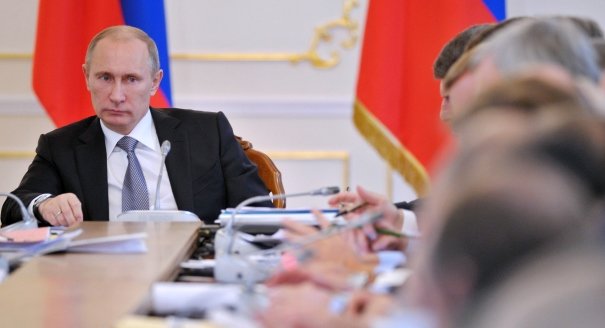
In his New York Times op-ed, Vladimir Putin asserts that Russia is not supporting Assad as an ally, but it is supporting the world order, centered on the U.N. Security Council.
Source: NPR’s Morning Edition
STEVE INSKEEP, HOST: It's MORNING EDITION, from NPR News. I'm Steve Inskeep.
RENEE MONTAGNE, HOST: And I'm Renee Montagne. Readers of this morning's New York Times will find an unusual contributor to the op-ed page: Russian President Vladimir Putin. He's calling for the U.S. to forego military strikes on the Syrian regime of Bashar al-Assad, his Syrian ally.
INSKEEP: Putin warned that an American military strike would destabilize the Middle East and, quote, "unleash a new wave of terrorism." And he again questioned allegations that the Syrian army was responsible for unleashing a poison gas attack that killed hundreds of civilians.
MONTAGNE: To talk about these developments, we reached Dmitri Trenin. He's director of the Carnegie Moscow Center. Welcome to the program.
DMITRI TRENIN: Hi. Glad to be on the program.MONTAGNE: What do you make of this New York Times op-ed by President Putin? I mean, what strikes you the most about his message?
TRENIN: I think he believes that the United States is too important to the world for U.S. foreign policy to be discussed by Americans alone. He wants to add another voice to the debate.
MONTAGNE: President Putin speaks here as a champion of the U.N., yet he has blocked U.N. Security Council efforts to condemn the Assad regime, and even just threaten sanctions. He has continued to arm Syria in a war that's cost 100,000 lives. How can he have it both ways?
TRENIN: Putin believes that U.S. policy toward Syria has been completely misguided. He sees the opposition on the ground in Syria to be dominated by al-Qaida and its friends. So he believes that sanctioning Assad and forcibly replacing him would lead to a result that would be essentially counterproductive.
What he is saying in that piece is that Russia is not supporting Assad as an ally. Rather, it's supporting a certain world order, and that world order, for Putin, is centered on the United Nations Security Council.
MONTAGNE: But he has also been supporting the Assad government, and that's a government that has stopped at nothing to fight this uprising.
TRENIN: Well, I think that he has no illusions about the brutality of the Syrian regime. But his counterargument would be that the United States is supporting al-Qaida. He wouldn't seriously say that the United States has an alliance with al-Qaida, but the United States and Al-Qaida are on the same side against Bashar al-Assad in Syria.
MONTAGNE: And, of course, since Russia first put forth this proposal to put Syria's chemical weapons under international control, the big concern has been that perhaps Putin doesn't mean it, that it's a just a tactic to put off and prevent an American strike on Russia's ally. Do you think something will come of this proposal?
TRENIN: Putin has decided to put his own prestige behind this proposal, not in order to score some tactical points. He wants the tide in the Syrian situation to be turned from ever widening and deepening war, to some kind of a political process that will result in a transition to a more representative government in Syria.
MONTAGNE: These last couple of weeks have seen a series of lightening moves, a kind of geopolitical chess match. Any idea what Russia's next move will be?
TRENIN: Well, I think Russia will be working hard to get the international inspectors to arrive at the Syrian chemical weapons facilities and take control of those facilities. I think the Russians will be engaged full-time now in an effort to channel the situation toward a political solution. That, I think, will be the Russian objective.
MONTAGNE: So, not to put a fine point on it, but you do believe that President Putin is in this for real.
TRENIN: I think he is in it for real. Otherwise, he could have let the foreign minister handle it, and he can always say, you know, we tried very hard, but you see what the Americans are, and, you know, they - but they will reap the fruit of their actions themselves. So we tried, but we couldn't help it. No, he decided to put himself squarely behind it. And, for him, it's also about Russia's role in the world, Russia's prestige. It's about the world order, centered on the U.N. Security Council. That's his goal, absolutely.
MONTAGNE: Dmitri Trenin is director of the Carnegie Moscow Center, speaking to us from Moscow. Thanks very much.
TRENIN: You're most welcome.
Former Director, Carnegie Moscow Center
Trenin was director of the Carnegie Moscow Center from 2008 to early 2022.
Recent Work
Dmitri Trenin
Dmitri Trenin
Carnegie does not take institutional positions on public policy issues; the views represented herein are those of the author(s) and do not necessarily reflect the views of Carnegie, its staff, or its trustees.

Trump has promised Belarus a massive potash deal. But Minsk is seeking something greater: restored Western transit and greater room for maneuver from Russia.

Balázs Jarábik

The European far right might fail to steer EU policy in the direction Russia wants, but they will create enough chaos inside Europe to benefit the Kremlin.

Dimitar Bechev

Minsk clearly expected the dialogue with Washington to yield more results, in particular the lifting of EU sanctions and permission to export potash.

Artyom Shraibman

Russia’s ruling party would have benefited from Putin appearing as its distant patron, but as an active frontman imposing his views on the public, he has done nothing but harm both the party’s election campaign and the ruling system overall.

Andrey Pertsev

Depleted financial reserves and a shrinking tax base mean it is no longer possible to simultaneously deliver high defense spending, price stability, and economic growth.

Alexandra Prokopenko