

Commentary
Alexey Malashenko
{
  "authors": [
    "Alexey Malashenko"
  ],
  "type": "commentary",
  "centerAffiliationAll": "",
  "centers": [
    "Carnegie Endowment for International Peace",
    "Carnegie Russia Eurasia Center"
  ],
  "collections": [
    "Arab Awakening"
  ],
  "englishNewsletterAll": "",
  "nonEnglishNewsletterAll": "",
  "primaryCenter": "Carnegie Russia Eurasia Center",
  "programAffiliation": "",
  "programs": [],
  "projects": [
    "Eurasia in Transition"
  ],
  "regions": [
    "North America",
    "United States",
    "Middle East",
    "Syria",
    "Russia",
    "Western Europe",
    "France"
  ],
  "topics": [
    "Security",
    "Global Governance",
    "Foreign Policy"
  ]
}
Source: Getty
The second round of negotiations between the Syrian opposition and the government failed. As of now, the resolution of the conflict almost entirely depends on the position adopted by the external actors, whose relations, however, are now getting more complicated.
As was expected, the second round of negotiations between the Syrian opposition and the government failed. The meeting lasted less than half an hour, thus indicating that neither of the sides was ready for serious dialogue. Actually, the parties did agree on a truce which will allow for the supply of medicine and food to the besieged Homs.
The negotiation mainly failed because each party is only willing to discuss its own side of the case. The opposition wants to talk about the composition of the interim government, while the Syrian authorities would like to focus on counterterrorism. It thus looks like both sides are ready for a handshake, but extend their hands in different directions. On the other hand, neither side rejects the third round of negotiations. It is possible, though, that the next round will be as fruitless as the last one. But, frankly speaking, the main goal of these Syrian-Syrian negotiations is the negotiations themselves.
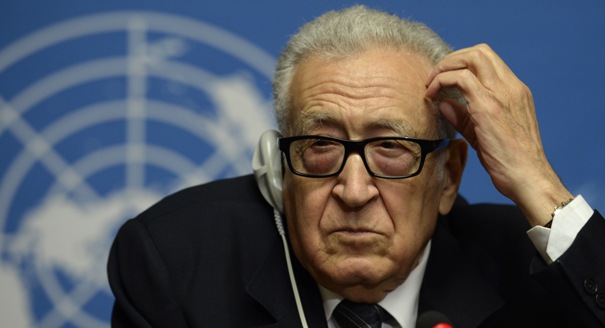
Not everyone shares this point of view. The UN and the Arab League Special Envoy Lakhdar Brahimi believes that, perhaps, there is no point in even starting the negotiations knowing that a compromise is impossible.
The difficulties in communication between the Syrian regime and the opposition underscore an important role the external actors play in the conflict. This is especially true of the United States and Russia, whose cooperation is even more important in light of the fact that the two regional parties to the conflict—Iran and Saudi Arabia—are not likely to come to a mutually acceptable agreement.
However, this winter the already complicated interaction between Washington and Moscow is becoming increasingly fragile. In a sense, we are back to the pre-Geneva state of affairs, when the Kremlin demanded that the White House step up its pressure on the opposition to make it more amenable to compromise, and the White House wanted Russia to get more concessions out of President Bashar al-Assad. Now the situation is repeating itself, and the exchange of demands continues. Along with the Syrian opposition, Washington insists that Assad must go, but Moscow disagrees. It aligns itself with Damascus, whose priority is counteracting terrorism (or in more explicit terms, fighting against the radical segment of the opposition). Incidentally, for its part, the opposition demands that foreign mercenaries, that is the Iranians and Hezbollah fighters, leave the country.
The Unites States, France, and the Great Britain blame the Assad regime for the current impasse, whereas Russia points to the opposition. At any event, the situation will remain unchanged in the nearest future. Lack of options prompted President Barack Obama to remind the parties that the United States reserves the right to strike Syria, which again harkens back to the situation we were in a few months ago. The French President Francois Hollande supports Obama’s position. At the same time, the U.S. president recognizes that the political resolution of the conflict should be the preferred option. So far, the Syrian conflict has claimed 130,000 to 140,000 lives, excluding those missing in action.
As of now, the resolution of this protracted conflict almost entirely depends on the position adopted by the external actors. Their relations, which showed some signs of improvement, are now getting more complicated. It appears that no one is ready for compromise yet—neither in Syria nor around it. Because of all of these negative aspects surrounding the Syrian civil war, some pessimists even started comparing it to the “perennial” Arab-Israeli conflict.
Former Scholar in Residence, Religion, Society, and Security Program
Malashenko is a former chair of the Carnegie Moscow Center’s Religion, Society, and Security Program.
Recent Work
Alexey Malashenko
Alexey Malashenko
Carnegie does not take institutional positions on public policy issues; the views represented herein are those of the author(s) and do not necessarily reflect the views of Carnegie, its staff, or its trustees.
If it proves impossible for the Russian authorities to avoid a gasoline deficit, the question then becomes how they will organize the distribution of a scarce resource.

Sergey Vakulenko

This year’s wars have made alternative routes to transit through Russia no less risky for Central Asian countries.

Galiya Ibragimova
Reestablishing a dialogue with Moscow is not a goal in its own right. The goal is to guarantee the independence of Ukraine and the peace and security of Europe.
Arkady Moshes
Ukraine’s increasingly confrontational posture on Belarus reflects Kyiv’s effort to shape the emerging regional order in Eastern Europe. Kyiv wants to limit European normalization with Minsk—and any future rapprochement with Russia.

Balázs Jarábik
The ruling elites in contemporary Russia are not a political class, but a community of managers who are not subject to competition or public accountability. The state is becoming an operating apparatus without any internal autonomy.

Alexandra Prokopenko