

Commentary
Alexander Zanemonets
{
  "authors": [
    "Alexander Zanemonets"
  ],
  "type": "commentary",
  "blog": "Carnegie Politika",
  "centerAffiliationAll": "",
  "centers": [
    "Carnegie Endowment for International Peace",
    "Carnegie Russia Eurasia Center"
  ],
  "englishNewsletterAll": "",
  "nonEnglishNewsletterAll": "",
  "primaryCenter": "Carnegie Russia Eurasia Center",
  "programAffiliation": "",
  "regions": [
    "Russia"
  ],
  "topics": [
    "Religion",
    "Domestic Politics"
  ]
}
Source: Getty
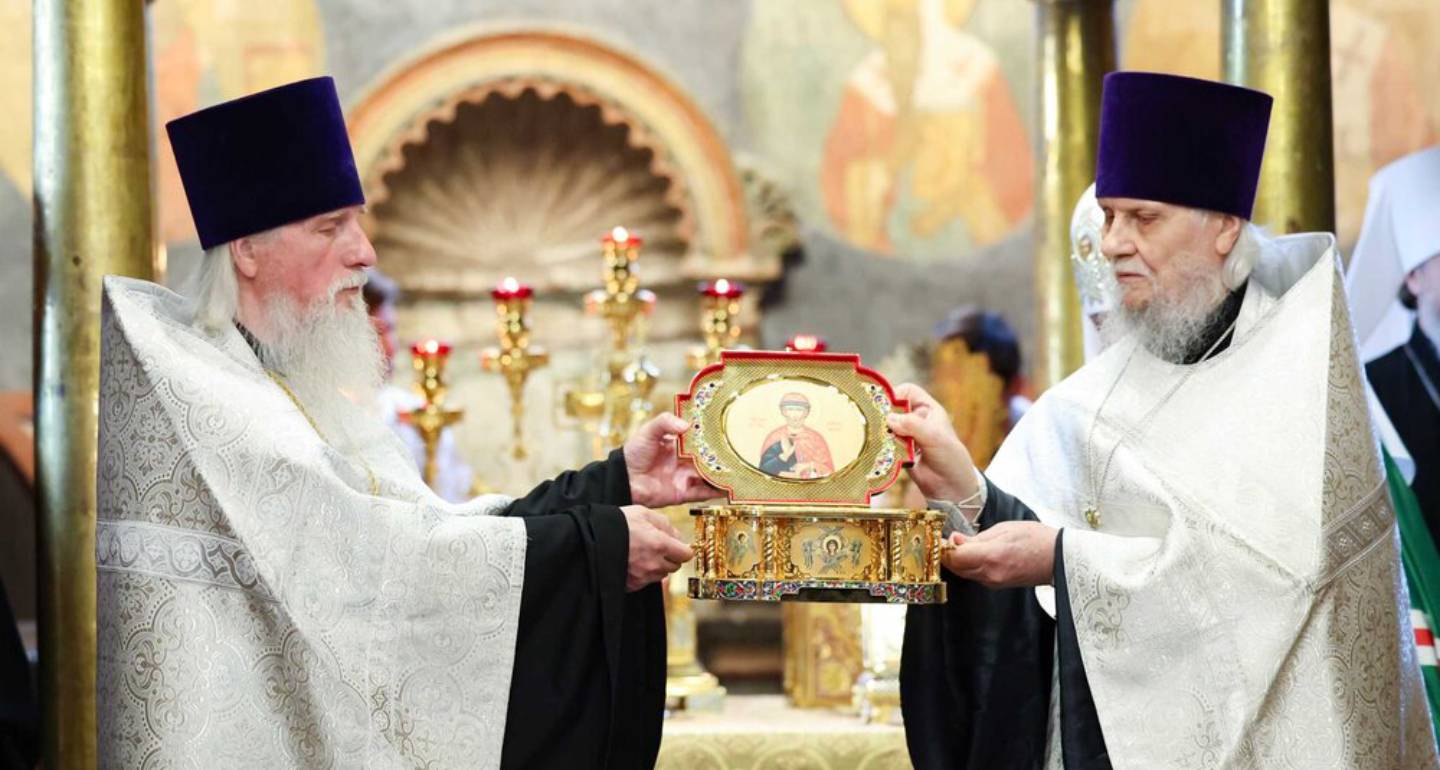
The recent uncovering of Dmitry Donskoy’s relics in the Cathedral of the Archangel is yet another attempt by the Russian Orthodox Church to help the state solve its problems. However, parroting the state’s version of Russian history leaves the Church with no message except “patriotism.”
The Russian Orthodox Church’s recent uncovering of the relics of Muscovite warrior-prince Dmitry Donskoy (1350–1389)—a prelude to the practice of veneration—feels more patriotic than priestly. Vladimir Putin himself took part in the ceremony at the Kremlin’s Cathedral of the Archangel, and some of the canonized prince’s remains will now be sent to the front in Ukraine. A new chapter of church-state relations in Russia is beginning: As Putin’s regime encroaches on more and more spheres of religious life, now even the historical tradition of venerating saints’ relics isn’t safe.
Venerating the relics of saints stems from the Orthodox Christian belief that death does not necessarily sever all ties between the living and the dead; therefore, even after death, holy people retain the same qualities and gifts that they possessed during their lifetime. Saints who were rulers or warriors during their lifetimes are believed to keep watch over their respective countries after death.
Often, the impetus to promote an ancient ruler comes from above. Take Alexander Nevsky: The atheist Soviet state popularized the image of this holy prince, who had defeated the Livonian Order back in the thirteenth century, because during World War II he was needed as a national hero who had vanquished the Germans. The Church had absolutely nothing to do with it.
It was also during World War II that the name of Alexander Nevsky’s great-great-grandson—Dmitry Donskoy, Prince of Moscow, seen by many Russians as having done much to throw off the Mongol yoke—appeared alongside his own. The name was given to a tank column funded by the Moscow Patriarchate for the Soviet Army in 1944.
While Alexander Nevsky had long been considered a saint by the church—he was canonized back in 1547—Dmitry Donskoy was not regarded as one at all; he was simply folded into the same patriotic movement initiated not by the Church, but by the Soviet state.
Dmitry Donskoy’s canonization did not happen until Perestroika, in 1988, when he was glorified as a “Holy and Righteous Grand Prince”: the same title bestowed upon Alexander Nevsky back in 1547. Donskoy’s canonization was intended to reaffirm the rapprochement between the Church and the state, as well as his status as a figure of “patriotic service” that had taken shape during World War II.
Even then, uncovering the canonized prince’s relics remained off the table. It was known that he was buried in the Cathedral of the Archangel, but since he was not venerated particularly widely, there was no demand for his relics.
In most cases, the uncovering of relics is not an unexpected find (though that occasionally happens), but rather the transfer of a saint’s body from its burial site to a church. That is done before canonization, however, not thirty-eight years later. Furthermore, it is done when the saint is the subject of popular veneration. This was not the case: Dmitry Donskoy remained more a symbol of “patriotic service.”
The Russian Orthodox Church was apparently willing to dispense with tradition in the case of Dmitry Donskoy in yet another attempt to demonstrate its loyalty to the state and prove it could be useful. The idea apparently emerged only after more than four years of full-scale war with Ukraine. So long as an easy victory was expected, no one had deemed it necessary.
But by the fifth year of war, the Church leadership in Moscow began to wonder what else it could do to show its support for what Russia terms its “special military operation.” It had already sent priests to the front lines, instituted mandatory prayers for Russian victory in every church, and flown icons over cities.
Dmitry Donskoy appears to be following in Alexander Nevsky’s footsteps once again, just as he did in 1943. A fragment of Nevsky’s relics was sent to the frontline in spring 2026—where it was lost. Now Dmitry has been called up to serve.
It seems that, for now, Dmitry Donskoy’s remains will stay at the Cathedral of the Archangel. Small fragments were set aside during the uncovering: one for Moscow’s Cathedral of Christ the Savior, one to be carried in a procession through Moscow on September 6, and one to be sent to the front. This is how the Moscow Patriarchate sees its “patriotic service.” Moreover, Dmitry Donskoy’s image as a defender rather than an aggressor fits neatly into the state’s narrative that it is “defending the fatherland,” rather than waging a war of aggression against a neighbor.
A state embroiled in war will try to compel all institutions—including religious ones—to participate in it. The Moscow Patriarchate has once again gone all out and intends to keep doing so. However, even in the worst dictatorships—from the Soviet Union to Hitler’s Germany, or the ostensibly pious regimes of Salazar and Franco—the norm has been for religious communities to maintain a distinct agenda from that of the state.
If nothing else, it’s a question of reminding people of the commandments, even in wartime. How else will citizens learn that “blessed are the peacemakers?” Not from national laws. Who will remind soldiers that they must not loot or kill unarmed people, or prison staff that they must not abuse prisoners of war and civilian detainees?
In autocratic regimes without a Church, who is there to remind judges or election commission officials that God’s law takes precedence over a call from the boss? It might seem that the Church has a duty to remind people of their obligations at every opportunity. After all, even in history’s most brutal dictatorships, religious authorities pointed out that the leader was not the highest authority, and that there was a word that carried more weight than the state’s.
Spanish priests sheltered the leaders of independent labor unions and members of banned “extremist” parties in monasteries. Even in the Third Reich, bishops reminded people—albeit, with limited success—that it was wrong to kill the mentally ill and fellow Catholics in Poland and other occupied countries, and indeed generally to kill unarmed people.
The Patriarchate and the episcopate of the Russian Orthodox Church have so far proved incapable of developing an independent agenda even at this most basic level. Time and again, they repeat their own version of Russian history—heavily doctored to suit the current political climate—and fervently bless the powers that be, acting neither to end the war nor even soften public morals during wartime.
As a result, the Russian Orthodox Church is essentially left with no ministry but a “patriotic” one, into which Prince Dmitry—elevated to a position of veneration without the slightest demand from the people or Church—fits perfectly. Perhaps this explains why church attendance is so low in the Russia of Putin and Patriarch Kirill. People get almost nothing from the Church that they cannot get from state TV.
Historian
Recent Work
Alexander Zanemonets
Alexander Zanemonets
Carnegie does not take institutional positions on public policy issues; the views represented herein are those of the author(s) and do not necessarily reflect the views of Carnegie, its staff, or its trustees.

Japan’s long-term security policy is driven by concerns about China, and there is little appetite for (or interest in) pursuing a confrontation with Moscow.

James D.J. Brown

The truth of the strategic situation is that Europe and Russia are extremely unlikely to be able to “turn the page” on their confrontation within the next two decades.

Arkady Moshes

Russia spent years building a “sovereign internet,” concentrating web infrastructure exclusively within Russian territory. Ukrainian drone attacks have shown how vulnerable that approach has left the Russian internet.

Maria Kolomychenko

Putin’s conservative staffing policies and search for ever greater control have cemented parliament’s transformation into a bureaucratic appendage of the executive branch.

Andrey Pertsev

Russia’s AI-driven propaganda campaigns operate in a fragmented, chaotic, and often illogical manner. That’s not necessarily a problem for the Kremlin, though: It’s much easier to mimic genuine public debate that way.

Ilya Klishin