

Article
Frederic Wehrey, Charles H. Johnson
{
  "authors": [
    "Frederic Wehrey"
  ],
  "type": "legacyinthemedia",
  "centerAffiliationAll": "dc",
  "centers": [
    "Carnegie Endowment for International Peace",
    "Malcolm H. Kerr Carnegie Middle East Center"
  ],
  "collections": [
    "Arab Awakening"
  ],
  "englishNewsletterAll": "menaTransitions",
  "nonEnglishNewsletterAll": "",
  "primaryCenter": "Carnegie Endowment for International Peace",
  "programAffiliation": "MEP",
  "programs": [
    "Middle East"
  ],
  "projects": [],
  "regions": [
    "North Africa",
    "Libya",
    "Maghreb"
  ],
  "topics": [
    "Political Reform",
    "Security",
    "Foreign Policy"
  ]
}
Source: Getty
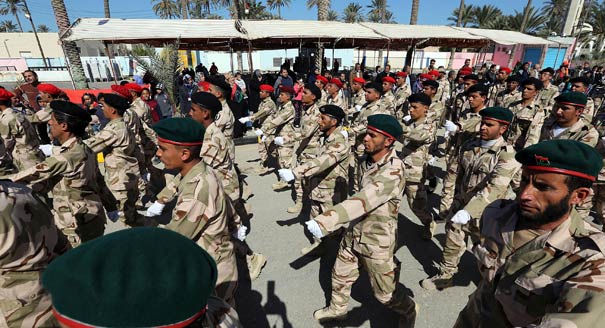
Libya is facing the worst violence since its 2011 revolution, thrusting the country into a new phase of its troubled transition and posing new challenges for the United States.
Source: Los Angeles Times
Libya is in the throes of its worst violence since the 2011 revolution, thrusting the country into a new phase of its troubled transition and posing new challenges for the United States.
A retired general, Khalifa Haftar, leading a diverse coalition of eastern tribes, former army officers and secular-leaning politicians, launched an attack against Islamist militias in Benghazi. Entire air force units and the city's charismatic special forces commander defected to his side.
The violence soon spread to Tripoli. Haftar's allies in the capital attacked the country's elected legislature, the General National Congress, demanding its closure. Tribal militias from Zintan, in western Libya, who are hostile to the Islamists, joined Haftar's forces. The Islamist-dominated congress, however, called on its militia allies from Misurata for defense.
For now, however, the country appears to have avoided full-scale civil war. The powerful Misurata militias, always a wild card, are sitting on the fence. In an apparent compromise, elections for a new legislature will be held June 25.
But a dangerous precedent has been set, as Libya drifts toward coup politics and a military takeover. And Haftar's campaign opens up profound challenges for U.S. policy, which until now has been dominated by hand-wringing over Benghazi, a focus on counter-terrorism and a commitment to building up a new Libyan army.
Libya's divisions are deep and multidimensional — the liberals-versus-Islamists narrative should not be taken at face value. In Benghazi, friends of mine speak of exhaustion and terror at the city's daily grind of violence. Others are indeed disenchanted with the Islamist-dominated congress, which has done little to move the country forward. Haftar is seen as either a hero ridding the country of a violent scourge and setting it back (if his promises are to be believed) on a democratic path, or a strongman in waiting, like so many other Arab leaders, ready to ride to power on a populist wave.
The parallels to Egypt's Abdel Fattah Sisi are clear, although they should not be overplayed. In Benghazi in November, I heard multiple calls for a Sisi-like figure to save the country from Islamists. Haftar appears to be answering this appeal: In news statements, the gray-haired general has declared his goal to "purge" Libya of the Muslim Brotherhood and terrorists. He recently spoke on behalf of a "Supreme Military Council" whose name seems directly borrowed from Egypt. He has introduced a dangerous discourse of "cleansing" and no compromise into a country that has a history of consensus-building. The results do not bode well for Libya's stability.
The United States' focus on rebuilding the army as a response to Benghazi and a hedge against Islamist terrorism needs to be recalibrated. Today in Libya it is no longer possible to speak of an army versus militias but rather of many armies, each claiming legitimacy and authority. Even before the latest violence, a plan by the U.S. — along with Britain, Turkey, Morocco and Italy — to train what is known as a "general purpose force" was plagued with unknowns about the force's inclusivity, mission and civilian oversight. Given Libya's polarization, it could've easily ended up becoming a palace guard or the private militia of an ambitious leader such as Haftar.
What is needed now is a shift to a more holistic approach toward Libyan security. Stability is not simply about training and equipping a new army; it requires the creation of a national security council-type body, stopping under-the-table payments to militias, salary increases for the regular army and police, and other infrastructural improvements to ensure that the new force does not dissolve along factional or regional lines.
But the ultimate solution for Libya's security woes resides in the political realm — specifically, the drafting of a constitution, reform of the congress, and a broad-based national reconciliation under the auspices of the ongoing "national dialogue" process. This is an area where the United States and other outside actors can lend advice and measured assistance, but where the ultimate burden must be borne by Libyans themselves.
Most important, Washington must not turn a blind eye to the country's authoritarian drift, embodied in the figure of Haftar, regardless of any possible but uncertain short-term benefits. This would be a Faustian bargain damaging not only to Libya's long-term future but also to U.S. values and credibility.
This article was originally published in the Los Angles Times.

Senior Fellow, Middle East Program
Frederic Wehrey is a senior fellow in the Middle East Program at the Carnegie Endowment for International Peace, where his research focuses on governance, conflict, and security in Libya, North Africa, and the Persian Gulf.
Recent Work
Frederic Wehrey, Charles H. Johnson
Frederic Wehrey, Charles H. Johnson
Carnegie does not take institutional positions on public policy issues; the views represented herein are those of the author(s) and do not necessarily reflect the views of Carnegie, its staff, or its trustees.

Sergei Kiriyenko used Russia’s parliamentary vote to further hone his strategy of corporate mobilization that is designed to maximize votes for United Russia.

Andrey Pertsev

The European far right might fail to steer EU policy in the direction Russia wants, but they will create enough chaos inside Europe to benefit the Kremlin.

Dimitar Bechev

Minsk clearly expected the dialogue with Washington to yield more results, in particular the lifting of EU sanctions and permission to export potash.

Artyom Shraibman

If the Russian-speaking community in Latvia cannot articulate their interests without being seen as disloyal, they could end up embracing a pro-Kremlin agenda.

Sergejs Potapkins

Russia’s ruling party would have benefited from Putin appearing as its distant patron, but as an active frontman imposing his views on the public, he has done nothing but harm both the party’s election campaign and the ruling system overall.
Andrey Pertsev