

Commentary
Uri Dadush
{
  "authors": [
    "Uri Dadush"
  ],
  "type": "legacyinthemedia",
  "centerAffiliationAll": "",
  "centers": [
    "Carnegie Endowment for International Peace"
  ],
  "collections": [],
  "englishNewsletterAll": "",
  "nonEnglishNewsletterAll": "",
  "primaryCenter": "Carnegie Endowment for International Peace",
  "programAffiliation": "",
  "programs": [],
  "projects": [],
  "regions": [
    "North America",
    "South America"
  ],
  "topics": [
    "Economy"
  ]
}
Source: Getty
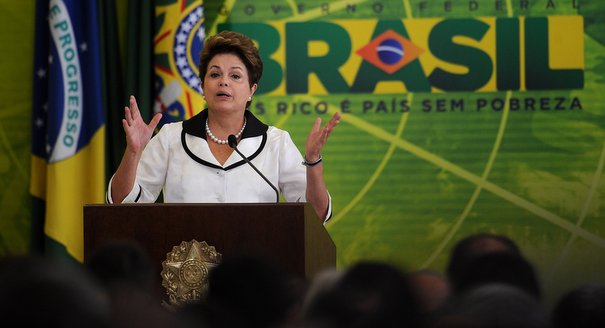
The prospects for Brazil’s economy will depend on the vigor with which the next government will pursue policies that remedy the problems that have so far held it back.
Source: Huffington Post
It was probably the great Stefan Zweig, who escaped to Brazil from Nazi persecution only to take his own life, who coined the expression, Brazil, the country of the future. Cynics, critical of Brazil's unfulfilled promise, like to say that Brazil is the country of the future and always will be. However, a look at Brazil's long-term record cautions against excessive pessimism.
Even as the world economy is recovering, Brazil is one of few countries in recession. The IMF predicts that this year and next Brazil will be one of the slowest growing developing economies. One reason is that Brazil's inflation is far too high, causing the central bank to tighten monetary policy, throttling growth even more. And, after failed attempts at government stimulus, a high budget deficit means that Brazil's fiscal arsenal is empty.
Brazil is also uncompetitive: its labor cost, and its cost of doing business according to the World Bank, is too high relative to its productivity. The country's infrastructure is insufficient, there is a shortage of skills to which the education system is not responding, corporate taxes are too high and complicated. Crime--partly the result of very high income inequality--remains a big problem. Government corruption is daily fare in the newspapers. The exchange rate is overvalued by 10-15% according to the IMF. Locals call this syndrome "Custo Brasil". Deindustrialization and a large current account deficit are the result, the latter made worse by a relatively low rate of national savings. Instead of dealing with the underlying causes of weak competitiveness, Dilma Rousseff's government has engaged in open protectionism. Not surprisingly, confidence is low and investment in Brazil has severely lagged that of other developing countries in recent years.Case closed? Not entirely. The prospects for Brazil's economy will depend on the vigor with which the next government will pursue policies that remedy these problems--and, technically at least, they can be remedied. Encouragingly, there is a long historical record that suggests Brazil can do much better. After all, despite its many problems, Brazil has risen to become the seventh largest economy of the world, bigger than France or Italy. Today, it has a sizable middle class and consumer market. It is, for example, the world's fourth largest car market.
In 2008 the Growth Commission--a group of prominent economists chaired by Nobel Prize winner Michael Spence--included Brazil in a group of just thirteen countries that stood out by achieving very high growth over a 30-year period. Brazil grew at an annual rate near 8 percent over the period from 1950 to 1980, multiplying its output about nine times in a generation. Then came two very bad decades heralded by the Latin American debt crisis. Brazil continued to grow but at a much slower pace, not even keeping pace with the rich countries. Then, from 2000 to 2012, the prices of primary commodities surged, macroeconomic management improved, helped by a more flexible exchange rate, and growth picked up again to around 3.5% a year--a very respectable rate. And one achieved despite the advent of the Great Recession. So the story of Brazil's development is--even quite recently--far from the unqualified disaster that is sometimes portrayed.
No one can say for certain whether Brazil's promise will actually be fulfilled. But here is an economy which evidently can grow fast over long periods, has large natural resources, and boasts a market of 200 million people. It is also a vastly underperforming economy, whose productivity is about one-third that of the United States, and where policy-makers are not delivering.
So don't write Brazil off yet. As the late Chinese Premier Zhou Enlai said when asked for his view of the French Revolution: it is too early to tell.

Former Senior Associate, International Economics Program
Dadush was a senior associate at the Carnegie Endowment for International Peace. He focuses on trends in the global economy and is currently tracking developments in the eurozone crisis.
Recent Work
Uri Dadush
Uri Dadush
Carnegie does not take institutional positions on public policy issues; the views represented herein are those of the author(s) and do not necessarily reflect the views of Carnegie, its staff, or its trustees.

Russian strikes are weakening the economy sustaining Ukraine’s war effort. Closing the growing funding gap will require more European support and politically contentious reforms in Kyiv.

Balázs Jarábik

For every ruble allocated to social policy, health, and education in 2027, double that amount is earmarked for the army, the police, and the security services.

Alexandra Prokopenko

Depleted financial reserves and a shrinking tax base mean it is no longer possible to simultaneously deliver high defense spending, price stability, and economic growth.
Alexandra Prokopenko
A much-discussed disagreement over internet restrictions in Russia was never an existential threat for Putin: It was about elite groups protecting their interests.
Alexandra Prokopenko

The demands of the Kremlin’s war in Ukraine, demographic problems, and public hostility toward Central Asians mean Russia does not have enough workers.

Salavat Abylkalikov