

Paper
George Perkovich
{
  "authors": [
    "George Perkovich"
  ],
  "type": "legacyinthemedia",
  "centerAffiliationAll": "dc",
  "centers": [
    "Carnegie Endowment for International Peace",
    "Malcolm H. Kerr Carnegie Middle East Center"
  ],
  "collections": [
    "Iranian Proliferation"
  ],
  "englishNewsletterAll": "ctw",
  "nonEnglishNewsletterAll": "",
  "primaryCenter": "Carnegie Endowment for International Peace",
  "programAffiliation": "NPP",
  "programs": [
    "Nuclear Policy"
  ],
  "projects": [],
  "regions": [
    "Middle East",
    "Iran"
  ],
  "topics": [
    "Political Reform",
    "Security",
    "Nuclear Policy",
    "Foreign Policy"
  ]
}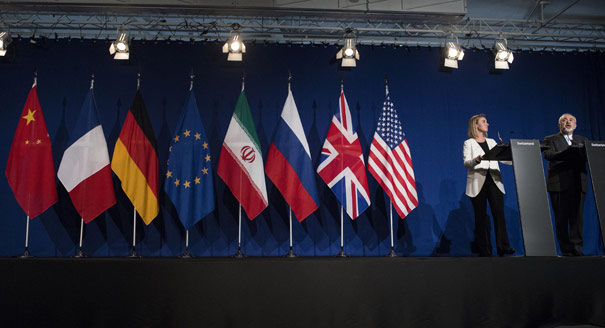
Source: Getty
If the proposed deal can be completed as now planned, at the end of its duration, near 2030, a major threat to international peace and security and the global nuclear order will have been abated.
Source: POLITICO Magazine
Multiple U.S. intelligence estimates conclude that Iran’s leaders have not decided to acquire nuclear weapons, and, according to one report, that “Iran’s nuclear decision making is guided by a cost-benefit approach, which offers the international community opportunities to influence Tehran.”
If this assessment is correct, it is possible to devise an arrangement that will satisfy Iran’s needs for a peaceful nuclear energy program and the international community’s requirement that Iran not acquire nuclear weapons. A sound deal, in short, would have to convince Iran that the risks of cheating and the cost of non-compliance are too high. Rather than “trust but verify,” as Ronald Reagan defined his approach to nuclear arms control, the logic with Iran should be “distrust, verify, and deter.”
The benefits Iran hopes to accrue from sanctions relief can themselves augment deterrence of cheating. To the extent that Iranian businesses and citizens welcome the economic improvements that follow, they will hold their government responsible if it acts in ways that cause sanctions to be snapped back on. While the Iranian internal security apparatus remains repressive, it is sensitive to popular discord, which can be expressed even in constrained presidential elections.For all of the imperfections of the comprehensive deal whose details must now be completed, the compromises that are being made to persuade Iranian leaders to accept it augment their incentives to uphold it. These leaders distrust the United States at least as much as the United States distrusts them. They have struggled to retain leverage in the negotiated arrangements to deter the U.S. and its partners from reneging on our side of the bargain. The underground research and development facility at Fordow, for example, is retained as insurance against military attack. The likely phasing of disclosure of past activities with possible military dimensions is meant to bide time to see if sanctions relief will be delivered as promised. Rather than being inherently bad for the U.S., the leverage Iran retains gives their leaders reason to think the U.S. will not renege on a deal.
Recent history demonstrates that Iran is deterrable. Iran began its secret quest for enrichment capability in 1985 during the war with Iraq. Saddam Hussein’s forces were attacking Iranian cities with ballistic missiles armed with chemical weapons. The United States and France rebuffed Iranian efforts to mobilize the UN Security Council to make Iraq stop. Iranian leaders then began looking for a nuclear option to ensure that their country would “never again” face such a threat.
Throughout the 1990s the United States and others reasonably sought to block most of Iran’s nuclear initiatives, as they also sought to verifiably eliminate all of Iraq’s weapons of mass destruction. While Iranians quietly welcomed the efforts in Iraq, they noticed the Bush Administration’s increasingly dire warnings that Iraq had WMDs and would use them.
The invasion of Iraq in 2003 removed the perceived Iraqi threat. At the same time, intelligence exposed that Iran was secretly building facilities to enable it to enrich uranium and produce plutonium, for which there was no realistic civilian requirement. The International Atomic Energy Agency began investigating and uncovered a long list of Iranian violations of requirements to report sensitive nuclear activities. The threat of possible U.S. intervention from Iraq into Iran also loomed. At this point, according to the U.S. intelligence community, “Tehran halted its nuclear weapons program… primarily in response to increasing international scrutiny and pressure resulting from exposure of Iran’s previously undeclared nuclear work.”
Negotiations ensued in 2003 and continued on and off until today. Since early 2014, the Joint Plan of Action that Iran implemented has essentially frozen its fuel-cycle program.
Throughout, Iranian leaders have assiduously sought to preserve space for an ambitious nuclear energy program, relenting only where the terms of the Nuclear Nonproliferation Treaty clearly require and when international pressure, including economic sanctions, made it too painful to press for more. The NPT clearly proscribes acquiring nuclear weapons, but it does not define precisely which enabling activities and capabilities are forbidden.
Iran’s performance since 2003 suggests, but does not prove, that its interests can be served without nuclear weapons. Saudi Arabia is a leading source of Sunni resistance to Iran, in terms of ideology and funding. But as long as Saudi Arabia does not have nuclear weapons, Iran will retain a significant power advantage over it. If making and keeping a nuclear deal reduces the likelihood of a Saudi bomb, Iran will be better off. And Iran does not need nuclear weapons to fight the Islamic State and other Sunni militias in Iraq.
A robust nuclear arsenal might make Iran more secure vis a vis Israel and the United States, but the problem is that getting from today’s capability to a robust nuclear arsenal would risk a war with one or both. Implementing a nuclear deal – and retaining the leverage of the capabilities it allows – practically removes the threat of Israeli and American military attack. And, by relieving Iran’s international isolation and earning it kudos from many countries, a nuclear deal would enhance Iran’s standing for condemning Israel’s own nuclear arsenal and occupation policies. The latter possibilities will not be welcome in Israel and the U.S., but this only buttresses the assessment that Iran would have an interest in upholding a nuclear deal.
To reinforce this Iranian calculation, the details of a comprehensive agreement should combine deterrence and positive incentives. On the deterrence side, verification is vital. Iranian leaders should conclude that efforts to cheat will be detected with enough time to allow military interdiction before Iran could acquire nuclear weapons. The primary risk is in the domain of uranium enrichment. Here, Iran’s activities must be monitored from mining of ore all the way through the enrichment process, as the U.S. fact sheet released April 2 says it will. All of Iran’s facilities and activities involved in producing centrifuges must be monitored, as well as all operations of centrifuges, from research and development to larger-scale production of low-enriched uranium for reactor fuel.
A satisfactory agreement also should prohibit research and development activities whose purposes are closely associated with nuclear weaponization. Even if Iran will not resolve the IAEA’s ongoing questions about past activities with possible military dimensions until the later stages of an agreed arrangement, Iran should conduct no new activities of this sort. To verify this, Iran will have to agree to procedures for international inspections of any facilities reasonably suspected of conducting work related to nuclear weaponization. Such arrangements would correct a shortcoming of the 1968 NPT and serve as an important precedent to be applied to all non-nuclear-weapon states.
Deterrence of cheating will be further enhanced by the process designed for relieving sanctions on Iran. In the initial years of an agreement, Iran’s performance of its obligations should be reciprocated by waivers of U.S. and other sanctions, rather than the removal of the underlying legal authorities behind them. This way, if Iran fails to perform, sanctions can be “snapped-back” into place quickly by ending waivers.
A final comprehensive nuclear agreement should be codified in a UN Security Council resolution, under Chapter VII, as it now appears has been agreed in Switzerland. The U.S. and other Security Council members can augment deterrence by explaining that violation of such a resolution may be punished by force. The U.S. Congress could affirm that it would support the use of force in the event Iran materially breeched the agreement.
None of this is to gainsay the violence Iran’s protégés and its Revolutionary Guard forces perpetrate in neighboring countries. Nor is it to accept the theocratic repressiveness of Iranian politics and governance. The U.S., Israel and Iran’s Arab neighbors will continue to contest Iranian assertiveness, as Iran will in reverse. Washington will continue to press for democratization and protection of human rights in Iran, just as Iran will denounce Israel’s treatment of the Palestinians and Washington’s complicity with it. A nuclear deal will limit the dangers of this competition by significantly reducing the risks of nuclear proliferation and war, and providing an opportunity to test whether diplomatic agreements can be maintained.
If the proposed deal can be completed as now planned, at the end of its duration, near 2030, a major threat to international peace and security and the global nuclear order will have been abated. At that time, Iran will have been restored to good standing under the Nuclear Nonproliferation Treaty, bound by its now clarified terms. Iran’s first-generation revolutionary leaders will have passed from the scene. Then, if new Iranian leaders somehow concluded that they wanted to try again to move towards nuclear weapons, as Prime Minister Netanyahu and others warn, they should expect an immediate and decisive international campaign to stop them.

Japan Chair for a World Without Nuclear Weapons, Senior Fellow
George Perkovich is the Japan Chair for a World Without Nuclear Weapons and a senior fellow in the Carnegie Endowment for International Peace’s Nuclear Policy Program. He works primarily on nuclear deterrence, nonproliferation, and disarmament issues.
Recent Work
George Perkovich
George Perkovich
Carnegie does not take institutional positions on public policy issues; the views represented herein are those of the author(s) and do not necessarily reflect the views of Carnegie, its staff, or its trustees.

The European far right might fail to steer EU policy in the direction Russia wants, but they will create enough chaos inside Europe to benefit the Kremlin.

Dimitar Bechev

Minsk clearly expected the dialogue with Washington to yield more results, in particular the lifting of EU sanctions and permission to export potash.

Artyom Shraibman

If the Russian-speaking community in Latvia cannot articulate their interests without being seen as disloyal, they could end up embracing a pro-Kremlin agenda.

Sergejs Potapkins

Russia’s ruling party would have benefited from Putin appearing as its distant patron, but as an active frontman imposing his views on the public, he has done nothing but harm both the party’s election campaign and the ruling system overall.

Andrey Pertsev

In the tenth year of his presidency, President Mirziyoyev’s system is becoming even more personalized than that of his predecessor Karimov.

Galiya Ibragimova