

Commentary
Uri Dadush
{
  "authors": [
    "Uri Dadush"
  ],
  "type": "legacyinthemedia",
  "centerAffiliationAll": "",
  "centers": [
    "Carnegie Endowment for International Peace",
    "Carnegie Europe"
  ],
  "collections": [],
  "englishNewsletterAll": "",
  "nonEnglishNewsletterAll": "",
  "primaryCenter": "Carnegie Endowment for International Peace",
  "programAffiliation": "",
  "programs": [],
  "projects": [],
  "regions": [
    "Western Europe",
    "Europe",
    "Iran"
  ],
  "topics": [
    "Economy",
    "EU"
  ]
}
Source: Getty
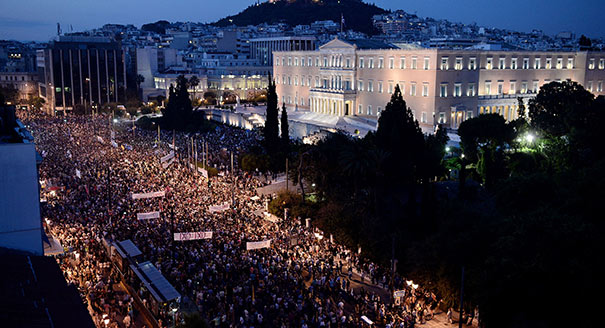
There is no good choice in Sunday’s referendum. For Greeks, it is either the devil or the deep blue sea.
Source: Euractiv
The fog of war has descended on Greece. Fear, confusion and misinformation reign as Greeks prepare to vote in Sunday’s referendum—“Yes” to accept the creditors’ terms, or “No’ to reject them. With banks closed, enormous additional pain is being inflicted on a people that have already seen their income decline by over 20% and suffered one of the largest fiscal adjustments in history. Many years of mismanagement by the eurozone nations and by Greece itself, and Syriza’s erratic negotiating approach has taken us to this shameful situation.
Yet, the economic dynamics that underlie the crisis were understood long ago. The difference is that now it is official: the IMF announced in a “preliminary” revision of its debt sustainability analysis that Greece is bankrupt and that it can only return to growth if it undertakes deep reforms and a large part of its debt is forgiven. IMF officials have known that Greece could not repay its debts all along but, reluctantly, they, too, played the “extend and pretend” game as instructed by their dominant shareholders, led by Germany, issuing one unrealistic projection after another. Now that Greece has failed to make a $1.7 billion payment to the institution, an extremely rare occurrence and unprecedented for an advanced country, the “extend” is still there by force of circumstance, but the pretense is, at last, over.
Looking forward, the outcome of Sunday’s referendum is too close to call. What can be said, however, is that, even if Greeks vote “No” and the Syriza government survives, there is little prospect of it becoming the effective agent of reform that Greece desperately needs. Moreover, the notion that a “No’ vote on Sunday would, as Syriza leader Alexis Tsipras claims, strengthen his hand in the negotiations and lead to better terms for Greece is entirely far-fetched given the alienation and distrust that has been sown.However, should Greece instead vote "Yes" and accept the terms set by creditors, it would only revert back to its “Via Crucis”, the path that led to its demise, but in an even more weakened state. According to the IMF, it now needs new financing to the tune of 50 billion euros over the next three years, even assuming it undertakes far-reaching reforms. Who believes that all this new debt can be repaid? And who believes in the prospect of imminent debt relief, given the total breakdown in trust, the inability to predict what a new Greek government might bring, and the adamant position of Germany and others against such a course? A "Yes" vote is more likely to lead to more protracted uncertainty and agony for Greece and an even deeper crisis in the future rather than to its salvation.
That is why (and not to endorse Mr. Tsipras) it is worth considering cold bloodedly the implications of a “No” vote. This would pave the way for massive debt reduction, done the old fashioned way, i.e. outright default. Based on past experience that would typically wipe out anywhere from 30% to 70% of Greek debt. The ensuing resolution would involve years of negotiation and, possibly, of litigation with official creditors, but insofar as the default is only on official debt (which represents the lion’s share) it need not mean Greece being cut off from private capital flows for very long.
A “No” vote would also quickly force the introduction of a parallel currency to pay government employees and pensions and in which most current transactions would be conducted, paving the way for the needed large-scale devaluation which has so far eluded Greece. The introduction of a new currency need not require redenomination of outstanding euro credits and debits, which would remain in euros.
The devaluation of the new currency would unfortunately mean a sharp increase in the cost of all items that Greeks import, beginning with necessities such as fuel and some food items. It would also mean that some euro debts will go unpaid and that banks—unsupported by the ECB—will require a government bailout, adding to inflationary pressures. An even more severe recession and financial crisis would ensue, and probably spell the end of Mr. Tsipras’ political career.
However, drawing from numerous precedents, the devaluation would also boost prospects for increased tourism and agricultural exports, as well as exports of some manufactures, and set the stage for renewed growth within 18 to 24 months. Many Greeks have built nest eggs in euros that are held abroad, and many receive migrant remittances, all of which would help cushion the shock for the middle class, though not for the millions that have been living hand to mouth for years.
Greeks would undoubtedly continue to use the euro in parallel to their new currency—who can stop them? As happens in many developing countries today, large transactions would be denominated in euros or US dollars. Foreigners visiting Greece would continue to use euros or Dollars.
In this “No” scenario, it is quite possible that Greece will remain formally part of the eurozone, as there is no legal mechanism to eject them. Their partners and creditors would probably not want them permanently out anyway, preferring to accept that they will temporarily run a parallel currency and hoping that they might one day return to the fold and that their debt to the European Central Bank (ECB) might one day be repaid, at least in part. Meanwhile, they are sure to resist Greece from availing itself of ECB facilities of any kind.
As many have argued, such a course—whether or not it amounts to “Grexit”—need not result in large scale contagion in the rest of the eurozone, and based on recent evidence, it will not. There is the downside risk of political contagion (“today Greece, tomorrow who?”) but there is also some upside risk, namely that the Greek disaster will show that, however painful, there is a way out of euro prison, and finally spur their complacent partners to the North—the big beneficiaries of the common currency—to undertake the reforms to establish a viable monetary union.
There is no good choice in Sunday’s referendum. For Greeks, it is either the devil or the deep blue sea. Barring a miracle announcement in the coming hours that Greece’s creditors will extend large scale and explicit debt relief conditional on their terms being accepted, Greeks should vote “No”.

Former Senior Associate, International Economics Program
Dadush was a senior associate at the Carnegie Endowment for International Peace. He focuses on trends in the global economy and is currently tracking developments in the eurozone crisis.
Recent Work
Uri Dadush
Uri Dadush
Carnegie does not take institutional positions on public policy issues; the views represented herein are those of the author(s) and do not necessarily reflect the views of Carnegie, its staff, or its trustees.

The truth of the strategic situation is that Europe and Russia are extremely unlikely to be able to “turn the page” on their confrontation within the next two decades.

Arkady Moshes

Russian strikes are weakening the economy sustaining Ukraine’s war effort. Closing the growing funding gap will require more European support and politically contentious reforms in Kyiv.

Balázs Jarábik

For every ruble allocated to social policy, health, and education in 2027, double that amount is earmarked for the army, the police, and the security services.

Alexandra Prokopenko

The European far right might fail to steer EU policy in the direction Russia wants, but they will create enough chaos inside Europe to benefit the Kremlin.

Dimitar Bechev

If the Russian-speaking community in Latvia cannot articulate their interests without being seen as disloyal, they could end up embracing a pro-Kremlin agenda.

Sergejs Potapkins