

Research
- +10
Rosa Balfour, Frances Z. Brown, Yasmine Farouk, …
{
  "authors": [
    "Moisés Naím"
  ],
  "type": "legacyinthemedia",
  "centerAffiliationAll": "",
  "centers": [
    "Carnegie Endowment for International Peace"
  ],
  "collections": [],
  "englishNewsletterAll": "",
  "nonEnglishNewsletterAll": "",
  "primaryCenter": "Carnegie Endowment for International Peace",
  "programAffiliation": "",
  "programs": [],
  "projects": [],
  "regions": [
    "North America",
    "United States",
    "South America",
    "Middle East",
    "North Africa"
  ],
  "topics": [
    "Political Reform",
    "Democracy",
    "Security",
    "Foreign Policy"
  ]
}
Source: Getty
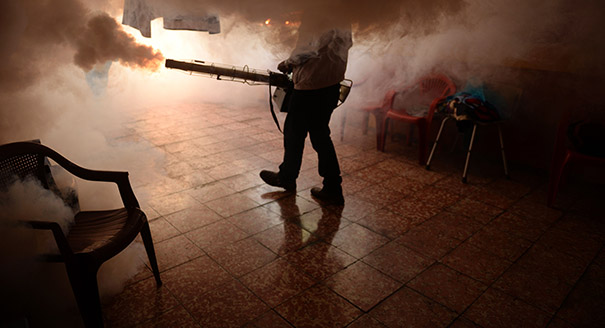
Zika, the self-proclaimed Islamic State, and Trump are new manifestations of old phenomena, upgraded and made more dangerous in their current forms.
Source: Atlantic
They are three of the stories dominating headlines around the world. They are insidious, shocking, and destructive, in wildly disparate ways. Zika is a virus, ISIS is a terrorist group, and Donald Trump is … Donald Trump. But while there’s not much the three phenomena have in common, they do have some instructive similarities: They are all modern-day versions of older phenomena, made more virulent by globalization.
Epidemics, terrorism, and demagoguery have afflicted the world for centuries, even as they’ve consistently taken on new forms. This means that their latest incarnations have earlier precedents. The current Zika epidemic started in 2015, but the virus was first identified in a monkey in Uganda’s Zika Forest in 1947. ISIS rose to international prominence in 2014, but it traces its ideological lineage and some of its leadership to al-Qaeda, a terrorist group formed in 1988, and even further back to ideas of radical Islam sketched out in Egypt in the 1960s. Donald Trump announced his candidacy in 2015 and has since become the Republican front-runner; in 2000, he managed to win two primaries while running for the Reform Party’s presidential nomination before dropping out and declaring the party “a total mess.” He even gave a quasi-campaign speech in New Hampshire in 1987 after a Republican activist suggested he’d make a good president, though he opted not to run that time. But Trump’s approach echoes the style, if not the policies, of the 1960s candidates Barry Goldwater and George Wallace, in his extreme rhetoric and polarizing policy positions.Yet despite the long histories behind the problems represented by Zika, ISIS, and Trump, the world seems to have been surprised by their sudden re-emergence. It’s suspected, for example, that the Zika virus is primarily transmitted by some of the same mosquitoes that also carry diseases like the dengue and West Nile viruses. But although this mosquito is well-known to health officials, Zika itself is not. In February, Brazil’s alarming rise in occurrences of microcephaly in newborns, as well as cases of the rare condition of the nervous system Guillain-Barre Syndrome—both of which seem to be connected to the Zika outbreak—led the World Health Organization to declare a “public health emergency of international concern.” Substantial sums are being invested in preventing new outbreaks and containing the epidemic, and scientific research has intensified to find vaccines and cures. But the international community is for now ill-prepared to combat this virus. It’s an old sickness with new strength.
Precisely the same description can be applied to modern terrorism. The tactic has existed for centuries, but its lethality has been increasing alarmingly over the past several years. ISIS’s ostentatious violence and its obsession with killing Shia Muslims is unacceptable even to al-Qaeda, which broke with the group in February 2014. Ayman al-Zawahiri, who has led al-Qaeda since the death of its founding leader Osama bin Laden, issued a statement that month disavowing ISIS and insisting that al-Qaeda was “not responsible” for the actions of its former affiliate. And it wasn’t only al-Qaeda that was caught unprepared for the rise of ISIS. The Islamic State’s cruelty, efficiency, wealth, and expert use of social media to recruit followers has surprised governments with long-time experience dealing with Islamic terrorists. “ISIS is different” seems to be the defeated consensus among security agencies.
A version of that same statement is made about Trump. Both Republican leaders who have attempted to block his candidacy, and political analysts who never believed he would make it this far, agree that “Trump is different.” Trump’s particular brand of theatrics seems unprecedented in U.S. politics. But his innovations are bigger than his outrageous rhetoric and aggressive policies. Trump has altered traditional ideas about campaign financing by trumpeting his own spending on his relatively cheap campaign (though he’s taken outside contributions as well), and has deftly turned even negative media attention to his benefit, not to mention causing a massive and potentially far-reaching rift in his own party. His apparent ability to make millions of people believe he can fulfill unachievable promises—like building a wall on America’s southern border and making Mexico pay for it, or bringing back large numbers of manufacturing jobs from China—has left analysts perplexed.
There’s a reason these disparate, dramatic phenomena are gaining strength now. Zika, ISIS, and Trump are all to some degree products of globalization. For example, the origins of the current Zika outbreak aren’t known for sure, but a leading theory has it that the virus was brought to Brazil from French Polynesia, likely on an airplane, in 2013. Easy travel and increased tourism to Brazil, which hosted the soccer World Cup in 2014, may have helped the virus spread. There are now reported cases of Zika in more than 30 different countries and territories within the Americas alone. ISIS, too, has globalization to thank for its success—in part through sophisticated use of modern media, it has managed to recruit jihadists from more than 80 countries; it has sent trained fighters back to the West through the means of modern travel; and the connectedness of international oil markets means the Islamic State’s smuggled oil may have found its way to numerous other countries via Turkey.
And what would Donald Trump do without the Mexicans that he’s essentially portrayed as invading the United States, the 11 million illegal immigrants he plans to deport, or the Chinese workers to whom in his view millions of Americans have lost their jobs?
Zika, ISIS, and Trump are new manifestations of old phenomena, upgraded and made more dangerous in their current forms. And the world is not prepared to deal with them.

Distinguished Fellow
Moisés Naím is a distinguished fellow at the Carnegie Endowment for International Peace, a best-selling author, and an internationally syndicated columnist.
Recent Work



Rosa Balfour, Frances Z. Brown, Yasmine Farouk, …
Moisés Naím
Carnegie does not take institutional positions on public policy issues; the views represented herein are those of the author(s) and do not necessarily reflect the views of Carnegie, its staff, or its trustees.

Japan’s long-term security policy is driven by concerns about China, and there is little appetite for (or interest in) pursuing a confrontation with Moscow.

James D.J. Brown
The truth of the strategic situation is that Europe and Russia are extremely unlikely to be able to “turn the page” on their confrontation within the next two decades.
Arkady Moshes

Putin’s conservative staffing policies and search for ever greater control have cemented parliament’s transformation into a bureaucratic appendage of the executive branch.

Andrey Pertsev

Russia’s AI-driven propaganda campaigns operate in a fragmented, chaotic, and often illogical manner. That’s not necessarily a problem for the Kremlin, though: It’s much easier to mimic genuine public debate that way.

Ilya Klishin

Without a ceasefire with Ukraine on attacking each other’s energy infrastructure—to which the Kremlin is unlikely to agree—the diesel agreement between Putin and Trump is largely for show, rather than representing a genuine increase in the volumes of Russian diesel on the global market.

Sergey Vakulenko