The Russian economy will probably not collapse in the near future, but there are enough red flags to warrant a close examination of the possibility.
Though the collapse of a single industry will not precipitate economic disintegration, a confluence of crises in several sectors could. If a major banking crisis erupts and the government is unable to mitigate it with capital injections before investors and account holders begin to panic, there could be a run on the banks, a spike in inflation and the exchange rate, and a massive devaluation of the ruble. The result could be reminiscent of Germany in the mid-1920s.
The disruption of production at a large number of infrastructure facilities due to amortization or interruptions in energy supplies could also wreak economic havoc. This scenario becomes increasingly plausible as authorities move forward with reductions in overall budget allocations and suspend investment in modern technologies.
A sharp decline in hydrocarbon production combined with continued low global energy prices also poses a threat. Oil production in Russia is inefficient and production will continue to decline in the coming decades: by 2035, production is expected to fall by half, in part because Russia lacks advanced exploration technologies.
Crises in other major industries could also be destabilizing. As purchasing power in Russia falls over the next few years, the demand for goods and services—particularly durable ones—will decrease significantly. As a result, an entire range of industries will be threatened, from the personal care sector to the construction industry.
Construction costs have fallen by 20 percent in recent years to 2002 levels, and prices have decreased to 2001 levels (both in real rubles). Unless the government introduces large-scale subsidies (which seems unlikely because an appreciable increase in demand would require tens of billions of dollars per year in subsidies), we can assume that the volume of construction will trend back toward 2002 levels, which would lead to 3 to 4 million people losing their jobs.
Banking, shipping, tourism, and the service industry are also vulnerable. Once one sector collapses, it could lead to a domino effect, leaving 5 to 10 million people unemployed and bringing the unemployment rate to between 13 and 18 percent. Neither the government nor the private sector would have much to offer to the newly unemployed, as the industries that were able to pick up some of the unemployment slack in the first half of the 2000s have massively contracted or disappeared altogether.
Domestic politics will undoubtedly have a strong bearing on the economy in the coming years. Infighting among elites is unlikely because the interests of various groups are well segregated and all of the key players understand that keeping the peace is in everyone’s best interest.
Still, in other countries, elites have historically fought for power when their rent falls below 10 to 12 percent of GDP and per capita GDP dips below $6,000. Economic rent is only slightly higher in Russia right now (about 16 to 17 percent) and is gradually declining, while per capita GDP is forecast to be $8,000 in 2016.
Even if elite infighting does not erupt into all-out war, it might still have a significant destabilizing effect on the economy: major personnel rotations, shortsighted decisions that harm the economy, and sharp increases in risks as elites instigate criminal cases against competitors would be incredibly damaging.
Russia lacks strong governmental institutions and leaders that are capable of critical analysis. At any point, the government could decide to impose crippling tax burdens on businesses; escalate—or initiate new—military or “hybrid” operations that undermine the economy or bring about a new round of sanctions; or introduce harsh price, currency, and capital controls.
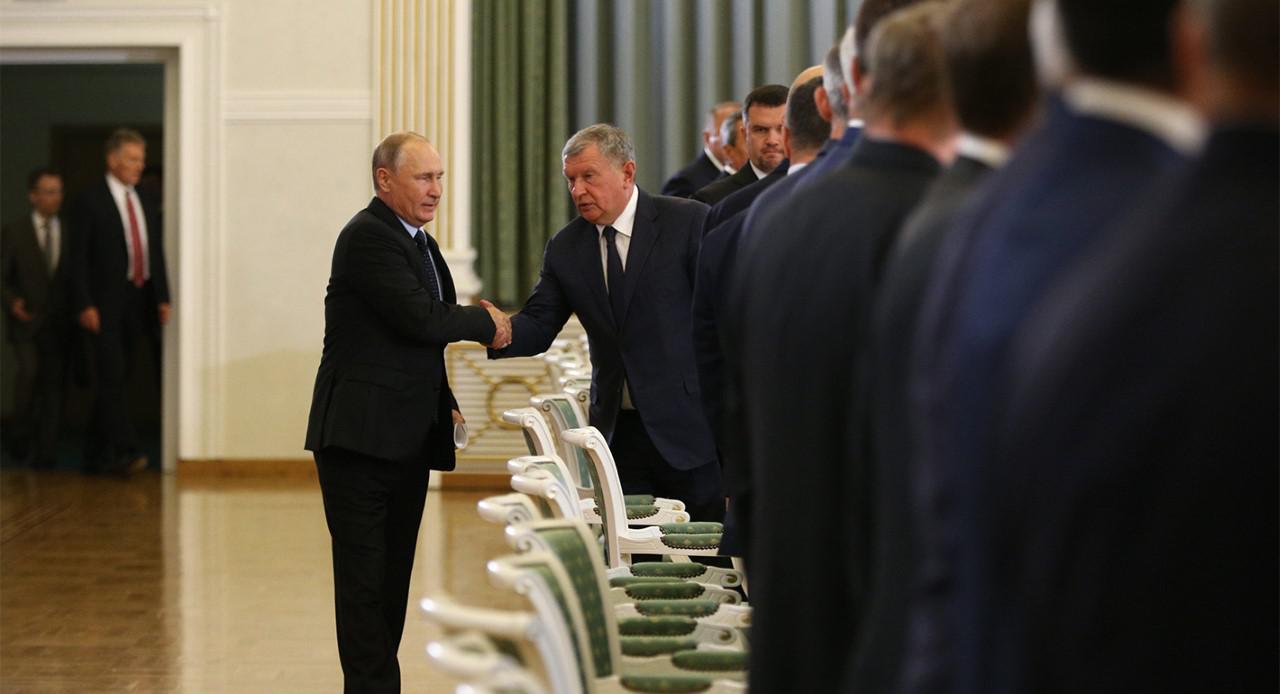
Indeed, Russia has only one real decisionmaker, leaving the state in a precarious position. Although Putin appears to be in good health and is still relatively young, any change at the top would be disastrous for Russia and its economy.
More plausible than economic implosion is steady erosion: the economy will likely contract gradually over the next three to four years and then become increasingly socialized as the government implements price and currency controls, monopolizes foreign trade, embarks on a large-scale nationalization of private industries, and increasingly regulates salaries and consumption.
These measures will further contract the economy while preventing its total collapse—perhaps for a decade or more.