

In The Media
John Judis
{
  "authors": [
    "John Judis"
  ],
  "type": "legacyinthemedia",
  "centerAffiliationAll": "",
  "centers": [
    "Carnegie Endowment for International Peace"
  ],
  "collections": [],
  "englishNewsletterAll": "",
  "nonEnglishNewsletterAll": "",
  "primaryCenter": "Carnegie Endowment for International Peace",
  "programAffiliation": "",
  "programs": [],
  "projects": [],
  "regions": [
    "United States"
  ],
  "topics": [
    "Political Reform",
    "Economy"
  ]
}
Source: Getty
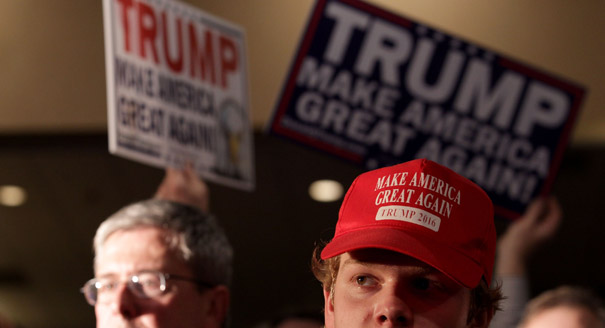
Despite previously inflammatory rhetoric, Trump’s victory speech portrayed the candidate as someone who, above all, wanted to make sure Americans were safe, employed, and prosperous.
Source: Talking Points Memo
At the beginning of May when Trump sewed up the Republican nomination, I thought he could go in three different directions: first, he could continue as the dark prince of political incorrectness, skewering Muslims and Mexican-Americans; second, he could become a conventional Republican, dropping his complaints about bad trade deals, runaway shops, foreign interventions, and K Street lobbyists; third, he could take his original message, which I heard in New Hampshire in August 2015, of Ross-Perot style economic nationalism, foreign policy realism, and opposition to illegal immigration, but pare away the incendiary racist, nativist, psycho-sexual and self-promotional provocations.
The first approach was a sure loser. The second was implausible. But the third might create a GOP coalition that would combine the traditional red states with the industrial Midwest. In the last month, he mostly followed alternative number one. There was the Mexican-American judge, the intermingling of his campaign with the fraud charges against Trump University, the forays into Bill and Hillary Clinton’s sex life. Trump probably did enough the last month to doom his chances. But in his “victory speech” on June 7 in Westchester, which the pundits pronounced as “boring,” Trump took the third path. If he can maintain it, and make people forget Trump #1, he could be formidable. Some highlights:*He framed the election in classic populist terms: “I’m going to be America’s champion because you see this election isn’t about Republican or Democrat; it’s about who runs this country – the special interests or the people and I mean the American people.”
*Instead of the usual Republican bromides against government spending, he bemoaned crumbling public infrastructure: “I visited the crumbling cities and the struggling schools. I’ve seen our dilapidated airports, highways, bridges and I’ve compared them to other countries where we see facilities so far superior to ours it’s really not to be believed, hard to imagine what’s happened to our country.”
*He cited the loss of manufacturing jobs: “I’ve visited communities in New York, New Jersey, Pennsylvania, Connecticut, Indiana and Ohio whose manufacturing jobs, they literally, these jobs have virtually disappeared, an embarrassment to our country and it’s horrible.”
*He used the slogan of “America First” (most Americans are unaware of the slogan’s origins) to highlight his opposition to foreign intervention that wasn’t directly linked to America’s security. Citing Clinton’s intervention in Iraq, Libya and Syria, he described his own foreign policy: “It means on foreign policy we will never enter into any kind conflict unless it makes us safer as a nation. It has to make us safer as a nation.”
*He also used the slogan of “America First” to link his opposition to illegal immigration, but on economic rather than cultural rounds: “America First means protecting the jobs, wages and security of American workers, whether first or tenth generation.” Then he segued to a universal appeal: “No matter who you are, we’re going to protect your job because let me tell you our jobs are being stripped from our country like we’re babies…Every American worker of every background is entitled to the same benefits, protections and rights and privileges; it’s got to be that way.”
*He also used “America First” to explain his opposition to NAFTA and other trade deals. “On trade, America First means the American worker will have his or her job protected from unfair foreign competition.”
*In his repeated promise to create new jobs, he specifically included African Americans with the highest rate of unemployment: “We’re going to put America back to work. We’re going to make our own products. We’re going to put America back to work. We’re going to rebuild our inner cities which are absolutely a shame and so sad. We’re going to take care of our African American people that have been mistreated for so long.”
*Finally, instead of attacking Clinton for her relationship with her husband – and some other sordid irrelevance – he honed in on where Clinton is most vulnerable: “The Clintons have turned the politics of personal enrichment into an art form for themselves. They’ve made hundreds of millions of dollars selling access, selling favors, selling government contracts, and I mean hundreds of millions of dollars. Secretary Clinton even did all of the work on a totally illegal private server. Something about how she’s getting away with this folks nobody understands.”
There was some of the usual crap scattered through the speech. Trump recounted how he had “embraced the victims of illegal immigration, moms and dads who have had to bury their own children because of people that shouldn’t have been in the country,” as if there were thousands of these cases. But these were minor notes in a speech that portrayed the candidate as someone who, above all, wanted to make sure Americans were safe, employed and prosperous. That’s the kind of appeal that could win some votes. But too many Americans may already be wise to his bilious and bigoted nature.

Former Visiting Scholar
As a visiting scholar at Carnegie, Judis wrote The Folly of Empire: What George W. Bush Could Learn from Theodore Roosevelt and Woodrow Wilson.
Recent Work
John Judis
John Judis
Carnegie does not take institutional positions on public policy issues; the views represented herein are those of the author(s) and do not necessarily reflect the views of Carnegie, its staff, or its trustees.

Sergei Kiriyenko used Russia’s parliamentary vote to further hone his strategy of corporate mobilization that is designed to maximize votes for United Russia.

Andrey Pertsev

Trump has promised Belarus a massive potash deal. But Minsk is seeking something greater: restored Western transit and greater room for maneuver from Russia.

Balázs Jarábik

The European far right might fail to steer EU policy in the direction Russia wants, but they will create enough chaos inside Europe to benefit the Kremlin.

Dimitar Bechev

Minsk clearly expected the dialogue with Washington to yield more results, in particular the lifting of EU sanctions and permission to export potash.

Artyom Shraibman

If the Russian-speaking community in Latvia cannot articulate their interests without being seen as disloyal, they could end up embracing a pro-Kremlin agenda.

Sergejs Potapkins