

Commentary
With the growth in points of friction between the great powers, organizations like the SCO will continue to play a role in the strategic adaptation of the smaller powers caught between them.
Temur Umarov
{
  "authors": [
    "Jeremy Shapiro",
    "Richard Sokolsky"
  ],
  "type": "legacyinthemedia",
  "centerAffiliationAll": "",
  "centers": [
    "Carnegie Endowment for International Peace",
    "Carnegie Russia Eurasia Center"
  ],
  "collections": [],
  "englishNewsletterAll": "",
  "nonEnglishNewsletterAll": "",
  "primaryCenter": "Carnegie Endowment for International Peace",
  "programAffiliation": "",
  "programs": [],
  "projects": [],
  "regions": [
    "North America",
    "United States",
    "Middle East",
    "North Africa"
  ],
  "topics": [
    "Security",
    "Military",
    "Foreign Policy"
  ]
}
Source: Getty
Instead of increased military interventionism, the United States should adopt the principle of “minimum essential engagement” in the Middle East.
Source: National Interest
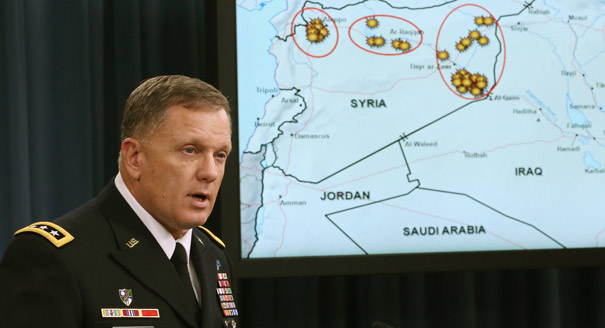
Recent presidents of both parties have agreed that the United States has vital interests in the Middle East. But the region has become extraordinarily turbulent. Civil wars rage in Syria, Yemen, Iraq and Libya, where central authority and state structures have broken apart. Various regional powers are intervening in these wars, many of which serve as proxy contests between Iran and Saudi Arabia. America is fighting a war against ISIS in Iraq, Syria and, increasingly, Libya. Russia has intervened in the Syrian Civil War.
The chaos convulsing the Middle East concerns the United States but is deeply rooted in local factors—in the failure of Arab governance, regional rivalries, and sectarianism and identity politics run amok. Alas, the last fifteen years have demonstrated the limited ability of the United States to bend these historical forces to achieve its preferred outcomes of peace, prosperity, security and better governance in the region.
Confronted with this clear mismatch between American aspirations and capabilities, some experts are calling for a partial U.S. disengagement from the region, while others want to double down on existing U.S. commitments. Most agree that nonmilitary tools of statecraft are important to protecting American interests and that the United States should continue to use them to address the political, economic and social drivers of instability. The main fault line in this debate focuses heavily on the role of military force in U.S. strategy for the region...
This article was originally published by the National Interest.

Jeremy Shapiro
Brookings Institution
Jeremy Shapiro is the research director and U.S. program director of ECFR. His areas of focus include U.S. foreign policy and transatlantic relations. Shapiro was previously a fellow with the Project on International Order and Strategy and the Center on the United States and Europe at Brookings, where he edited the Foreign Policy program’s blog Order from Chaos. Prior to Brookings, he was a member of the U.S. State Department’s policy planning staff, where he advised the secretary of state on U.S. policy in North Africa and the Levant. He was also the senior adviser to then assistant secretary of state for European and Eurasian affairs Philip Gordon, providing strategic guidance on a wide variety of U.S.-European foreign policy issues.

Nonresident Senior Fellow, Russia and Eurasia Program
Richard Sokolsky is a nonresident senior fellow in Carnegie’s Russia and Eurasia Program. His work focuses on U.S. policy toward Russia in the wake of the Ukraine crisis.
Carnegie does not take institutional positions on public policy issues; the views represented herein are those of the author(s) and do not necessarily reflect the views of Carnegie, its staff, or its trustees.

With the growth in points of friction between the great powers, organizations like the SCO will continue to play a role in the strategic adaptation of the smaller powers caught between them.

Temur Umarov

When faced with fuel shortages in the past, Central Asian governments could always count on additional supplies from Moscow. That safety net no longer exists.

Galiya Ibragimova

Two divergent trends—Putin’s hardline vision of how to prosecute the war in Ukraine, and a growing desire for change in Russia—could tear the regime apart.

Tatiana Stanovaya

Andrey Melnichenko’s essay offers no answer to the fundamental question of how, under any kind of negotiated settlement, Europe can protect itself from the Russian ressentiment that is inevitable in all scenarios except for an outright victory for Putin.

Leonid Bershidsky

Despite unhappiness on the ground, Moscow is determined to use both carrot and stick to ensure there is record support for United Russia in occupied Ukraine.

Konstantin Skorkin