

Commentary
Aron Lund
{
  "authors": [
    "Aron Lund"
  ],
  "type": "other",
  "centerAffiliationAll": "dc",
  "centers": [
    "Carnegie Endowment for International Peace"
  ],
  "collections": [
    "Arab Awakening"
  ],
  "englishNewsletterAll": "menaTransitions",
  "nonEnglishNewsletterAll": "",
  "primaryCenter": "Carnegie Endowment for International Peace",
  "programAffiliation": "MEP",
  "programs": [
    "Middle East"
  ],
  "projects": [],
  "regions": [
    "Middle East",
    "North Africa",
    "Syria"
  ],
  "topics": [
    "Political Reform",
    "Security",
    "Military"
  ]
}
Source: Getty
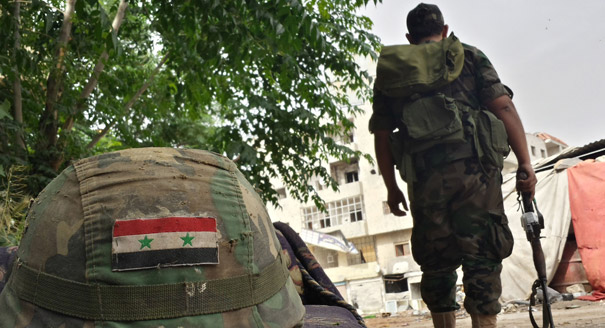
The Syrian government has been able to offset its manpower shortage by relying on local actors with decades-old ties to the regime, but counting on these proxies may no longer be possible.
Source: Century Foundation
The Syrian war continues to flow back and forth, but since Russia and Iran intervened in Syria’s civil war in autumn 2015, President Bashar al-Assad has largely stabilized his position. Despite the continuing economic decay of his government, Assad’s army has managed to reverse some earlier losses and capture key areas from its enemies, notably around Aleppo. Since March 2016, Russia has limited its support for Assad, in grudging compliance with a truce negotiated with the United States. But if Russians and Iranians were to decisively put their shoulders to the wheel again, as they did in January and February, it is likely that they could further tip the scales in Assad’s favor.
There is little doubt that Assad is still hoping for a full restoration of Baathist rule. As recently as June, he vowed to “liberate every inch of Syria.” However, swallowing new territory is one thing; digesting it is another. Governing hostile populations in the midst of a civil war is a costly and manpower-intensive task. Assad already suffers from a severe shortage of soldiers, an increasingly dysfunctional administrative structure, and dwindling resources. If he recaptured lost territory, he would have trouble supplying enough soldiers, police, and administrators to rule it. If the rebels were pushed back further, they would also be very likely to turn to urban guerrilla tactics, sabotage, and bombings, making newly acquired territory even more difficult to rule.
Ultimately, Assad’s ambition to restore the pre-2011 status quo ante runs up against the enormous changes wrought by the war. In many areas, the Syrian president was able to offset his manpower shortage only by relying on local actors with decades-old ties to his regime. Where the insurgents have gained ground, these supporters have largely disappeared: some have switched sides, others have fled or been killed. Old relationships and networks that used to benefit the government have been shattered beyond repair.
This policy brief examines the northwestern provincial capital of Idlib—alongside jihadi-controlled Raqqa, it is the most important city captured by the insurgency so far—to explore how Assad previously managed to rule it by entrusting security tasks to local proxies, and why that may no longer be possible.
The case of Idlib does not tell us who will ultimately win the war in Syria, if anyone can, or even where the city itself is headed. But it does show that Assad’s original system of population control has been ruined by his loss of the city in 2015, probably to the extent that it can never be restored. It gives us a grim glimpse of the alternatives on offer, indicating that Syria’s future, much like Idlib’s present, is more likely to be an unstable and violent patchwork of local fiefdoms than a united country capable of healing its wounds. Because, as improbable as it seems that Assad would ever be able to fully reassert control over the half Syria where his regime has been uprooted by the rebellion, none of his rivals seem any better placed to do it...
Former Nonresident Fellow, Middle East Program
Aron Lund was a nonresident fellow in the Middle East Program and the author of several reports and books on the Syrian opposition movement.
Recent Work
Aron Lund
Aron Lund
Carnegie does not take institutional positions on public policy issues; the views represented herein are those of the author(s) and do not necessarily reflect the views of Carnegie, its staff, or its trustees.

Putin’s conservative staffing policies and search for ever greater control have cemented parliament’s transformation into a bureaucratic appendage of the executive branch.

Andrey Pertsev

Russia’s AI-driven propaganda campaigns operate in a fragmented, chaotic, and often illogical manner. That’s not necessarily a problem for the Kremlin, though: It’s much easier to mimic genuine public debate that way.

Ilya Klishin

Russian strikes are weakening the economy sustaining Ukraine’s war effort. Closing the growing funding gap will require more European support and politically contentious reforms in Kyiv.

Balázs Jarábik

Ex-president Gurbanguly Berdimuhamedov remains interested in politics, but his son Serdar, Turkmenistan’s current president, is becoming increasingly independent and willing to break with his father’s legacy. If their covert rivalry goes too far, both risk losing power.

Galiya Ibragimova

Sergei Kiriyenko used Russia’s parliamentary vote to further hone his strategy of corporate mobilization that is designed to maximize votes for United Russia.
Andrey Pertsev